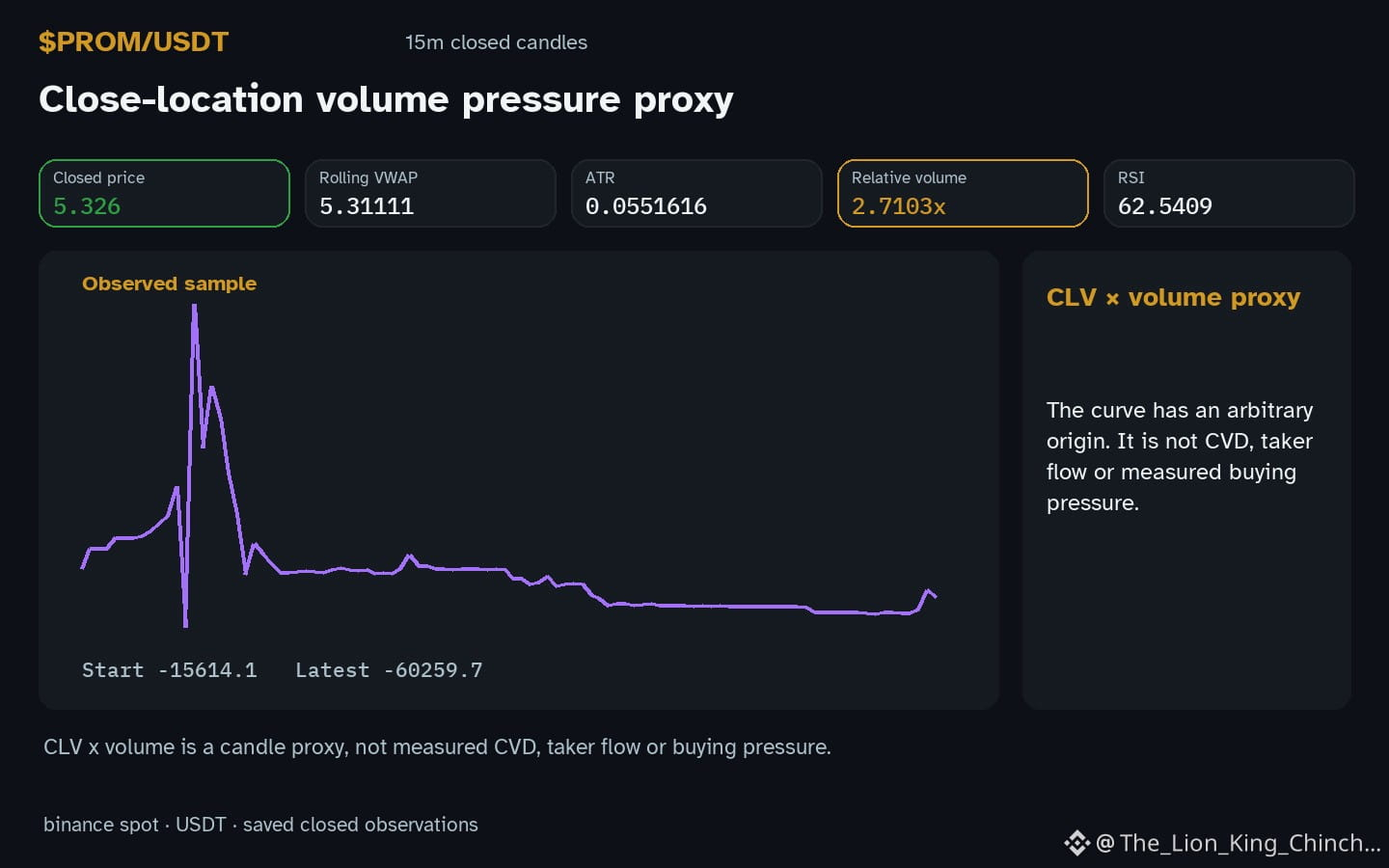
$PROM: PROM: When Fast Rallies Trigger Informational Cascades
What does the recent up hourly move in $PROM tell us about trader psychology? The chart shows price rising while volume sits above baseline, a pattern that can spark an informational cascade.
A common assumption is that rising volume confirms a strong demand signal, prompting more participants to jump in without re‑examining the underlying fundamentals. This reflects the bias of anchoring: the first observed surge becomes a reference point that shapes later decisions.
A counterexample to consider is a scenario where the same volume spike occurs after a prolonged downtrend, yet the price quickly stalls at the local resistance 5.36. In that case, traders who pause to reassess may avoid being swept into a false rally, illustrating that cascades are not inevitable.
What could change the reading? Introducing a simple self‑check: before adding to a position, ask whether the volume rise is supported by an independent catalyst or merely mirrors the prior move. If the answer relies solely on the observed price climb, the bias may be at play.
By treating the fast rally as a thought experiment rather than a proven outcome, we keep the analysis grounded. Remember that cascades amplify attention but do not guarantee direction. A disciplined pause can break the chain and reduce regret later. 📊
Probabilistic market research, not a recommendation or guaranteed return.
New evidence or a familiar bias?
#PROM #TradingPsychology #CryptoLearning