

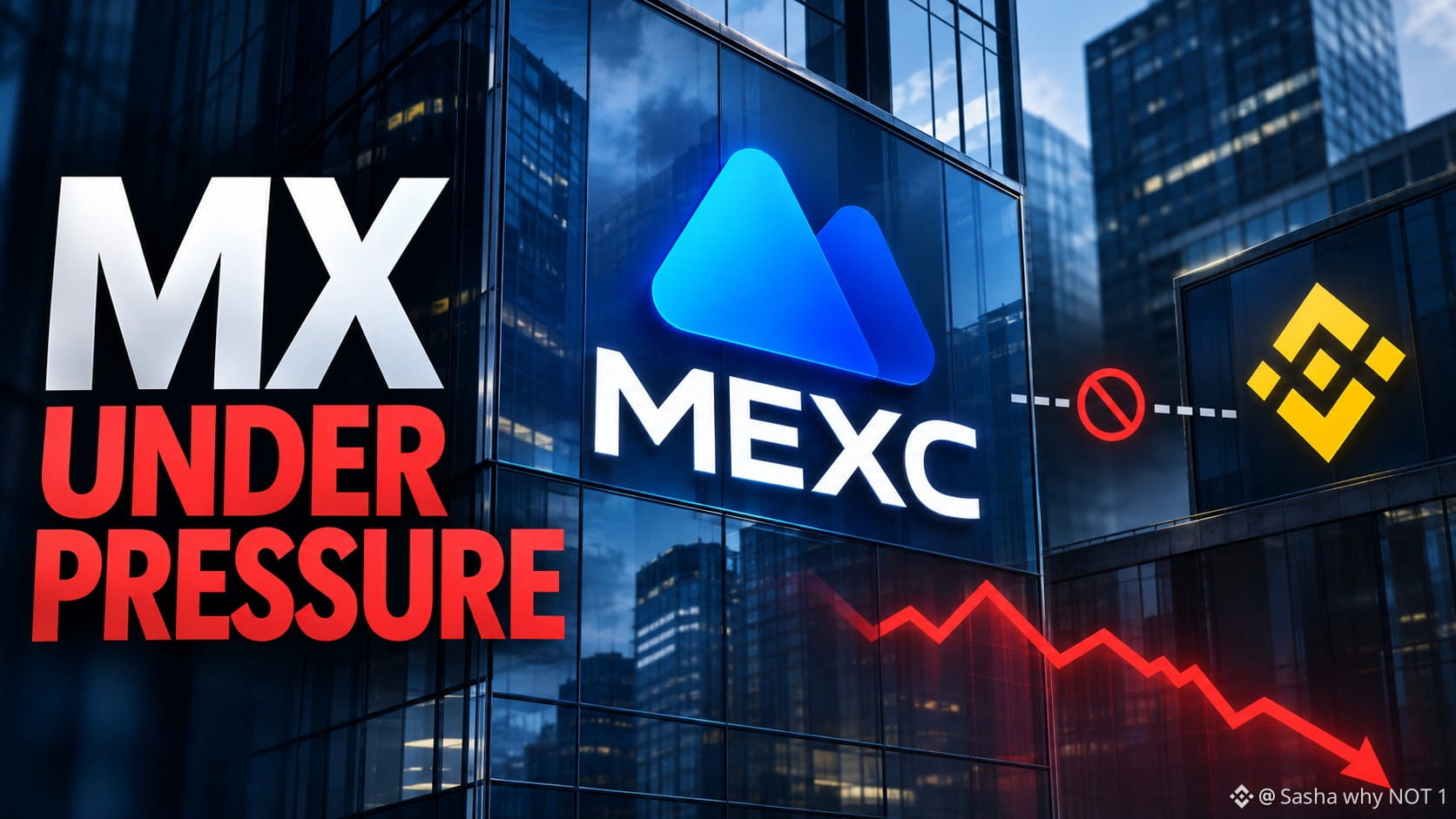
$MX has fewer reasons to attract buyers. And more reasons to lose holders. An exchange token depends on demand for its platform. When users must leave and other exchanges restrict transfers, the question becomes simple: why keep holding its token? On October 20, MEXC announced it would discontinue services for users from Russia and Belarus, with individual notifications setting the timelines. Before the announcement, MX traded around $1.93. By November 10, it was near $1.42–1.43 roughly 26% lower. This does not prove the restrictions caused the entire decline, but the token has failed to recover. Now the pressure is building. November 6: FinCEN prohibited US financial institutions from processing transfers involving MEXC, alleging the exchange facilitated illicit transactions. November 10: Binance announced restrictions on MEXC-related transfers. Outgoing transfers will be rejected; incoming deposits will be held for compliance review. Account restrictions may follow. Earlier, Luxembourg’s CSSF warned that MEXC lacked authorization to provide financial services there. Dubai’s VARA also took enforcement action over unlicensed operations. For MX, the potential chain reaction matters: fewer eligible users and transfer channels → weaker platform activity → less demand for token benefits. #MEXC says operations remain normal, user assets are secure, and an independent review of its AML controls has begun. These developments alone do not establish insolvency. My outlook on MX is bearish. A short deserves consideration, but calling this the perfect entry is premature. After a substantial decline, a sharp rebound remains possible. Contract liquidity and holding costs also need checking. The next catalyst: will other platforms follow Binance’s lead? #Macro Insights#
Krypto-Nutzer weltweit auf Binance Square kennenlernen
⚡️ Bleib in Sachen Krypto stets am Puls.
💬 Die weltgrößte Kryptobörse vertraut darauf.
👍 Erhalte verlässliche Einblicke von verifizierten Creators.
E-Mail-Adresse/Telefonnummer