$BTC: Mechanistic Research and the Trade-off of Patience
Does deep learning of one mechanism provide more clarity than shallow feed browsing? Consider a thought experiment where a researcher studies only how price interacts with a volume-weighted average. By ignoring the constant noise of social feeds, the researcher might notice how $BTC behaves near 74728.2. In contrast, shallow browsing introduces dozens of conflicting signals that often lead to hesitation. This highlights a practical trade-off: waiting for a specific structural alignment versus acting on the first available headline.
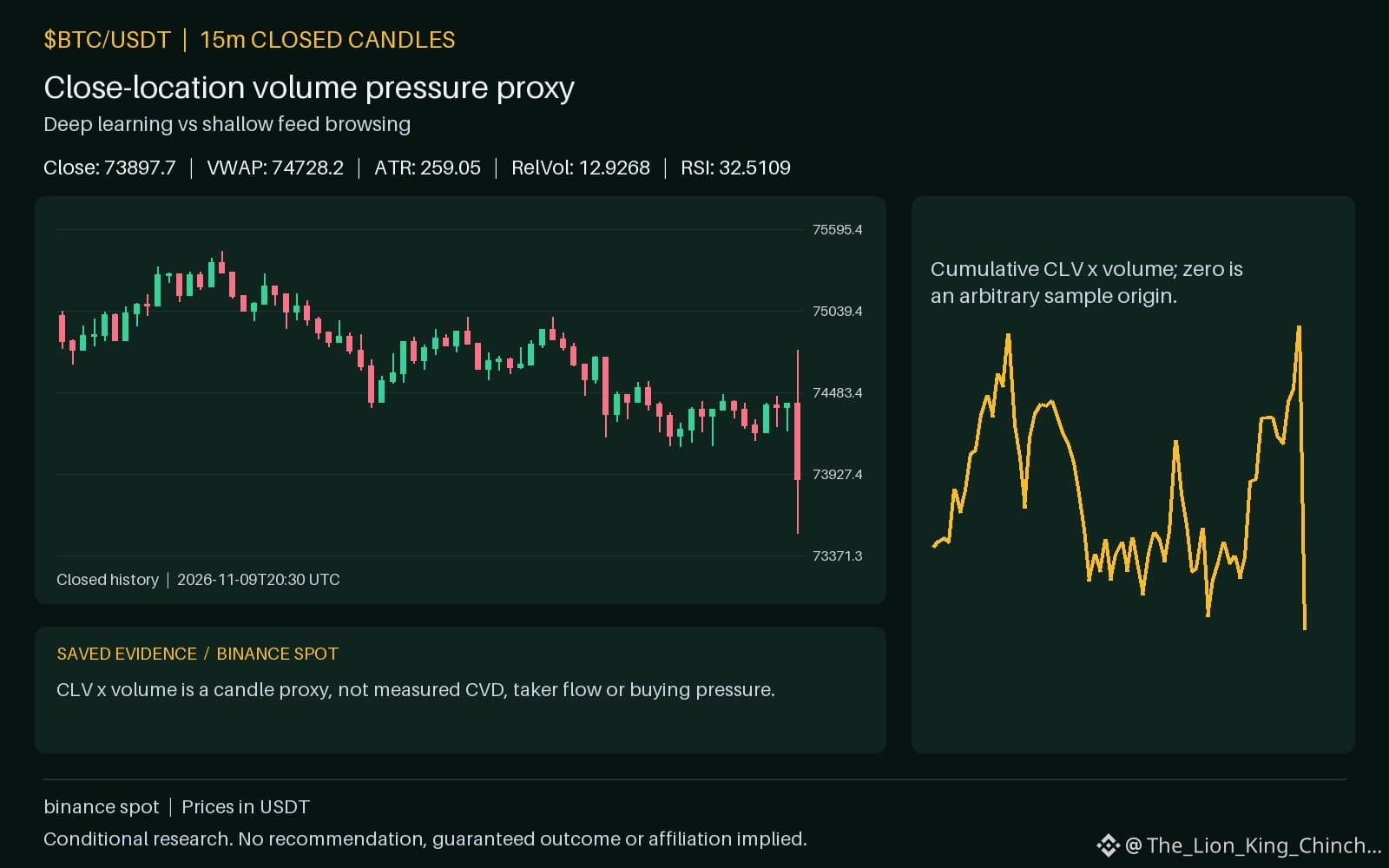
Waiting for a high-quality entry near a known level like 74115.6 can minimize risk, but it carries the chance of missing a move if the price reverses early. Chasing a move already in progress might ensure participation, but it often results in poor entry quality. Currently, $BTC is trading at 73897.7, which is positioned below the identified 74115.6. The daily change sits at -0.983881 while the RSI is 32.5109. These facts suggest a market in motion, yet a deep study focuses on the mechanism of the breakdown rather than the speed of the tape.
A counterexample to deep study is reacting to every minor fluctuation in the hourly change of -0.428937. If a researcher treats every small tick as a primary trend, they risk over-trading. To reassess this interpretation, one can compare the relative volume of 12.9268 against historical averages. If the volume does not sustain the move below 74115.6, the thesis of a structural shift requires revision. This patient approach prioritizes understanding the mechanics over simply following the crowd. ⚖️
Probabilistic market research, not a recommendation or guaranteed return.
What is one market mechanism you have been wanting to study deeply rather than just skimming headlines about?
#BTC #RiskManagement