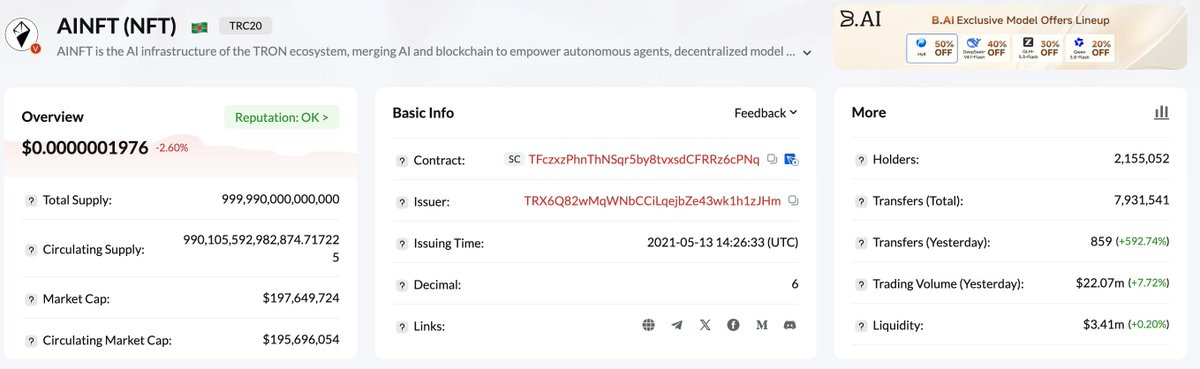
AINFT's latest TRONSCAN update reports a 592.74% increase in daily NFT token transfers and a 7.72% rise in trading volume.
The ecosystem also reports more than 2.15 million holders.
Those numbers are interesting, especially the sharp increase in transfers.
But I think the more useful question is what people are actually doing with the token.
Not every transfer represents a new user
Imagine someone moves tokens from an exchange to a personal wallet.
That creates blockchain activity.
Another person might transfer tokens between two wallets they control.
That also creates activity.
Neither example necessarily represents a new participant entering the ecosystem.
This is why transaction counts and user adoption should be evaluated separately.
Large percentages need context
A 592.74% increase sounds dramatic.
However, percentage growth depends on the starting point.
Without the absolute number of transfers, it's difficult to understand how large the activity increase was in practical terms.
The announcement does not provide that baseline.
Trading volume tells another story
The reported 7.72% increase in trading volume suggests additional market activity.
But trading volume doesn't explain whether people are buying for long-term participation, trading short-term movements, or transferring assets for other purposes.
It also doesn't guarantee future price appreciation.
The holder count is worth watching
More than 2.15 million holders suggests broad token distribution across tracked addresses.
However, addresses aren't necessarily unique people.
A useful next step would be understanding how many addresses remain active over time.
What would meaningful growth look like?
For an ecosystem connected to digital art, I would be interested in whether token activity eventually translates into more creative participation, collecting, or practical application usage.
That connection isn't established by the reported figures alone.
My perspective
AINFT's transfer surge deserves attention because it signals a notable change in blockchain activity.
But sustainable ecosystem development should be evaluated through repeated usage and real participation, not a single impressive percentage.
Would you pay more attention to daily transfer growth or the number of consistently active users?