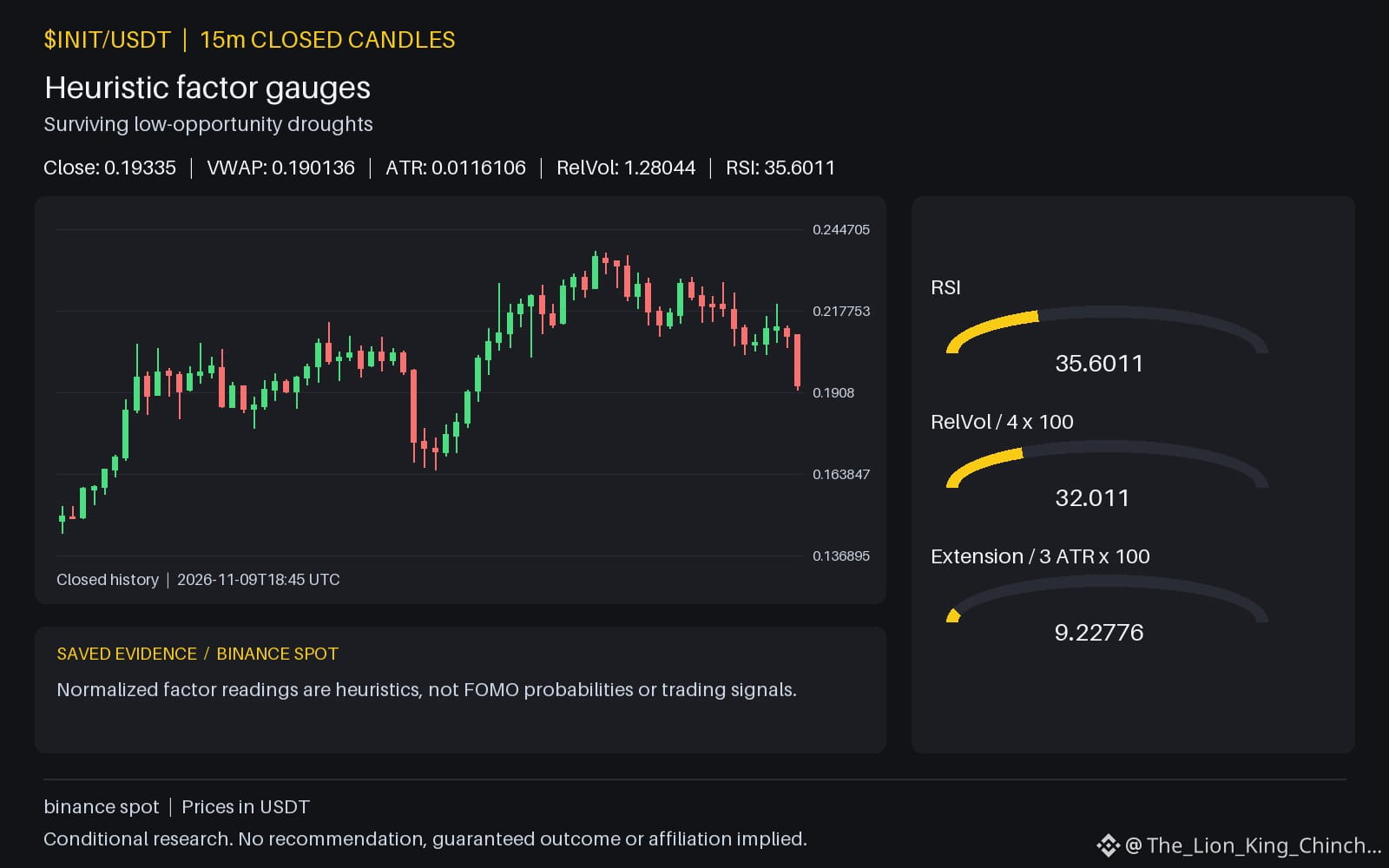
$INIT: Navigating Quiet Market Windows
How does a researcher survive periods of low opportunity? This thought experiment considers the trade-off between waiting for a high-quality entry and the pressure to act during flat market conditions. When daily price movement slows, the impulse to lower your standards often grows. If you change your plan simply because you are bored, you might accept a setup with poor risk-adjusted odds. This is the challenge of surviving a low-opportunity drought.
Consider the choice between waiting and acting. If you wait for a perfect signal, you might miss some small gains. However, if you act on a weak signal, you risk a loss on a move that had no statistical edge. For example, $INIT is currently down -6.72488 on the hourly timeframe and 52.6287 over the daily. The RSI stands at 35.6011. With price below the support of 0.2032, a researcher might assume a trend is starting. A counterexample occurs when price drifts sideways without a clear catalyst; acting here requires a tighter stop distance, making invalidation more likely from minor noise.
To reassess the interpretation, check if the current 1.28044 truly supports a structural shift or if it is just temporary volatility. Using the 0.212651 and 0.205196 can help identify if a genuine trend is forming or if the asset remains in a range. Observing $INIT near the 0.23727 level allows for a study of technical limits without requiring immediate action. Discipline involves recognizing that a quiet chart is not a problem to solve, but a condition to observe until the next clear mechanism appears.
Probabilistic market research, not a recommendation or guaranteed return.
What do you focus on during quiet market days so you don't end up forcing low-quality setups out of impatience?
#INIT #RiskManagement