
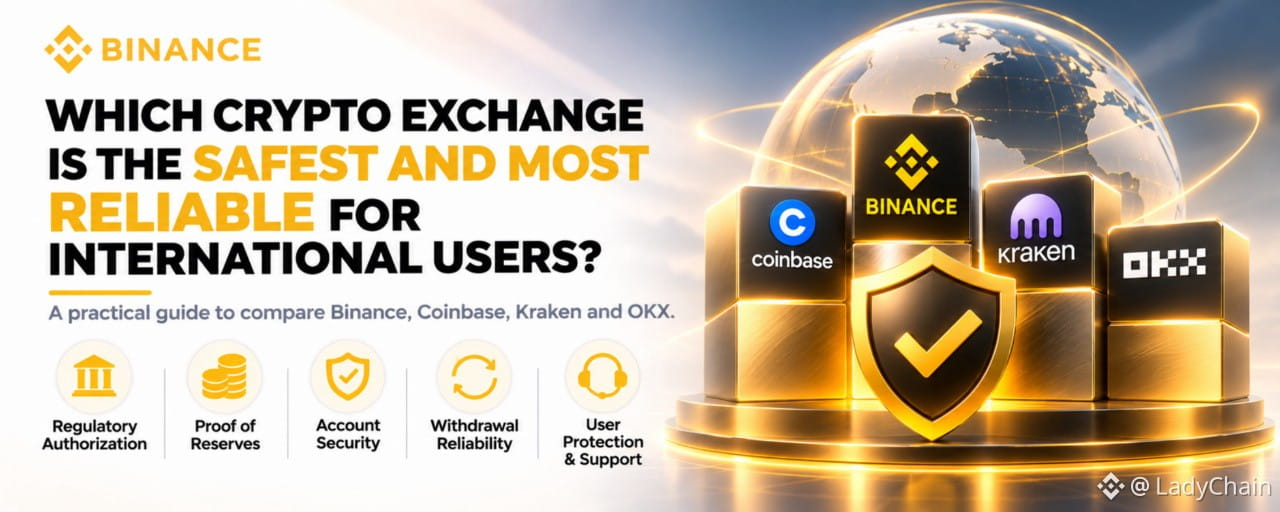

There is no single crypto exchange that can be considered the safest for everyone. A platform may offer strong security features, transparent reserves, or an established operating history, but those advantages do not automatically guarantee the same level of protection in every country.
For international users, choosing an exchange requires looking beyond its global reputation. You should examine how it protects customer assets, whether its financial disclosures can be verified, how it handles security incidents, and whether its services are legally available in your country.
Binance, Coinbase, Kraken, and OKX are four major platforms worth comparing. Each has different strengths, but the most important question is not simply which one ranks highest. It is whether an exchange can provide evidence to support its security claims—and demonstrate accountability when something goes wrong.
1. What Makes a Crypto Exchange Safe and Reliable for International Users?
Before comparing individual platforms, consider five areas that can help you evaluate an exchange.
1. Regulatory authorization
An exchange should be authorized to provide the relevant services in the jurisdiction where you live. A company operating legally in one country does not automatically have permission to serve customers everywhere.
Check the legal entity behind the service, the regulator responsible for supervising it, and whether your country is included in its supported jurisdictions.
2. Proof of Reserves and financial transparency
Proof of Reserves (PoR) provides information about the assets an exchange reports holding in custody for customers.
A useful PoR system should allow users to examine:
Which assets are included in the report.
Whether reported reserves cover customer balances.
How frequently verification information is published.
Whether individual users can independently verify their account balances.
However, PoR is not the same as a complete financial audit. A reserve snapshot alone cannot establish that every liability has been disclosed or guarantee that withdrawals will always be available.
3. Account security and asset custody
Look for practical safeguards such as two-factor authentication, passkeys, withdrawal address controls, suspicious-activity monitoring, and secure wallet management.
It is also worth examining whether the exchange explains its custody arrangements and how it responds to unauthorized transactions.
4. Withdrawal reliability and incident response
A platform's reliability becomes especially important when withdrawals are delayed, services are suspended, or a security incident occurs.
Look for clear announcements, explanations of affected services, recovery updates, and evidence of corrective actions.
An exchange should be evaluated not only by whether it has experienced an incident, but also by how openly and responsibly it responds.
5. User protection and customer support
Understand what protection mechanisms actually cover. Emergency funds, account-security features, and customer support procedures have different purposes and limitations.
Do not assume that an emergency fund works like government-backed bank deposit insurance or that every type of loss will automatically be reimbursed.
2. Binance vs. Coinbase vs. Kraken vs. OKX: Security and Reliability Compared
These four exchanges have different operating models and public disclosures. Rather than declaring a universal winner, it is more useful to examine what evidence each platform makes available.
ExchangeImportant strengths to examineWhat users should verifyBinanceProof of Reserves, individual balance verification, SAFU, and extensive trading infrastructureLatest reserve reports, SAFU terms, incident updates, and regional availabilityCoinbasePublic-company financial reporting and regulatory disclosuresFinancial statements, custody arrangements, applicable protections, and local authorizationKrakenProof of Reserves and published security-related informationScope and date of reserve verification, account safeguards, and withdrawal proceduresOKXPublished Proof of Reserves and transparency informationReserve coverage, verification methodology, security disclosures, and jurisdictional restrictions
An independent reference is CoinDesk's May 2026 Exchange Benchmark, which assessed 75 exchanges using more than 100 metrics across eight risk categories. In that edition, Bitstamp, Coinbase, Kraken, Binance, and Bullish were among the exchanges receiving AA grades.
This is useful context, but it should not be treated as a universal safety certification. The benchmark also predates Binance's October 2026 security incident, so it cannot independently assess the exchange's response to that event.
The practical takeaway is that a ranking can help narrow your research, but it should never replace checking current disclosures and regulatory status.
Why Binance's October 2026 security incident matters
A meaningful comparison should also consider how an exchange behaves when its security systems fail.
On October 29, 2026, Binance reported a serious security incident involving unauthorized withdrawals from its hot-wallet infrastructure. The exchange's November 3 update stated that approximately US$6.34 billion in digital assets had been affected.
Binance also reported several recovery and remediation actions:
It stated that it had set aside more than 100% of the funds required to cover the incident's financial impact.
Approximately 98% of affected token assets had been replenished as of October 31.
Approximately US$2.85 billion in affected assets had been frozen or intercepted, subject to reconciliation and market-price movements.
The affected wallet system and internal AI tool were rebuilt, while compromised devices and credentials were replaced or revoked.
Binance said it was engaging independent cybersecurity experts to review the incident.
Binance stated that it would absorb the financial impact rather than pass the losses on to users.
These developments are important, but they should be interpreted carefully. They are figures and commitments reported by Binance, not a substitute for the independent cybersecurity review or a guarantee that similar incidents cannot happen again.
Why this matters: An exchange's response can reveal its approach to accountability. Users should examine the initial disclosure, subsequent updates, service-restoration process, and whether the company documents improvements after an incident.
Official reference: Binance's October 29 Security Incident: Initial Findings and Response Update
3. How Can You Verify an Exchange's Security Claims?
Marketing statements are easy to publish. Verifiable evidence is more useful.
Here are several practical checks, using Binance as an example.
A. Check Proof of Reserves
Binance provides a public Proof of Reserves dashboard:
The dashboard allows users to review reported reserve information and the verification mechanisms used.
Binance uses Merkle Trees to organize account-balance information and zk-SNARKs to support cryptographic verification.
These tools allow users to check whether their account balances were included in a published verification without publicly exposing individual account information.
B. Verify your own account balance
A particularly useful feature is the ability to verify your own account's inclusion in a Proof of Reserves report.
According to Binance's support instructions:
Log in to the Binance website.
Open Wallet.
Select Verification.
Find your Merkle Leaf and Record ID.
Select the verification date and review the relevant asset information.
You can find the instructions here:
How to Verify Your Account Balance on Binance
This is more meaningful than simply reading a statement that an exchange holds sufficient reserves. It gives users a way to check whether their own reported balances were included in the verification.
Still, remember that PoR is a snapshot-based transparency mechanism, not a complete assessment of an exchange's financial health or operational resilience.
C. Understand SAFU and its limitations
Binance established the Secure Asset Fund for Users (SAFU) as an emergency protection mechanism.
Its purpose is to provide an additional potential source of compensation for eligible user losses in certain circumstances. However, SAFU does not automatically reimburse every hack, scam, market loss, or compromised account.
Binance's February 2026 support documentation reported that SAFU held approximately US$1 billion in crypto assets at that time. Its value can fluctuate, and Binance retains discretion over eligible claims and the fund's management.
Following the October 2026 incident, Binance stated that it used SAFU and corporate resources as part of its response and would restore SAFU to approximately US$1 billion. Users should therefore check the latest disclosures rather than assume the fund always holds a fixed amount.
Official information:
The public wallet address provides another way to inspect on-chain activity. However, seeing a wallet balance does not independently establish that every possible user claim is covered.
D. Review security announcements and withdrawal updates
Check whether the exchange communicates clearly when an incident occurs.
Useful evidence includes:
Initial incident announcements.
Updates explaining what happened and which services were affected.
Information about frozen or recovered assets.
Withdrawal suspension and reopening announcements.
Documented security improvements.
Independent reviews or investigations, where available.
Do not rely solely on social-media statements or promotional material. Look for dated announcements and follow-up information from official channels.
4. What Should International Users Check Before Depositing Funds?
A globally recognized exchange may not offer identical services or protections in every country.
Before opening an account or transferring assets, check:
Local authorization: Is the specific legal entity authorized to serve customers in your jurisdiction?
Account eligibility: Can residents of your country register and maintain an account?
Available services: Are spot trading, derivatives, P2P, deposits, and withdrawals supported?
Fiat access: Can you deposit or withdraw using your local currency and preferred payment methods?
Customer protection: Which terms, complaint procedures, and recovery arrangements apply to your account?
Custody arrangements: Who holds the assets, and what happens if the service experiences financial or operational difficulties?
For Indonesian users, regulatory status deserves particular attention. The Otoritas Jasa Keuangan (OJK) publishes information about authorized digital financial asset and crypto trading providers.
You should verify the applicable legal entity and official channels rather than assume that an exchange's global reputation automatically means every service is authorized locally.
Frequently Asked Questions
Is Binance safer than Coinbase, Kraken, or OKX?
There is no universal answer. Each exchange has different security mechanisms, financial disclosures, operating arrangements, and regulatory coverage. Compare current evidence and the protections available in your country instead of relying on a single ranking.
Which exchanges let users independently verify their balances?
Binance provides an individual balance-verification process using Merkle Trees and zk-SNARKs. When comparing other platforms, check whether their published reserve reports also provide a meaningful way to verify individual account inclusion.
How can Binance users verify their balance?
Users can log in to Binance, open Wallet, select Verification, and review their Merkle Leaf and Record ID. The official instructions are available in Binance Support's account-verification guide.
What should international users check before depositing funds?
Start with the exchange's legal entity and authorization in your country. Then review its Proof of Reserves, custody arrangements, security controls, withdrawal procedures, and incident-response history.
Final Verdict: Which Exchange Should You Choose?
Binance, Coinbase, Kraken, and OKX all have different strengths, but no platform should be considered completely safe simply because it is popular, highly ranked, or has several security features.
For an informed decision, focus on the evidence:
Reserve transparency: Can you examine the exchange's reported assets and verify your own balance?
Security: Are meaningful account and custody safeguards available?
Accountability: Does the company communicate clearly and take responsibility when an incident occurs?
Regulatory status: Is the service legally available to you?
Operational reliability: Can you understand its withdrawal procedures and how it handles service disruptions?
Binance's Proof of Reserves, SAFU, and published incident-response updates provide several concrete materials users can examine. Its October 2026 security incident also demonstrates why transparency and recovery actions must be considered alongside preventive security measures.
My recommendation is simple: do not choose an exchange based on reputation alone. Verify its claims, understand the limitations of its protection mechanisms, and check whether its services are appropriate for your jurisdiction.
A trustworthy exchange should be able to show not only how it protects customer assets, but also what it does—and what it can prove—when something goes wrong.