
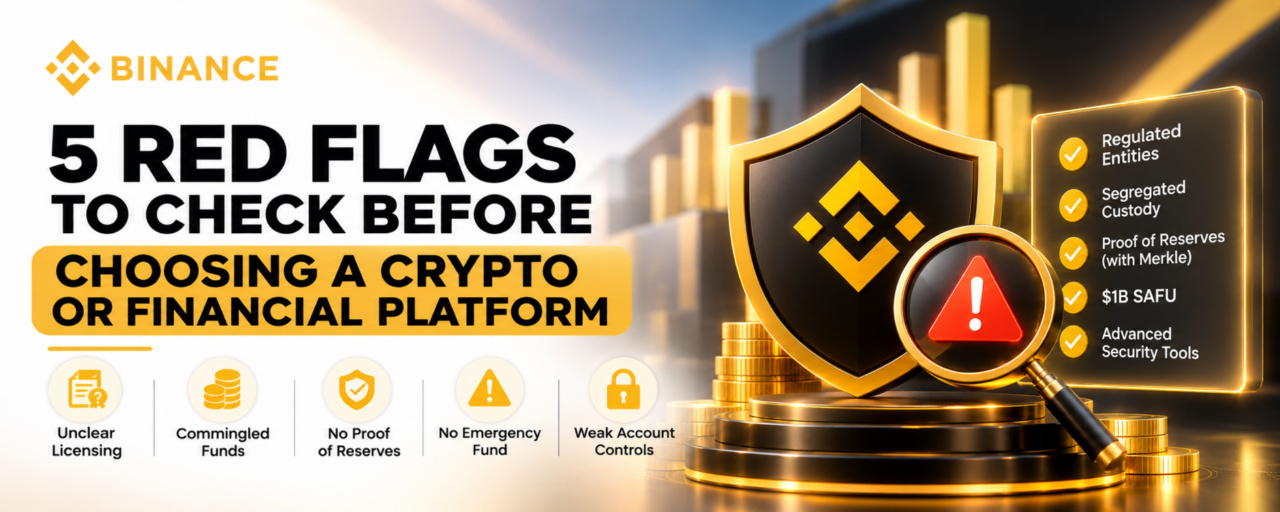

Choosing a crypto or financial platform is about more than fees, convenience, or the number of available features. Before trusting a platform with your money and personal information, it is worth looking at how it manages funds, handles risks, and protects user accounts.
Some warning signs are easy to overlook at first. Here are five red flags to check before choosing a platform—and how Binance's safeguards address these areas.
1. Unclear Licensing or Regulatory Status
A platform may have an attractive interface and a wide range of services, but do you know which legal entity operates it and whether that entity is authorized to provide the service in your region?
Unclear licensing can make it harder to understand who is responsible for the service and what protections may apply if something goes wrong.
Before signing up, check the platform's legal entity, relevant regulatory status, and whether the specific service is available in your jurisdiction.
Binance operates through different entities across various jurisdictions. Users should check the applicable entity, local requirements, and service availability rather than assuming that the same regulatory status applies everywhere.
2. Commingled or Unclear Custody of Funds
Another important question is how a platform holds customer assets.
If a platform does not clearly explain how customer funds are held and managed, users may find it difficult to understand how their assets are treated, particularly during financial or operational difficulties.
Look for clear information about custody arrangements and whether customer assets are kept separate from the platform's own funds.
Binance describes safeguards involving segregated custody arrangements. However, users should still review the terms and custody information that apply to the specific Binance entity and service they use.
3. No Proof of Reserves
How can users assess whether a platform holds the assets it reports?
Proof of Reserves (PoR) can provide useful information by allowing users to check whether their account balances are included in a published reserve verification.
Binance provides a Proof of Reserves system that uses cryptographic techniques, including Merkle tree verification. This allows users to verify the inclusion of their balances without requiring the platform to publicly disclose every customer's private account information.
Still, PoR has limitations. It does not automatically provide a complete picture of every liability, prove overall financial health, or guarantee that withdrawals will always be available.
4. No Emergency Fund or Clear Incident Response
Security incidents can happen even when a platform has preventive measures in place. What matters is whether the platform has a clear approach to responding to serious incidents.
An emergency fund may provide an additional layer of protection in certain qualifying situations. However, its existence should not be interpreted as a promise that every loss will be reimbursed.
Binance established the Secure Asset Fund for Users (SAFU) as an emergency reserve. The fund has been maintained at a target value of approximately $1 billion, although its composition and market value can change.
SAFU is intended to help cover eligible losses under applicable terms. It is not equivalent to bank deposit insurance and does not guarantee compensation for every type of loss.
5. Weak Account Security Controls
Even a platform with strong infrastructure cannot fully protect an account if users have limited security options or do not use the protections available.
At a minimum, look for features that help prevent unauthorized access, detect suspicious activity, and reduce the risk of fraudulent withdrawals.
Binance offers several account-security features, including:
Passkeys: An additional authentication option designed to make account access more secure.
Two-factor authentication (2FA): Adds another verification step beyond a password.
Anti-phishing codes: Help users identify genuine Binance communications.
Withdrawal address allowlisting: Allows users to restrict withdrawals to approved addresses.
These tools can strengthen account protection, but users still need to maintain good security habits, use unique passwords, and avoid sharing authentication codes or clicking suspicious links.
Final Thoughts: Check the Safeguards Before You Trust a Platform
Unclear licensing, uncertain custody arrangements, no Proof of Reserves, no emergency fund, and weak account controls are five warning signs worth taking seriously.
Binance has safeguards designed to address these areas, including regulated entities in applicable jurisdictions, segregated custody arrangements, Proof of Reserves with Merkle verification, the SAFU emergency fund, and account-security tools such as passkeys and 2FA.
However, no platform is completely risk-free. The availability and scope of protections can vary depending on the legal entity, service, and region.
Before choosing any crypto or financial platform, take time to understand how it operates, what protections it provides, and what those protections do not cover. An informed decision starts with asking the right questions—not simply trusting the biggest name or the most attractive offer.
Disclaimer: This article is for educational purposes only and does not constitute financial or legal advice. Platform features, regulatory status, and service availability may vary by jurisdiction. Always review the applicable terms and conduct your own research before using a financial service.