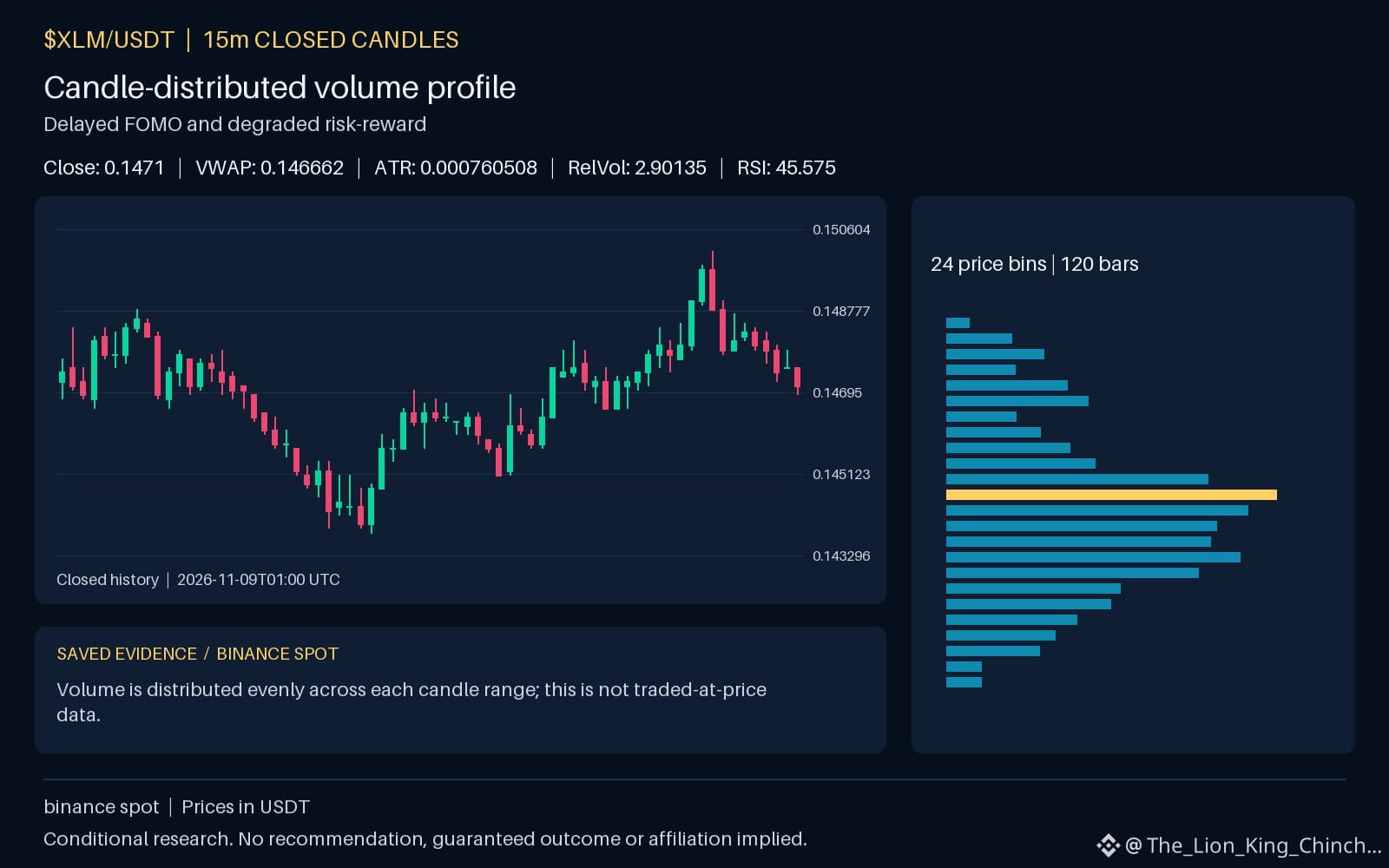
$XLM: Delayed Entry Mechanics
Consider $XLM moving above 0.146662. Volume is 2.90135. A trader plans a buy at 0.1466. Price skips that level. The original edge is gone.
Hypothetical mechanism
Fear of missing out can distort judgment. The brain anchors to the skipped level. It ignores that distance increased. Chasing here reduces potential reward relative to risk. You are no longer buying cheap. You are buying later with a wider stop.
This is not a prediction. It is a logic puzzle. If entry moves up, stop must move up. The ratio degrades. Some traders hold because they regret missing the first candle. This is loss aversion. They fear the pain of being empty-handed more than the cost of a bad entry.
Limits
We cannot know actual order flow. We only see price and volume. 45.575 reads current momentum but does not measure regret. 0.000760508 shows average range, not individual intent. Candles do not prove causes.
Self-check
Ask yourself: "Would I open this trade now if I had never seen the previous opportunity?" If the answer is no, the hesitation has already cost you. The plan was to buy at 0.1466. That level is gone. The safe action is to wait for a new setup. Do not let memory force a new decision. Define a strict rule before price moves. If price is higher than planned, reassess the odds. If the risk-reward is poor, pass. Accept small missed gains. Large errors come from chasing. Discipline is planning your exit before you buy. Not after you miss.
Probabilistic market research, not a recommendation or guaranteed return.
When you hesitate on a planned level and price runs away, what rule stops you from chasing it higher?
#XLM #TradingPsychology #CryptoLearning
Binance spot proof for $XLM: closed price 0.1471 USDT.
Source: binance. Closed candle: 2026-11-09T18:15:00+00:00.