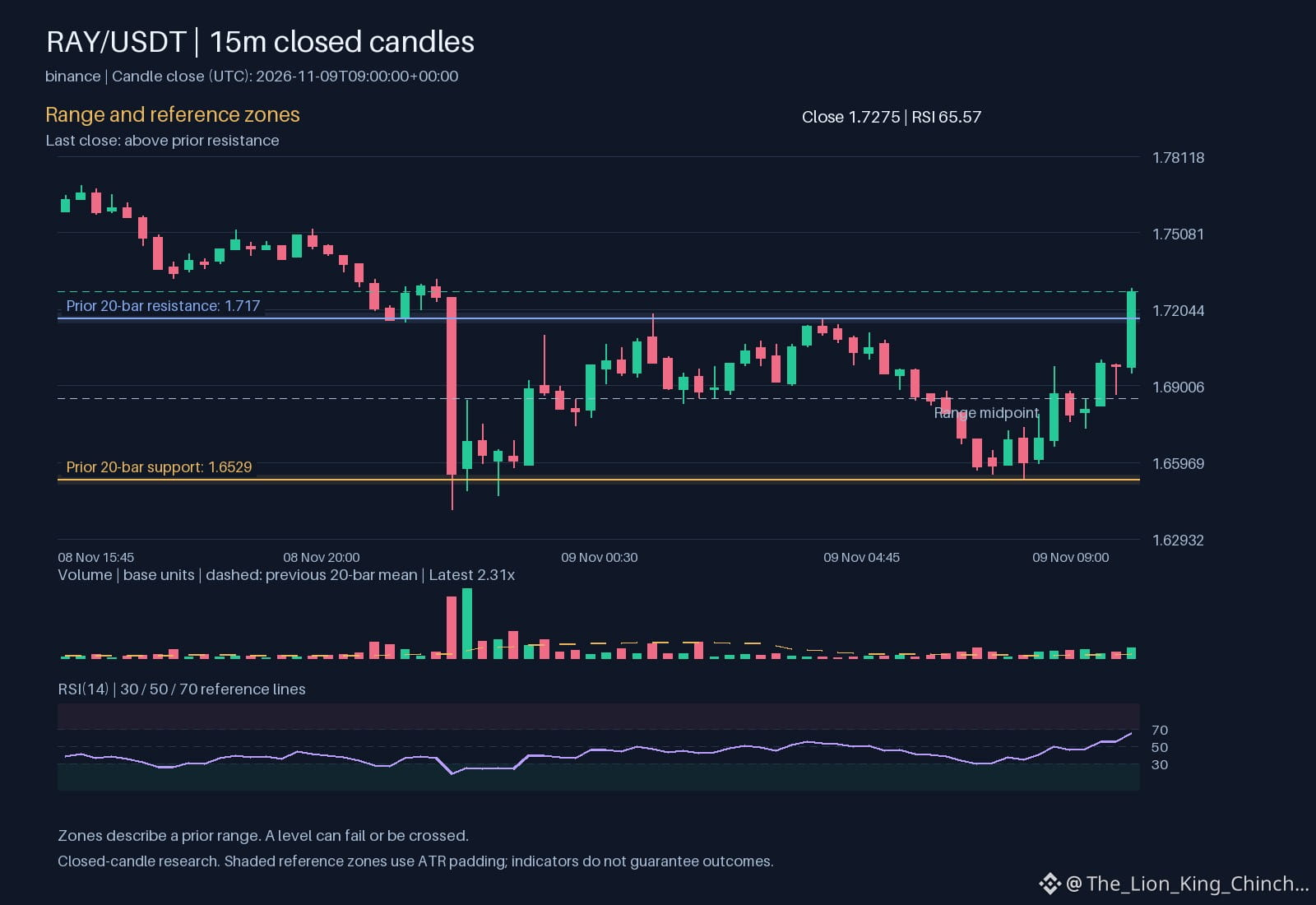
$RAY : How Anchoring Skews Our Reading of Price
Anchoring bias makes us cling to a familiar price level when new data arrives. In the market for $RAY , observation shows price trading above resistance while hourly direction is up and volume is above baseline. This combination can create a strong visual cue, yet it does not prove a permanent shift. Instead of treating the level as a fixed truth, consider it a temporary reference point that may become irrelevant if momentum weakens.
### How it changes interpretation
When a trader sees price break a key level, they often stop questioning the original thesis. The relative volume at 2.31357 signals activity, but silence on sustained confirmation remains possible. If you anchor to the break, you might ignore the current RSI reading of 65.5745 or the gap between price and the 1.68893. This tunnel vision risks mistaking a short term burst for a structural change. The decision quality drops because the fresh evidence gets filtered through an old mental model.
### A practical self-check
Before finalizing a view, ask yourself if you would still weight the same factors if the price opened differently. If the answer changes once you remove the previous level from sight, anchoring is active. Reassess the situation by comparing current momentum against past averages without naming specific numbers. This resets your frame and helps separate fact from expectation.
Probabilistic market research, not a recommendation or guaranteed return.
Would you keep the same rule after missing a move?
#RAY #TradingPsychology #CryptoLearning