
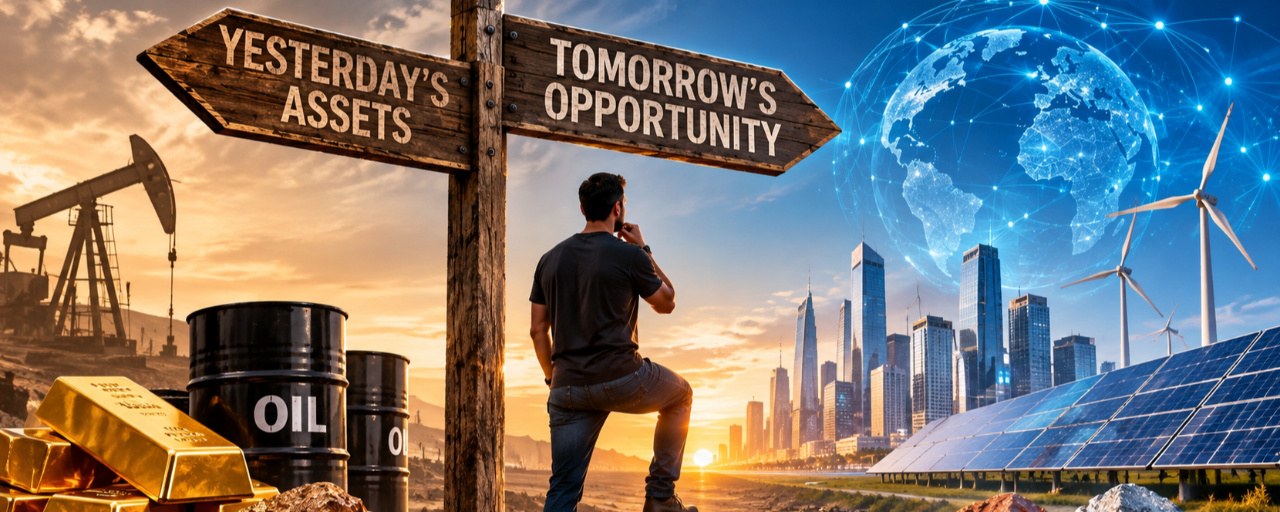

What happens when the resources that built our wealth are no longer the resources that build our future?
I’ve been thinking about something increasingly interesting about the way we invest.
For generations, we’ve been taught that certain things are simply valuable. Gold, oil, real estate and a handful of other assets have become almost unquestionable pillars of wealth creation. And to be fair, they’ve earned their place.
But I have a question: Are we investing in what the world needs, or what the world used to need?
There is a difference.
Gold has been valuable for as long as we can remember. Oil helped fuel the Industrial Revolution. Both have shaped economies, governments, wars and entire financial systems. But somewhere along the way, I think we’ve become a little too comfortable assuming that their importance will continue indefinitely.
Something being valuable for centuries doesn’t mean it will always be the best place to put your money.
The market doesn’t have permanent favorites
Before getting into gold, oil and the next generation of strategic resources, let’s look at something interesting: how differently commodities can perform over the same period.
For example, in 2025, silver gained approximately 153%, gold 57%, and copper 35%. Meanwhile, Brent crude oil fell almost 10%, and WTI crude fell nearly 11%. Interesting, isn’t it?
One year doesn’t establish a long-term trend, of course. Silver can surge and then give back a substantial portion of those gains. Oil can have a terrible year and still remain essential to the global economy.
But the comparison shows something important: the market doesn’t reward every resource the same way, and its favorites can change.
Investors who focus mostly on what has historically performed will miss where new demand, supply constraints and industrial priorities are emerging.
We’ve been worshipping gold for thousands of years. At some point, somebody decided shiny rocks were a great way to measure wealth, and apparently we’ve all agreed to keep playing along.
Jokes aside, gold has earned its place. It’s scarce, durable, globally recognized and has a long history as a store of value. But what role does it actually play in the modern economy?
Gold has many industrial uses, particularly in electronics, but its enormous market valuation is driven primarily by investment demand, central bank reserves, monetary confidence and geopolitical uncertainty. Much of its value comes from what people believe it represents, rather than how much of it the world needs to manufacture things.
In 2025, global gold ETF holdings increased by approximately 801 tonnes, while central banks purchased around 863 tonnes. Technology demand was around 323 tonnes. That tells us something: financial and official demand for gold is considerably larger than its technological consumption.
I’m not suggesting gold is going to become worthless. That would be ridiculous. I’m questioning whether investors sometimes confuse historical importance with future industrial importance.
There is a difference between something being a good store of value and something becoming the next great engine of industrial growth. Perhaps we should stop pretending those are the same thing.
Oil isn’t going anywhere. But neither is innovation.
Before somebody starts selling their oil stocks and buying solar panels, let’s get something straight: oil isn’t disappearing tomorrow.
Your airplane isn’t flying on good intentions, and your plastic containers aren’t made from sunshine.
Oil remains deeply embedded in transportation, petrochemicals, manufacturing and global trade. However, the economics of energy are changing.
Electric vehicles, renewable energy, nuclear power, energy storage and improvements in efficiency are gradually changing how the world produces and consumes energy.
The International Energy Agency’s 2025 outlook projected global oil demand reaching a plateau around 105.5 million barrels per day toward the end of the decade, with a small decline expected in 2030 under its stated-policy assumptions. It also projected that electric vehicles could displace approximately 5.4 million barrels of daily oil demand by 2030.
Think about that. Oil can remain an enormous industry, generate billions in profits and continue to influence geopolitics while gradually losing its position as the primary growth opportunity of the future.
An industry doesn’t need to die to stop being the best investment. Remember that.
Now look at what humanity is trying to build: artificial intelligence, massive data centers, advanced semiconductors, robotics, electric transportation, sophisticated military systems, energy storage and increasingly complex electrical infrastructure.
These technologies don’t run on motivational speeches. They require physical materials, and quite a few of them.
Copper, gallium, germanium, indium, tungsten, yttrium, lithium and rare earth elements are becoming increasingly important.
Take copper. We need it for electrical infrastructure, power transmission, electric motors, data centers and electrification. The IEA’s 2026 outlook estimates that, based on announced projects and its base-case assumptions, the copper supply pipeline could leave a 25% shortfall by 2035. That’s significant.
Now consider gallium and germanium. They are important in specialized semiconductors, telecommunications and advanced optical technologies. Their markets are relatively small, but their industrial importance can be substantial.
Imagine a $2 component stopping the production of a $50,000 machine. Suddenly, that $2 component becomes a very interesting conversation.
And that’s the problem with looking at commodities only through their market price. Sometimes the smallest piece of the puzzle has the biggest leverage. Perhaps the next generation of strategic resources won’t be the ones everybody is already talking about.
The real money might not be in the mine
Here’s something I believe deserves considerably more attention. We spend a lot of time discussing who owns the minerals, who has the largest reserves and who produces the most. But what happens after extraction?
The mineral still needs to be processed, refined and transformed into something manufacturers can actually use. And that’s where things get complicated.
The IEA estimates that the average share of the top refining country across key energy minerals, excluding rare earths, increased from approximately 70% in 2023 to 72% in 2025. For certain materials, concentration is even more extreme. China accounts for more than 90% of refining in some strategic mineral markets.
These are enormous concentrations. You could discover a massive mineral deposit in your backyard tomorrow. Congratulations. You’re not necessarily going to be supplying semiconductor manufacturers next Monday.
You still need the infrastructure, technology, expertise, capital and industrial capacity to process it.
This makes me wonder whether some of the most interesting investment opportunities are actually downstream. Instead of simply owning the resource, what about owning the technology that processes it? The refining infrastructure? The recycling operation? The specialized equipment?
Sometimes the toll booth is a better business than the highway. And this is an area where I think investors might be overlooking some interesting opportunities.
But before everybody starts buying lithium, copper and rare earth stocks, let’s not repeat the same mistake with a different set of commodities.
Just because something becomes important doesn’t mean its price will go up forever.
Lithium is a perfect example. The world needs batteries. Battery production needs materials. Demand is growing. Yet lithium prices have experienced enormous fluctuations as supply expanded, investment accelerated and production capacity caught up with demand.
And technology doesn’t sit still. Take lithium iron phosphate batteries. Their growing adoption has reduced the need for cobalt in a substantial portion of battery production.
Think about that for a moment. You can correctly identify an industry that will grow tremendously and still invest in the wrong material.
That’s not a small detail. It’s the difference between understanding a technological trend and understanding the economics behind it.
I would rather identify a business that controls a critical bottleneck than blindly buy a commodity because somebody on the internet has decided it will be worth ten times more in five years.
Innovation has a rather inconvenient habit of destroying investment theses
This might be the most important part of the entire discussion.
We often value resources based on scarcity. Something is difficult to find, difficult to extract or difficult to produce. Therefore, we assume its value will remain high.
But what happens when somebody figures out a better way?
What happens when a new battery chemistry reduces the need for a particular mineral? When synthetic materials replicate properties that previously required rare geological resources? When recycling becomes economically viable at an industrial scale? When a new generation of semiconductors changes the materials required to manufacture them?
Suddenly, yesterday’s strategic resource might not be quite as strategic.
Imagine buying a fleet of horse carriages just before automobiles become commercially viable. You might own the best horses, the most beautiful carriages and the largest stable in town.
Congratulations. You’re also in the wrong business.
That’s essentially the risk we’re discussing. Not that gold, oil or lithium suddenly become useless, but that our definition of strategic value changes while our investment habits remain stuck in the past.
And innovation doesn’t particularly care about your portfolio.
So, what should investors actually be looking at?
I wouldn’t approach the next decade by simply asking which commodity is going to become more expensive. I’d ask which industries are growing faster than their supply chains can support, which materials are difficult to replace, which resources are concentrated in the hands of a few producers, and where the processing bottlenecks are.
I’d pay particular attention to electrical infrastructure and copper; strategic minor minerals such as gallium, germanium, tungsten, yttrium and rare earth elements used in permanent magnets; advanced refining and processing; recycling and material recovery; and next-generation materials and technologies.
I’d also keep an eye on nuclear energy and uranium infrastructure as electricity demand grows.
But I wouldn’t blindly buy any of these assets. Supply, valuation, competition, technological substitution and actual profitability still matter.
There is no point being right about the future and going bankrupt before it arrives.
Are we investing in yesterday’s world?
I don’t think gold is going to disappear, nor do I think oil is going to become irrelevant. And I’m certainly not suggesting that traditional investments have suddenly lost their place.
What I am questioning is the assumption that the resources that made previous generations wealthy must necessarily be the resources that make the next generation wealthy.
Markets are constantly trying to price the future, but investors often use the past as their reference point.
Sometimes that works. Other times, it creates enormous opportunities for those willing to look somewhere else.
The Industrial Revolution changed the value of resources. The automobile changed the importance of oil. The digital revolution changed the importance of semiconductors. And artificial intelligence is already transforming the economics of electricity, computing and industrial infrastructure.
So what’s next?
I don’t pretend to know exactly which element, technology or industry will dominate the next 20 years. But I do know that the periodic table isn’t going to remain economically relevant in the same way forever. And perhaps that’s the point.
The next generation of wealth might not come to those who own what the world has always valued. It might belong to those who recognize what the world is about to need.
My belief is that if we want to invest in the future, we should stop looking at yesterday’s news.
Not financial advice. Just my thoughts.