

Imagine a bank holding millions of dollars worth of tokenized assets on its own private blockchain.
Everything works fine inside that network. The bank controls access, manages transactions and keeps sensitive information away from the public.
But what happens when it wants to use those assets outside its own system?
Maybe it wants to connect with public blockchain applications, reach more investors or access liquidity.
That's where things get complicated.
I was looking into how Rayls handles this, and something interesting stood out to me. Connecting a private blockchain to a public one isn't just about moving tokens. It's also about making sure the original assets remain properly accounted for.
The problem with moving assets between networks
Let's say a bank has 1,000 tokenized assets on a private ledger.
If it wants to make those assets available on a public blockchain, it can't simply create another 1,000 tokens without accounting for the originals.
Otherwise, the same economic value could end up being represented twice without the necessary backing controls.
This is one of the reasons cross-chain infrastructure needs more than a basic transfer function.
It needs a way to track what happens to assets on both sides.
How Rayls approaches this
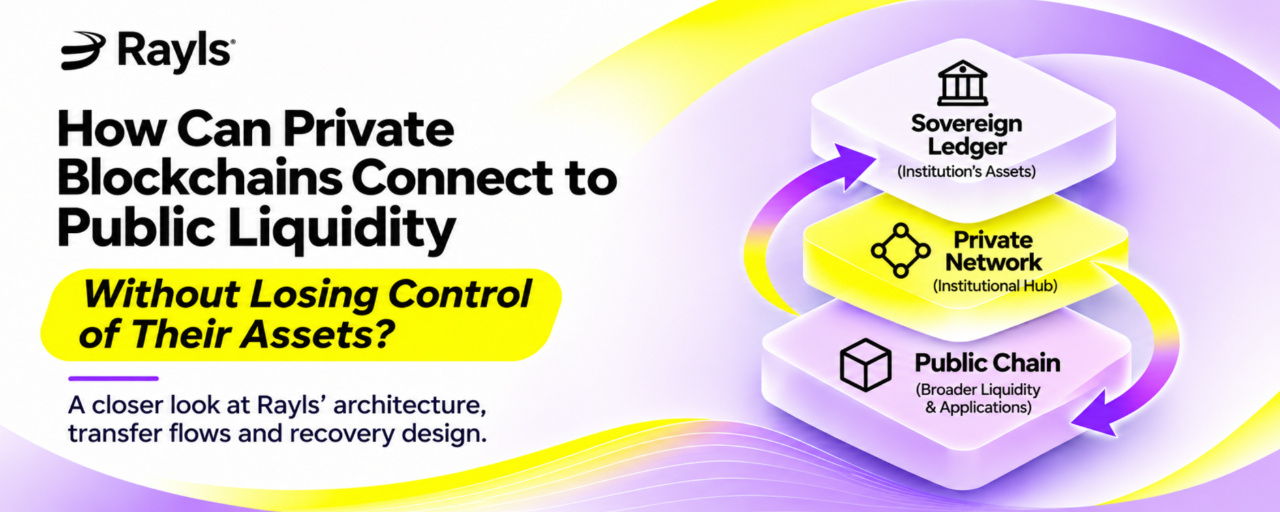
Rayls uses an architecture that connects institution-operated Sovereign ledgers, a permissioned Private Network and a Public Chain.
The Sovereign ledger is where an institution manages its assets and smart contracts.
The Private Network allows participating institutions to communicate through a shared Hub.
The Public Chain provides an environment where assets can interact with public blockchain applications.
What I found interesting is that Rayls doesn't use exactly the same mechanism for every connection.
Transfers between private institutional networks and transfers to the Public Chain follow different routes.
What actually happens when tokens move?
Here's a simple example based on Rayls' documented design.
Imagine Bank A holds 1,000 tokens on its Sovereign ledger and wants to make them available on the Rayls Public Chain.
First, the bank initiates a transfer through a function called teleportToPublicChain.
The original tokens are locked on the Sovereign ledger.
A message is then generated for the destination network, and a separate public relayer processes that message.
Once the destination transaction succeeds, a corresponding representation of those 1,000 tokens is minted on the Public Chain.
So the original tokens haven't simply disappeared or been copied without restriction.
They're locked on one side while their corresponding representation becomes available on the other.
This is called lock-and-mint.
And it raises an important question: what happens if the second part doesn't work?
What if the transfer fails halfway?
This was probably the most interesting part of the documentation for me.
Imagine the tokens have already been locked on the private ledger, but something goes wrong when the public-chain transaction is executed.
Without a recovery mechanism, the assets could remain locked even though the recipient never received the public representation.
Rayls describes a process where the relayer checks the destination transaction result.
If execution fails, a prepared revert message can be submitted to the original network to unlock the tokens.
The reverse direction has a similar idea.
When tokens move back from the Public Chain, the public representation is burned and the original assets are unlocked. If the destination operation fails, the system provides a recovery route to restore the public representation.
That doesn't mean failures are impossible or that recovery is guaranteed under every circumstance.
It means the architecture has a documented process for handling unsuccessful transfers.
Whether it works as intended in every deployment still needs practical testing.
One detail I didn't expect
While reading about Rayls' architecture, I noticed something that is easy to miss.
The Private Network Hub isn't involved in every transfer.
When institutions transfer assets through the Private Network, the Hub and private relayer infrastructure are part of the process.
But a Sovereign-to-Public Chain transfer uses a separate public relayer and a direct connection.
The asset mechanisms are different too.
Private Network transfers generally use burn-and-mint for standard token teleports, while transfers to the Public Chain use lock-and-mint, followed by burn-and-unlock when assets return.
This difference matters because the two routes have different trust assumptions, operational dependencies and failure scenarios.
It's not enough to say that a system supports interoperability. We also need to understand how each route actually works.
Can this be verified independently?
This is the next part I'd like to see tested.
Rayls has a public Sovereign CLI repository that describes how developers can set up an environment and work with the bridge.
A useful test would be to transfer a small amount of a test token and inspect both sides.
Did the original tokens get locked?
Did the correct amount appear on the Public Chain?
Can the transfer be traced through the relevant transaction records?
And what happens if the destination transaction fails?
These questions would tell us much more than simply reading that a bridge exists.
To be clear, I haven't executed that test myself. My observations here come from comparing the documented transfer flows, not from claiming to have verified a live transaction.
Does public-chain access automatically mean liquidity?
Not really.
A bank might successfully make its tokenized assets available on a public blockchain, but that doesn't mean buyers or liquidity providers will immediately appear.
There still needs to be actual demand, accessible markets and confidence in the asset.
The bridge also introduces risks around smart contracts, relayers, permissions and recovery.
So connecting private assets to a public chain solves one part of the problem, not everything.
Final thoughts
Before looking into this, I mainly thought of interoperability as moving tokens from one blockchain to another.
But the more important question is what happens to the original assets, how the two networks keep track of them and what happens when a transfer doesn't complete.
That's what makes Rayls' approach worth examining.
The separate transfer routes, lock-and-mint process and documented recovery mechanism show how much more is involved than a simple token transfer.
There's still a difference between an architecture that looks good on paper and one that's been independently tested.
And for financial institutions handling real assets, that difference matters.
Getting assets onto another blockchain is one thing. Making sure they're properly accounted for and recoverable is the bigger challenge.
#Rayls #Blockchain #Interoperability