


I've seen this movie enough times to know where the uncomfortable part usually starts. Nobody needs to hack anything. Nobody needs to find a clever bug. The contracts can behave exactly as written while the economic machine underneath them starts grinding itself into the floor because new tokens are arriving, buyers are disappearing, and the liquidity everyone thought was there turns out to be much thinner once people actually need it.
That's where IDOL gets interesting.
IDOL is a BEP-20 token running on BNB Chain. The basic contract is fairly ordinary: it keeps track of balances and processes transfers. The complicated part sits around it. Voting, purchases, staking, rewards and token burns depend on other application contracts and on the wider MEET48 platform. So there's a distinction that gets blurred way too easily in crypto: a token contract can work perfectly while the economic system built around that token doesn't.
The contract can't create demand.
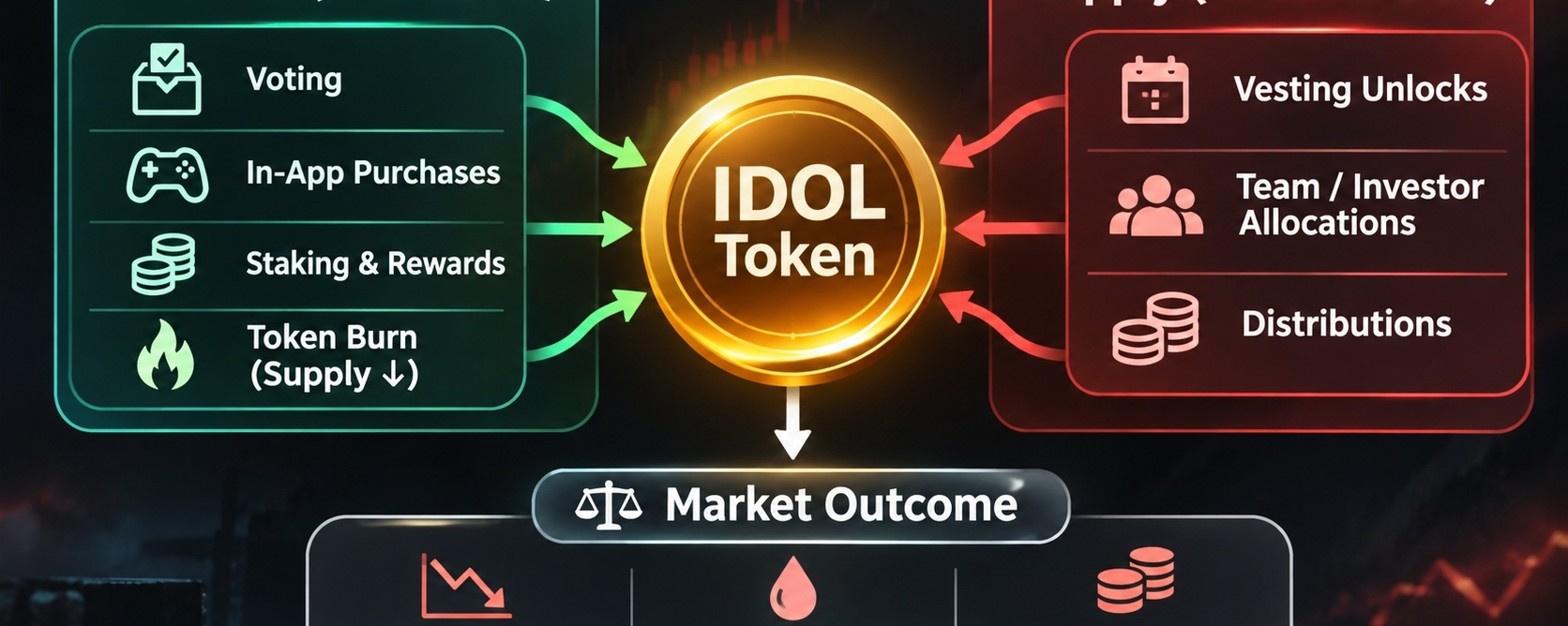
People have to buy IDOL first, then actually use it. That might mean voting, buying virtual goods or using other platform functions. For the economics to hold together, that activity needs to create enough real demand to absorb the tokens that keep becoming available. MEET48's published tokenomics put the maximum supply at 4.8 billion tokens, with large allocations subject to vesting rather than being immediately liquid.
And this is where the math starts getting uncomfortable.
There are basically two flows fighting each other. Platform activity can pull tokens into use. At the same time, vesting and distribution schedules can push previously restricted tokens into the market. Burns can remove tokens permanently, sure, but only to the extent that the number being burned is meaningful compared with the amount becoming transferable.
A burn function isn't a magic eraser.
The supply numbers themselves also deserve some suspicion. CoinMarketCap currently reports roughly 1.04 billion IDOL circulating against a 4.8 billion maximum supply, while other market-data providers have reported materially different circulating figures. That isn't a minor detail when you're trying to understand dilution. You can't just grab one number from a data site and call it the amount of supply the market has to deal with.
You need to trace the actual contracts.
That means checking vesting wallets, exchange addresses, ecosystem wallets, liquidity pools and the other addresses involved in the system. The token contract can tell you that an address holds a certain balance. It doesn't automatically tell you whether those tokens can be dumped tomorrow morning. Some may be locked. Some may be controlled by vesting contracts. Some may sit in liquidity pools. Some may already be sitting on exchanges.
The market doesn't care much about theoretical supply.
It cares about what can actually hit the order books or liquidity pools.
Now imagine the ugly version of the story. IDOL falls hard while locked allocations continue becoming transferable. Existing holders get nervous and start selling. People receiving newly vested tokens now have the ability to sell too. So the market is dealing with more liquid supply at exactly the moment demand is getting weaker.
That's a nasty combination.
And the falling price creates another problem that doesn't get enough attention. Platform activity may still be happening, but the economic value represented by that activity changes when the token price collapses. If parts of the platform are priced in IDOL, the same token amount can suddenly represent a very different dollar value unless those prices are adjusted dynamically.
Then you've got the burn argument.
It sounds reassuring until you ask the boring question: how many tokens are actually being burned, and how does that compare with the number becoming liquid? A burn is denominated in tokens, but the damage from dilution shows up in economic value, liquidity and demand. If IDOL has already fallen heavily, burning a large number of tokens may sound impressive while representing relatively little economic value.
The smart contracts don't save you here.
A verified contract can process every transfer exactly as intended and still sit inside an economy that isn't producing enough demand. There doesn't have to be an exploit. There doesn't have to be a malicious developer. There doesn't even have to be a coding mistake.
The system can fail honestly.
MEET48's documentation describes burns connected to voting and other activity, but the real question isn't whether the burn mechanism exists. It's whether those burns can keep pace with the supply becoming economically available. If they can't, then the burn is just one force pushing against another.
Liquidity is the other ugly part.
Trading volume can look enormous without meaning there's enough real liquidity to absorb serious selling. Current market data shows substantial trading activity relative to the token's market capitalization, while reported liquidity in individual BNB Chain pools can be far smaller than the headline daily volume.
Those numbers aren't interchangeable.
A token can trade heavily and still be painfully thin when somebody tries to sell size.
You usually don't notice this while prices are going up. Buyers keep replacing the liquidity sellers consume, so the machine looks healthy. Then the market turns. In an automated market maker, selling removes assets from the pool and moves the price against the seller. If the pool is shallow, relatively modest net selling can cause a surprisingly violent price move.
That's the part I'd watch.
The real test for IDOL isn't whether the token contract works, whether burns exist, or whether people can find uses for the token during a bull market. It's whether the application contracts, vesting system, treasury-controlled allocations and available market liquidity can keep functioning together when the market is actively trying to break the price.
Nobody needs to hack it.
Tokens unlock. Holders sell. Liquidity gets eaten. Price falls. The purchasing power generated by platform activity falls with it. And right when the system needs fresh demand, the economic value being generated by that demand may already be shrinking.
That's a much harder problem to fix than a smart-contract bug. The code can do exactly what it was programmed to do and still leave the system exposed because supply, genuine usage and liquidity don't move together when the pressure arrives.