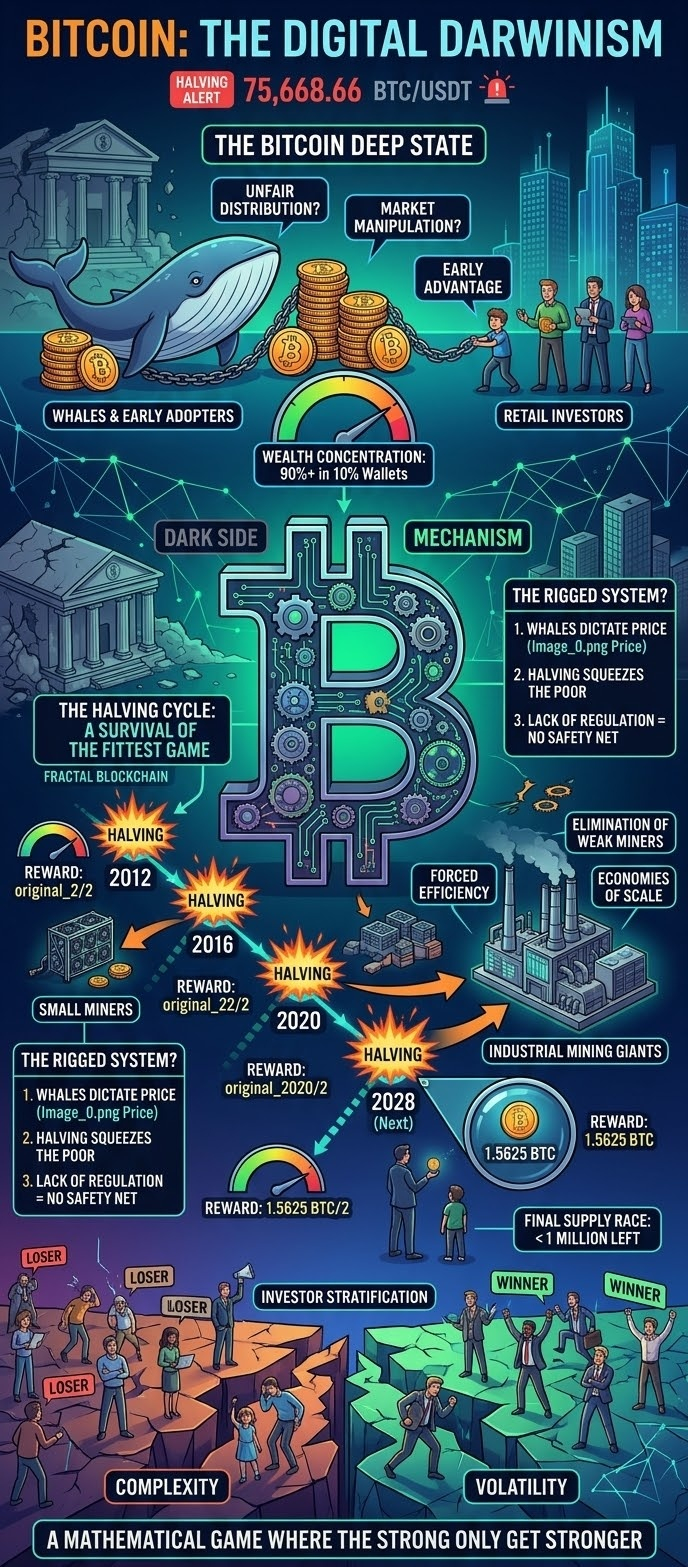

When Bitcoin is discussed, headlines are usually dominated by promises of quick wealth, absolute decentralization, and financial freedom away from central banks. However, behind this shiny facade lies a harsh and cold reality—a system built on economic mechanisms resembling "Digital Darwinism," where only the strongest (financially and technologically) survive.
Here is a breakdown of the dark side behind Bitcoin's mathematical rules and why many view it as a rigged game:
1. The Illusion of Decentralization: Who Holds True Power?
The original ethos of Bitcoin promises a peer-to-peer system free of central authorities. However, real-world application reveals a massive gap between theory and reality:
Whales & Wealth Concentration: An alarming percentage of all circulating Bitcoin is concentrated in a tiny fraction of wallets owned by early adopters, institutional funds, and mega-whales. These entities can manipulate market sentiment, trigger liquidations, or crash prices with a single move, leaving retail investors completely vulnerable.
Industrial Mining Monopoly: While anyone could mine Bitcoin on a personal computer in 2009, today’s landscape is dominated by massive corporate mining farms consuming nation-scale electricity. The individual miner has been completely squeezed out and marginalized.
2. The Halving Cycle: Squeezing Weak Players & Squeezing Supply
As the remaining unmined supply drops below 1 million BTC, the Halving mechanism makes the game exponentially harder:
The Squeeze on Mining Operations: Every 4 years, the Halving cuts block rewards in half while operational costs (electricity, hardware, facilities) remain high or increase. The inevitable result? Smaller, lower-capital miners are forced to capitulate, leaving the network's security and rewards strictly in the hands of deep-pocketed conglomerates.
First-Mover Advantage: The system permanently rewards those who arrived early when mining was easy, while imposing brutal capital requirements on latecomers. The rich utilize their liquidity to hoard more, while retail struggles to accumulate even a fraction of a coin.
3. Absolute Sovereignty Means Zero Safety Net
Bitcoin grants absolute financial control, but the trade-offs are unforgiving:
No Password Reset Button: If you lose your Private Keys, forget your passphrase, or get scammed, your assets are gone forever. There is no customer support, no court of law, and no central authority to reverse transactions or bail you out.
Psychological Slaughterhouse: The market’s brutal volatility creates an environment designed to trap retail investors through FOMO and panic selling—frequently transferring wealth from everyday individuals into the algorithmic hands of institutional market makers.
Bottom Line
Bitcoin is not a human conspiracy; it is an unyielding, unemotional mathematical system. But in practice, its rigid code creates a ruthless playground where the strong get stronger and the weak get eliminated.
Is Bitcoin true financial freedom, or just a new mathematical arena for the powerful?