

🚨 The entire U.S. financial system is becoming dangerously dependent on AI.
And the numbers are much worse than most people realize.
According to a Bloomberg analysis, AI has become so deeply connected to the U.S. stock market, pension funds, corporate debt and economic growth that a serious downturn could affect almost everyone.
Here's how big this has become.
1. The stock market
Since ChatGPT launched in November 2022, the S&P 500 added nearly $32 TRILLION in market value through November 3.
More than HALF of those gains came from just 10 companies, all connected to AI.
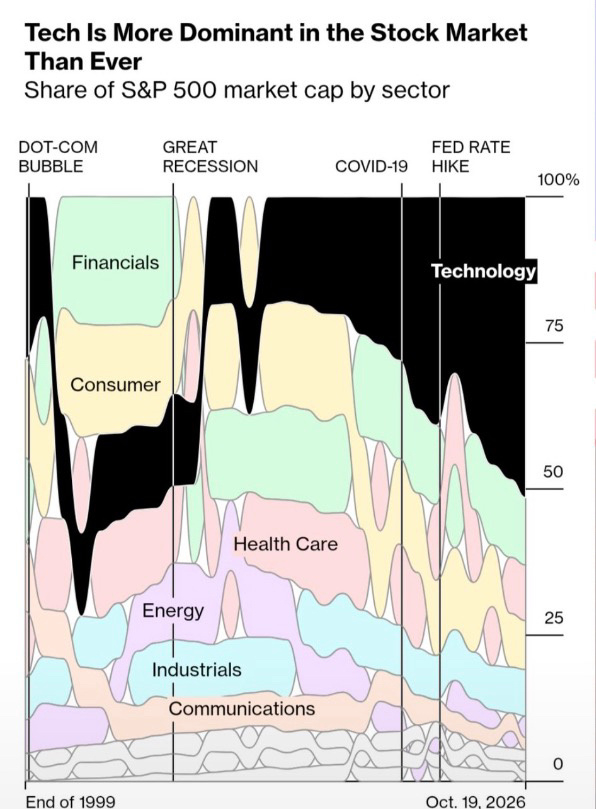
Technology and tech-related companies now account for nearly 50% of the S&P 500's value, even more than during the dot-com bubble.
Nvidia alone recently represented around 8% of the entire index.
This means a crash in a handful of AI companies could drag down the broader stock market, even if other businesses are performing well.
2. Retirement savings
The risk isn't limited to people buying AI stocks.
Bloomberg analyzed more than 70 U.S. pension funds and found that around 44% of their stock investments, worth $610 BILLION, are now tied to technology.
Hedge funds and insurance companies have also increased their exposure.
So even people who have never bought Nvidia, Microsoft or other AI stocks could be affected through their retirement savings.
3. The massive debt problem
This is probably the most concerning part.
Technology companies issued $296 BILLION in investment-grade bonds through October 12, making tech the largest nonfinancial borrowing sector.
Meanwhile, AI infrastructure developers issued more than $43 BILLION in high-yield debt, compared with just $8.5 billion last year.
Technology's share of the junk-bond market has nearly tripled to 19.7%.
And the six biggest cloud companies are expected to spend more than $850 BILLION this year on AI-related projects.
That's an 83% increase from 2025.
The concern is that companies are taking on enormous financial commitments today based on profits they expect to earn years from now.
If those profits disappoint, the damage won't be limited to shareholders.
Banks, bondholders and investment firms financing these projects could suffer losses too.
4. The U.S. economy
AI-related investment has become one of the biggest drivers of American economic growth.
Spending on technology hardware, software and data centers now makes up more than one-third of all U.S. business investment.
And these categories accounted for most of the growth in business investment over the past year.
So if companies suddenly cut AI spending, it could affect construction, electricity demand, equipment suppliers, jobs and overall economic growth.
That's why the recent AI stock selloff is so important.
The U.S. economy has become increasingly dependent on companies continuing to spend hundreds of billions building AI infrastructure.
But there's still a major unanswered question.
Can AI companies eventually generate enough profits to justify all this investment?
Because right now, the same industry is supporting stock valuations, retirement portfolios, corporate borrowing and a significant part of economic growth.
If the AI boom suffers a prolonged collapse, this won't just be another tech stock crash. The consequences could spread across the entire U.S. financial system.
#JobsReportRaisesHikeOdds #CPITestsDecemberRateOutlook #BitcoinRebounds$75KAsChipsLead #US Data Center Rules May Constrain AI Expansion #ARKPlans14ThematicETFsCoveringAIAndTokenizedMarkets