


In early August 2026, Meteora’s weekly trading volume sat near $630 million. By mid-October it had recovered to roughly $1.5 billion—a 2.4x rebound. Memecoins accounted for only 30% to 45% of that volume in recent weeks, yet they generated more than 90% of protocol revenue. Traders simply pay higher volatility-based fees on the pairs that move the most.
Meteora does not own a dominant launchpad. It does not capture the bulk of the initial player-versus-player (PvP) volume that erupts the moment a new memecoin is created. Instead it has become one of the main liquidity venues for the tokens that survive that first chaotic phase. The Dynamic Liquidity Market Maker (DLMM) pools concentrate capital into discrete price bins and adjust fees with volatility. Liquidity providers keep 90% of trading fees—higher than the 84% share on Raydium’s concentrated liquidity market maker (CLMM). The result is competitive execution and stickier liquidity once a token has graduated from the launchpad and found any lasting demand.
MET, the protocol’s token, is ultimately a bet that memecoin activity on Solana remains strong enough to keep those post-launch pools active. At an FDV around $370 million in late October 2026, the token traded on a revenue multiple closer to Pump.fun’s PUMP than to Raydium’s RAY. Some discount is justified—memecoins still dominate the fee line. The gap, however, looks wide when 55–70% of volume comes from other assets and Meteora captures successful tokens regardless of which launchpad originated them.
How DLMM Captures Volume After the Launch
A standard constant-product automated market maker spreads liquidity across the entire price curve. Most of that capital sits idle far from the current price. DLMM divides the curve into discrete bins. Liquidity providers choose how many bins to occupy and how to shape their position—spot, curve, or bid-ask. Only the bins a trade actually crosses earn fees. When volatility spikes, a dynamic fee component rises, capped at 10%, so LPs are compensated for the risk of providing depth during rapid moves.
This structure is particularly well suited to memecoins that have moved past the pure launch phase. Early volume is often captured by the bonding-curve launchpad itself or by the native AMM of the platform that graduated the token (PumpSwap or Raydium). Once a token develops any secondary market, traders and aggregators look for the deepest, most capital-efficient pools. Meteora’s bin model lets LPs concentrate tightly around the active price while still offering a wide enough range for larger orders. In 10 of the 12 pairs examined in the October Blockworks/Messari analysis, Meteora generated more volume per dollar of TVL than the comparable Raydium CLMM pools.
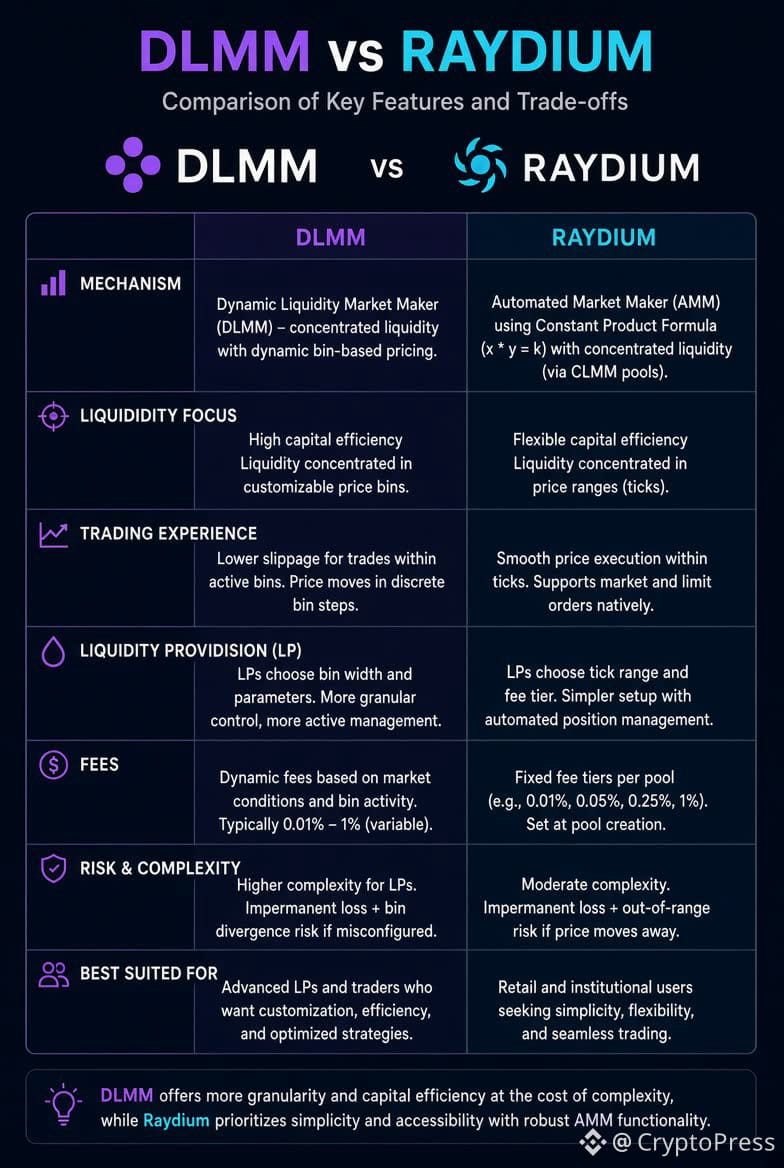
The higher LP fee share compounds the advantage. On a standard DLMM pool the protocol takes 10% and LPs receive 90%. Raydium’s CLMM leaves LPs with 84%. Because Meteora’s effective take is still competitive after the LP share and the dynamic fee, aggregators continue to route flow there. The protocol does not need to win the first hour of a launch; it needs to win the subsequent days and weeks when volume migrates toward the best available liquidity.
Distribution Funnels: Fomo and Jupiter
Two of Solana’s most important memecoin distribution channels feed Meteora directly. Fomo, a mobile-first trading app, routes a substantial share of its Solana memecoin volume through Meteora pools—around 30% in the periods measured. Jupiter, the dominant aggregator, sends 25% to 35% of its memecoin flows to Meteora. Neither figure is a majority, yet both are large enough to make MET one of the cleaner liquid exposures to growth in those funnels.
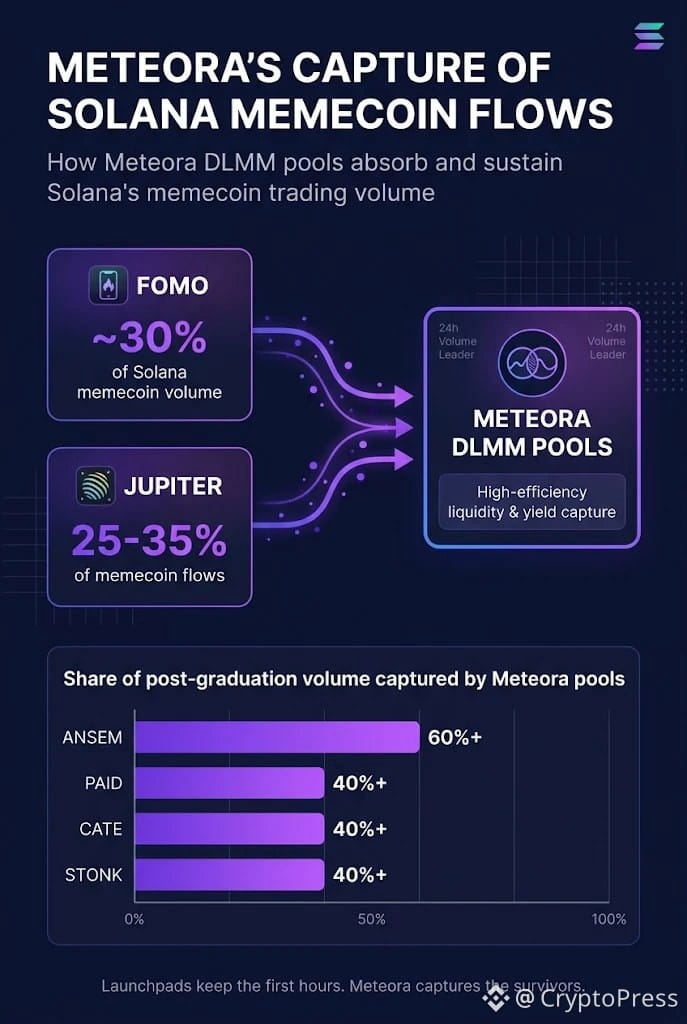
The pattern appears across individual tokens as well. For several prominent names that graduated on other platforms—ANSEM, PAID, CATE, STONK—Meteora pools have accounted for 40% or more of subsequent volume, and in some cases well above 60%. The launchpad that created the token keeps the initial bonding-curve fees and the first wave of PvP trading. Once the token exists as a regular SPL asset with any lasting interest, a meaningful slice of the secondary volume lands in DLMM pools.
This is why the thesis is framed as a bet on survivors rather than launches. Launchpad volume is noisy and highly concentrated in the first hours or days. Post-graduation volume is smaller in absolute terms for any single token, but it is recurring across every token that retains attention. Meteora’s share of that recurring layer is what shows up in the revenue numbers.
How Meteora Generates Revenue
Protocol revenue on Meteora comes primarily from its cut of trading fees. On DLMM pools the protocol retains 10% of the fee paid by the trader. A portion of that protocol fee is directed to stakers and referrers under the Referral Staking program; the remainder supports operations and treasury. Because dynamic fees rise with volatility, the effective fee rate on memecoin pairs is materially higher than on SOL-stable or major-token pairs. That is why a 30–45% volume share can produce more than 90% of revenue.
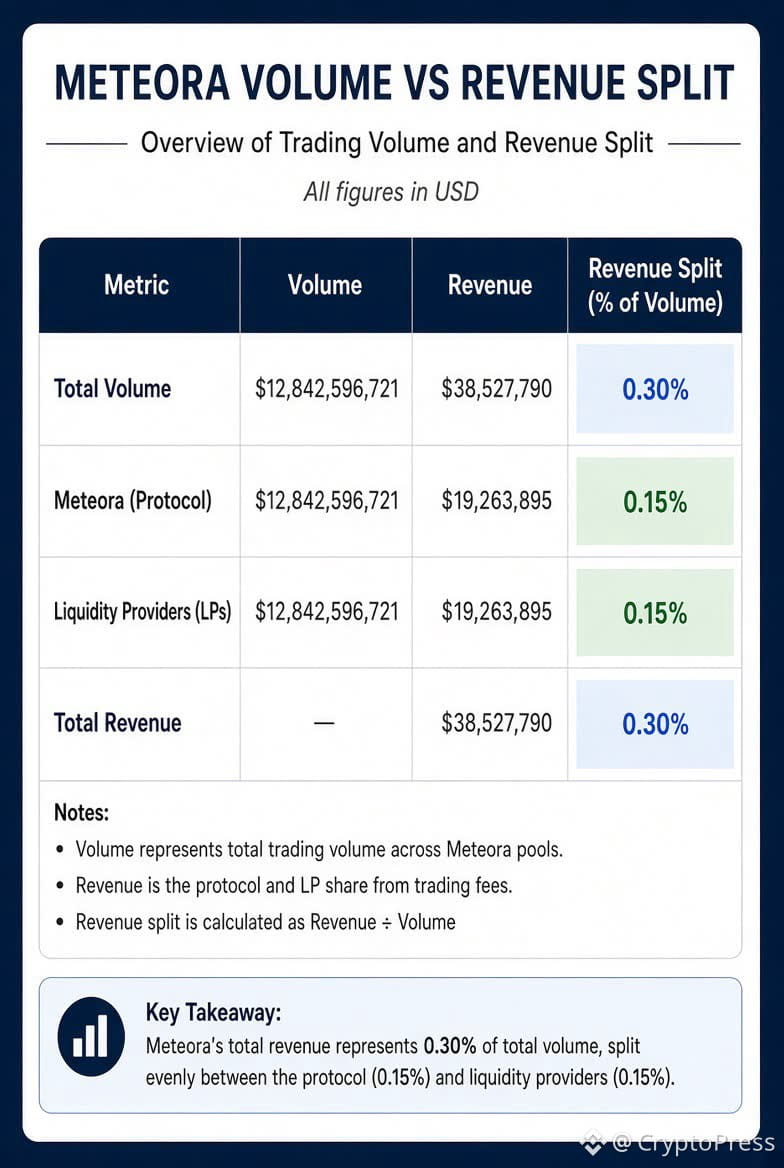
The arithmetic is straightforward. A low-volatility SOL-USDC pool might charge an effective fee measured in a few basis points. A volatile memecoin pool can charge 1% or more once the dynamic component engages. Even if the notional volume is smaller, the fee dollars are larger. LPs still receive the majority (90%), so the incentive to provide liquidity remains intact. The protocol simply takes its fixed percentage of a larger absolute fee.
Staking has become a visible supply sink. Roughly 128 million MET, or about 23% of circulating supply, was staked as of the late-October data. Stakers earned an estimated 15% APR funded largely by actual DLMM revenue rather than new token emissions. The Referral Staking program routes a slice of protocol fees to both stakers and the users who bring new liquidity providers. Because the rewards are paid in USDC from real fees, the sink is not dependent on inflationary emissions.
Why MET Is Priced the Way It Is
At an FDV near $370 million, MET’s revenue multiple sat closer to PUMP than to RAY. Pump.fun’s business is more purely leveraged to memecoin creation and the initial PvP phase. Raydium has a broader mix of pairs and a longer operating history. Meteora sits between them: its fee line is still dominated by memecoins, yet 55–70% of its volume comes from other assets, and it captures secondary volume from tokens launched elsewhere.
The discount relative to a pure general-purpose DEX is therefore understandable. Memecoin volume is cyclical and can compress quickly when risk appetite fades. At the same time, the multiple gap versus Raydium appears wide once the post-launch capture rates and the superior LP economics are taken into account. Meteora does not need to own the launchpad to keep earning on the tokens that survive. Every successful graduate from Pump, Raydium, or any other pad that later trades on DLMM contributes to the revenue base.
Two observable factors support the current valuation. First, the volume recovery from the August lows demonstrates that activity can rebound without a new narrative launch. Second, the staking ratio has risen to roughly a quarter of circulating supply, reducing the liquid float that must be absorbed by the market. Both are concrete, on-chain signals rather than forward projections.
What Could Raise or Lower the Value
Several near-term indicators would strengthen or weaken the case for MET.
Volume sustained above the recent $1.5 billion weekly level, particularly if the memecoin share of revenue remains high, would confirm that the post-launch layer continues to generate fees. A sustained drop back toward the August lows would compress revenue and pressure the multiple. Capture rates on Fomo and Jupiter are also watchable: if Meteora’s share of those flows falls below the 25–30% range for several consecutive weeks, the distribution advantage narrows.
Staking growth matters as a supply sink. Further increases in the percentage of circulating MET locked, especially if the APR remains funded by fees rather than emissions, reduce sell pressure from unlocks. Conversely, a sharp decline in staking—whether from lower APR or competing opportunities—would increase the liquid float.
Competitive responses are the clearest external risk. Raydium or another venue could improve LP economics or introduce bin-style concentrated liquidity of its own. Launchpads could also alter graduation mechanics to retain more secondary volume. Any of these would reduce Meteora’s share of the survivor layer. Regulatory or platform risk around memecoin trading itself remains an overhang; a broad contraction in Solana memecoin activity would hit the revenue line regardless of market-share gains.
None of these are price calls. They are the observable levers that determine whether the current revenue multiple expands or contracts. The protocol’s ability to keep winning routes on tokens that have already launched is the central variable.
Challenges and Structural Limits
Meteora’s model has clear boundaries. It does not capture the majority of the highest-intensity PvP volume at the moment of launch. That volume is economically important to the launchpads and to the traders who specialize in the first minutes. DLMM’s strength appears later. If the overall memecoin market shrinks to a point where few tokens survive past the launch window, the post-graduation layer shrinks with it.
Fee competition is continuous. Because the protocol takes a fixed percentage, any sustained reduction in effective fees—whether from lower volatility or from competitive pressure—reduces absolute revenue even if volume holds. The May 2026 increase in the protocol’s DLMM fee share from 5% to 10% did not drive LPs away in the subsequent data, but the reverse is always possible if other venues offer better net returns.
Token unlocks continue on a multi-year schedule. Monthly increases in circulating supply create ongoing absorption demand. The staking program offsets part of that pressure, yet it does not eliminate it. Transparency around treasury and buyback policy has also varied; holders ultimately rely on the fee-share rules that are written into the protocol rather than on discretionary actions.
Outlook
The durable element is the separation between launch volume and survivor volume. As long as Solana remains a primary venue for memecoin creation and a subset of those tokens develop secondary markets, a liquidity layer optimized for concentrated, volatility-aware provision has a role. Meteora has demonstrated that role without owning the launchpads. The 2.4x volume recovery, the 90%+ revenue contribution from a minority of volume, and the measurable capture of Fomo and Jupiter flows are all consistent with that positioning.
Whether the revenue multiple closes the gap toward broader DEX comps depends on whether those capture rates and fee dollars persist. The data available through late October 2026 show a protocol that earns disproportionately from the tokens that last, not from the tokens that launch. That is the concrete foundation under the current valuation.
For readers who want ongoing research on Solana liquidity, fee economics, and token design choices, subscribe at https://cryptopress.substack.com/subscribe.
The post MET Is a Bet on Survivors, Not Launches appeared first on Cryptopress.