
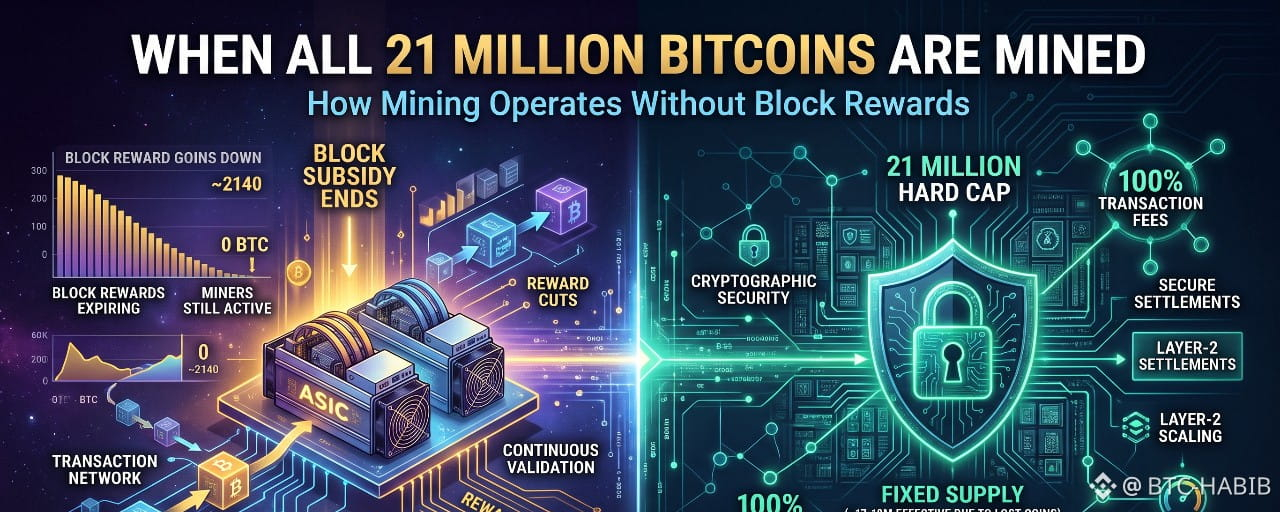

The short answer is simple: the Bitcoin network will not shut down.
A common misconception among beginners is that once the last Bitcoin is created, mining stops and the blockchain freezes. In reality, Bitcoin's code was engineered from day one to handle this milestone smoothly.
When the final fraction of a coin is minted, Bitcoin will complete its century-long transition from an issuance-driven network into a pure transaction-fee network. Miners will still run their machines, transactions will still process every ten minutes, and users will continue to transfer funds across the globe.
When Will the Last Bitcoin Be Mined?
Based on Bitcoin’s mathematical halving schedule, the final Satoshi (the smallest unit of Bitcoin, equal to 0.00000001 BTC) will be minted around the year 2140 at block height 6,930,000.
It often surprises people that mining will last until 2140, considering that more than 93% of all Bitcoins have already been created.
This stretched timeline happens because of the halving rule:
The block reward cuts in half every 210,000 blocks (roughly every four years).
In early 2009, miners received 50 new Bitcoins per block.
By 2024, that reward dropped to 3.125 Bitcoins.
By 2036, it will drop to under 0.4 Bitcoin per block.
Because the reward cuts in half repeatedly, the rate of new supply slows down exponentially. It took only about a decade to mine the first 18 million coins, but it will take more than a century to mine the final 2 million.
How Mining Works Without Block Rewards
To understand why miners will stay active after 2140, look at how miners get paid today.
A miner's income comes from two sources:
The Block Subsidy: Freshly minted Bitcoin created out of thin air by the protocol.
Transaction Fees: Small fees paid by users to have their transactions included in a block.
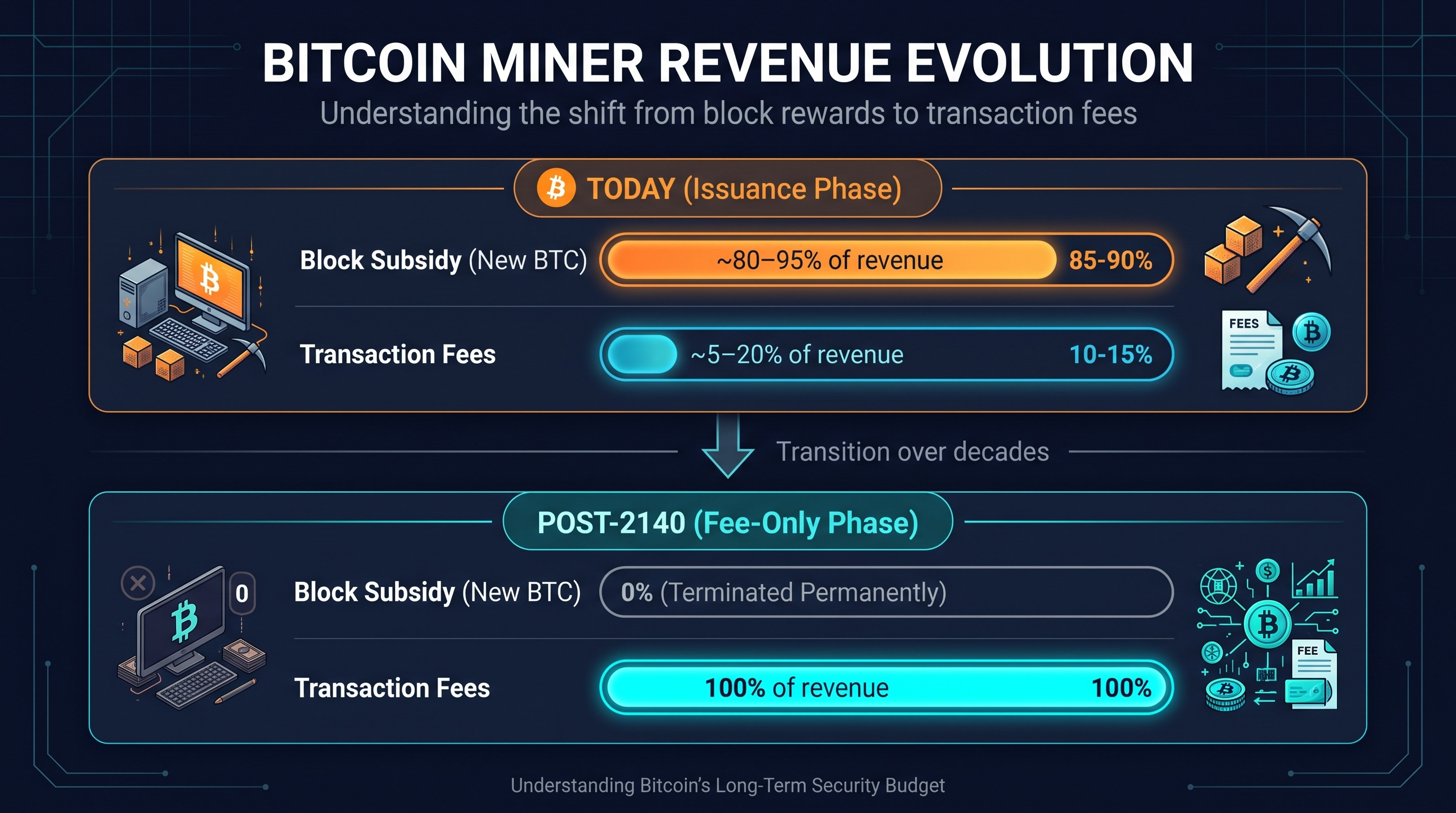
Today, the block subsidy makes up the vast majority of miner income. But every four years, that subsidy shrinks.
By 2140, the block subsidy drops to zero. At that point, transaction fees become 100% of a miner's income. Miners will still group transactions, order them into blocks, and solve Proof of Work calculations to earn the accumulated fees attached to every transfer.
Satoshi Nakamoto clearly explained this transition in the original 2008 Bitcoin Whitepaper:
"Once a predetermined number of coins have entered circulation, the incentive can transition entirely to transaction fees and be completely inflation free."
Will Network Security Suffer?
A blockchain's security depends on its security budget—the total dollar value spent rewarding miners to protect the ledger. If miner revenue drops too low, miners might turn off their hardware, reducing the computing power (hash rate) protecting the network and making it vulnerable to attacks.
Economists and network developers expect security to stay strong through three main drivers:
1. High-Value Base Layer Settlement
As global adoption grows, the Bitcoin base layer will likely function as an institutional settlement network—similar to Fedwire or central bank clearing systems. While regular coffee purchases happen on low-cost second layers, banks, multinational corporations, and sovereign funds settling tens of millions of dollars on the base layer will gladly pay higher transaction fees for absolute finality.
2. Layer-2 Expansion (The Lightning Network)
Technologies like the Lightning Network allow millions of small, fast, everyday payments to happen off-chain. Periodically, these Layer-2 channels open, rebalance, and close by settling their net balances onto the main Bitcoin blockchain. These batch settlements bundle thousands of payments together, creating steady, competitive fee pressure for main-chain miners.
3. Energy and Hardware Efficiency
As mining hardware reaches physical efficiency limits, mining operations become less about buying faster chips and more about finding the cheapest surplus energy (such as stranded natural gas, hydro overflow, or solar peaks). Lower operational costs allow miners to remain profitable even when relying entirely on transaction fees.
Will Exactly 21 Million Bitcoins Ever Exist?
Technically, no. The circulating supply will never reach 21,000,000 whole coins for two specific reasons:
1. The Code Rounds Down
Bitcoin's code uses integer math with bit-shift operators (>>) to divide block subsidies. Because numbers cannot divide infinitely, the math rounds down at the smallest unit (the satoshi). The theoretical mathematical maximum that can ever be mined is actually 20,999,999.9769 BTC.
2. Millions of Coins Are Permanently Lost
The true usable supply of Bitcoin is much lower than 21 million. Over the past fifteen years, people have thrown away hard drives, lost private keys, died without passing on seed phrases, or sent coins to invalid burner addresses.
Blockchain analytics firms estimate that between 3 and 4 million Bitcoins are permanently lost and out of circulation forever. Because these lost coins can never move, Bitcoin’s effective circulating supply is already permanently capped at around 17 to 18 million coins.
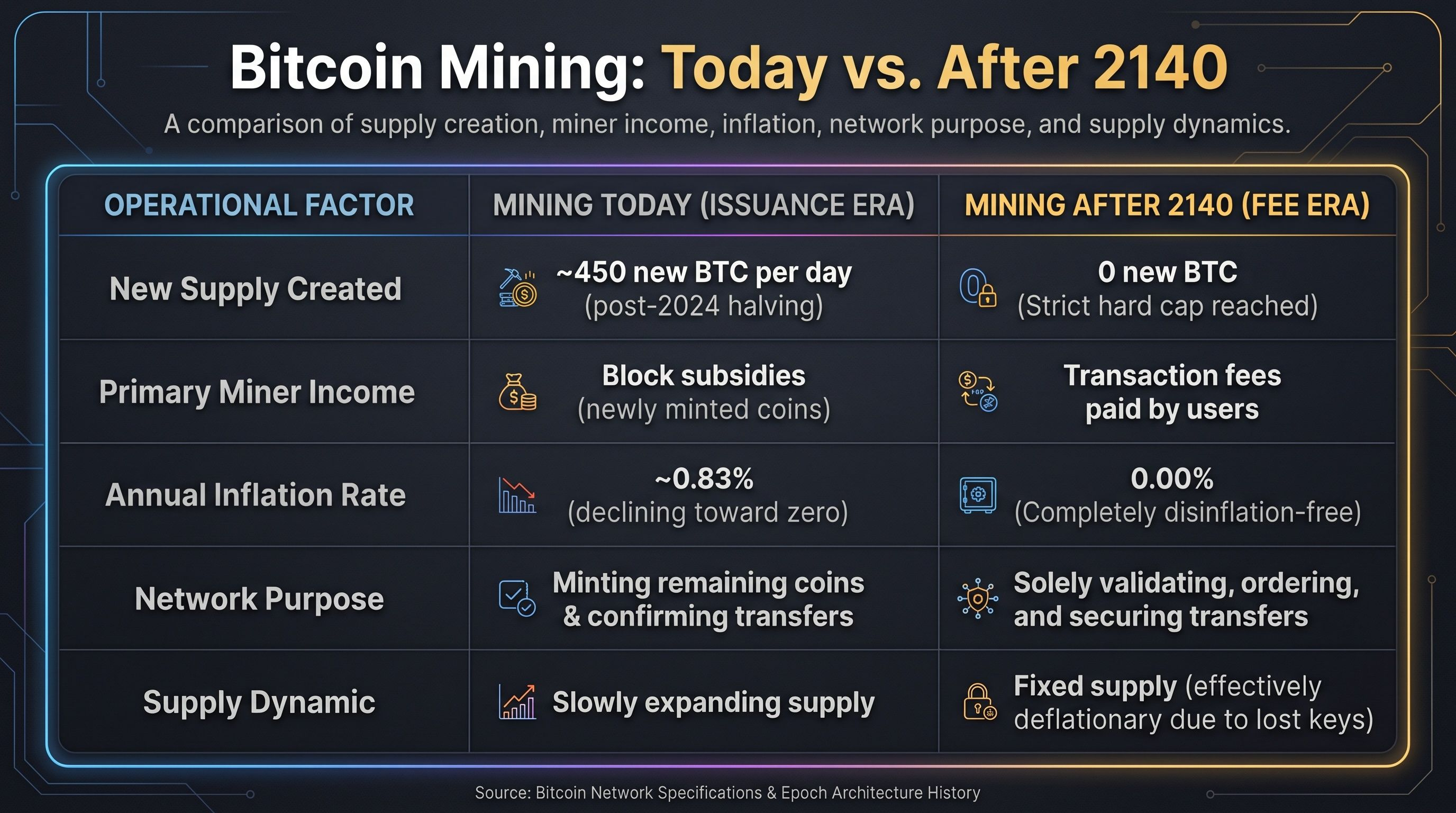
Bitcoin Mining: Today vs. After 2140
Frequently Asked Questions
Will Bitcoin stop working when all 21 million are mined?
No. Bitcoin will continue processing transactions just as it does today. The only change is that no new coins will be created; miners will collect user transaction fees as their sole compensation.
Can the 21 million limit ever be increased?
Technically, Bitcoin's software code is open-source, but changing the 21 million cap requires a network hard fork. Independent node operators, businesses, and miners globally would have to choose to run the new rules. Because increasing the supply dilutes the value of everyone's savings, the community has an overwhelming economic incentive to reject any rule change that alters the 21 million limit.
What if transaction fees are not enough to keep miners profitable?
Bitcoin has a built-in difficulty adjustment that recalculates every 2,016 blocks (roughly every two weeks). If fees drop and some miners turn off their machines, the network automatically lowers mining difficulty. This makes mining cheaper and easier for the remaining participants, restoring balance without stopping the network.
Key Takeaway
The year 2140 will not bring a sudden crash or a dramatic shutdown. It simply marks the day Bitcoin fulfills Satoshi Nakamoto’s original design: a fully decentralized, self-sustaining global financial network with an unchangeable monetary policy and zero inflation.