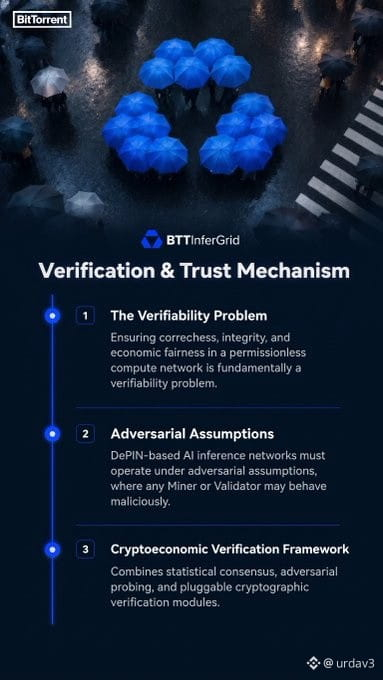
Decentralized AI computing can only scale when users have confidence that the computing resources they pay for are actually performing the work correctly.
This is where BTTInferGrid’s Verification Mechanism becomes particularly important. In a distributed environment, workloads may be handled by different independent providers, making it difficult to guarantee that every computation is accurate and reliable. Verification introduces an additional layer of accountability by helping assess whether completed tasks meet the required standards.
This matters because decentralization changes the traditional trust model. Instead of relying entirely on one centralized operator, the network needs mechanisms that allow participants to evaluate performance and detect unreliable results.
For developers, this can reduce uncertainty when outsourcing AI workloads. For compute providers, it creates incentives to maintain consistent service quality. For users, it strengthens confidence in the infrastructure supporting their applications.
The bigger opportunity is that verification can become a core building block for an open AI economy, where computing resources are distributed without sacrificing accountability.
Decentralization should not mean accepting lower standards. It should mean creating better ways to prove that those standards are being met.
@BitTorrent_Official @Justin Sun孙宇晨 #TRONEcoStar