

#BitcoinRebounds$75KAsChipsLead
I’ve learned to be careful when two markets start moving in the same direction. From a trading perspective, correlation can look convincing on a chart while hiding what’s actually driving the orders underneath. A rebound in semiconductor stocks can improve the mood across risk markets, but that doesn’t mean the same money is moving into @Bitcoin . Right now, that distinction matters because chip stocks have recovered while Bitcoin has struggled around the $75,000 area.
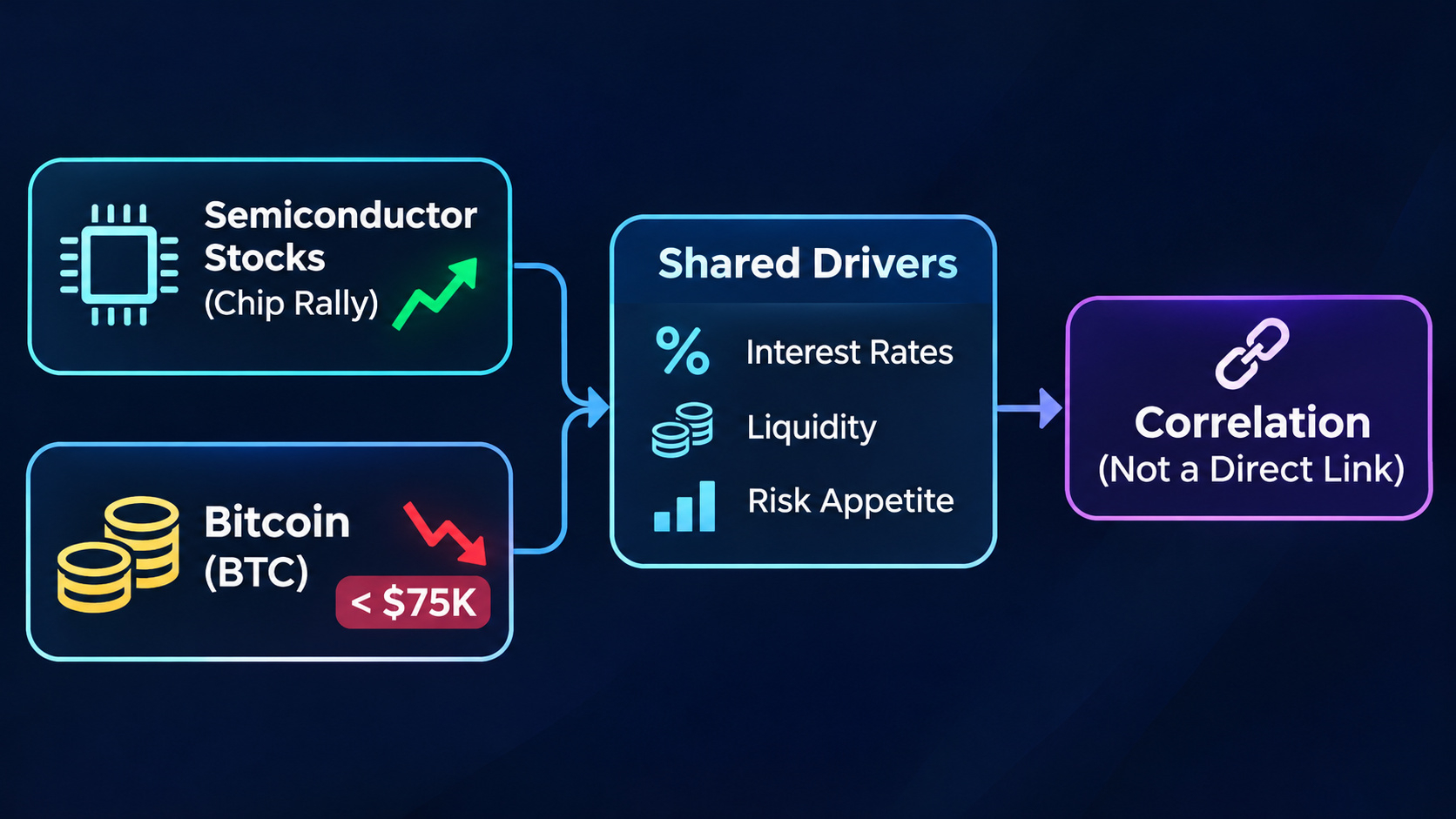
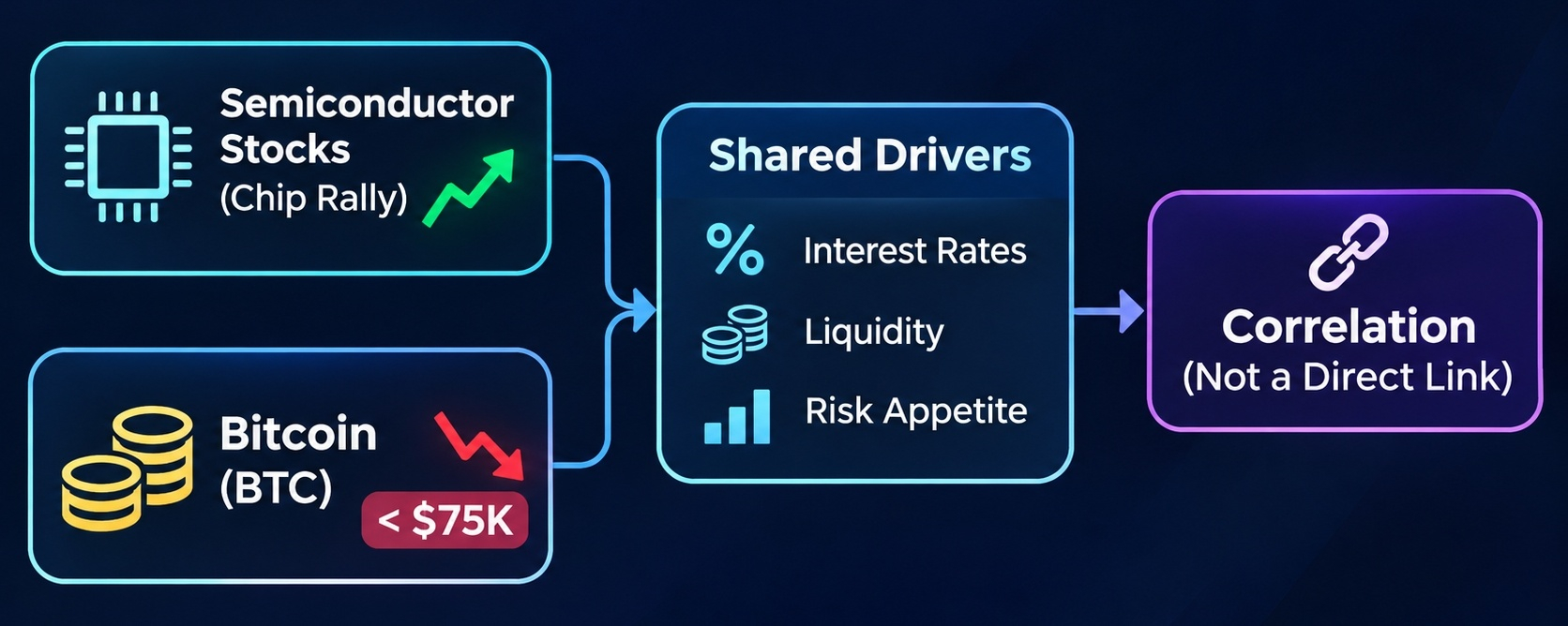
I don’t see the relationship between Bitcoin and semiconductor stocks as a direct one. It’s a changing correlation. Investors buying chip stocks aren’t automatically buying Bitcoin, and investors selling Bitcoin aren’t necessarily selling technology shares. Both markets can react to the same forces, though. Interest rates, expectations about liquidity, existing trading positions, and general appetite for risk can push both in the same direction.
The recent price action shows why the distinction matters. Bitcoin traded below $75,000 even while technology stocks recovered after an earlier selloff. If chip strength were a reliable signal that Bitcoin was about to recover, you’d expect the move to show up more clearly in Bitcoin. It didn’t.
There’s a basic market-structure reason for that. Bitcoin has its own spot and derivatives markets. Semiconductor stocks trade through equity markets with different participants, trading hours, settlement systems, and financing methods. The people and firms moving prices in those markets aren’t necessarily making the same decisions at the same time.
That creates plenty of room for the two markets to diverge.
A rebound in chip stocks can improve overall risk sentiment without producing enough direct buying in Bitcoin. An equity trader might see a semiconductor stock as oversold and start buying it, while a Bitcoin trader might still be worried about interest rates or crowded derivatives positions. Both traders can be comfortable taking risk, but they’re not necessarily taking the same risk in the same place.
The correlation itself also changes. Bitcoin doesn’t maintain a fixed relationship with technology stocks or semiconductor companies. Coinbase Institutional noted that Bitcoin had become less correlated with chip stocks than earlier in the year while becoming more sensitive to interest-rate changes. That’s something I’d pay attention to because a correlation that worked during one market regime can break when the underlying conditions change.
Bitcoin’s derivatives market makes the picture even messier.
I watch futures open interest, funding rates, options positioning, and liquidations because these can move Bitcoin independently of what semiconductor stocks are doing. When traders build large positions in one direction, the market doesn’t need a huge spot move to start forcing those positions out. A relatively small move can trigger liquidations, and those forced trades can add another layer of buying or selling pressure.
That can make a Bitcoin move look like a simple reaction to the wider market when part of it is actually coming from Bitcoin’s own positioning.
The process can work both ways. A sharp decline can trigger long liquidations, which add more selling and push the price lower. A recovery can do the opposite to heavily positioned shorts. In both cases, the semiconductor market doesn’t have to move at the same speed for Bitcoin’s own market structure to create a much larger move.
Interest rates are another reason I wouldn’t use chip stocks as a simple Bitcoin signal. A stronger-than-expected employment report increased expectations for a December Federal Reserve rate hike and added pressure to Bitcoin, even as investors bought some technology stocks after their decline.
That’s a useful example of how two traders can look at the same market and reach different conclusions. An equity investor might see a technology stock that has fallen sharply and decide the price is attractive. A Bitcoin trader might see the same broader environment and focus on what higher rates could mean for financial conditions. One market can recover while the other stays under pressure.
There’s also a timing problem that’s easy to overlook. Stock markets mainly react to new information during their trading hours. Bitcoin doesn’t close. It trades around the clock. Bitcoin can move before, during, or after a related move in stocks, and its derivatives markets can react to new information before the underlying stock market opens.
So when I see someone say, “chip stocks rose, so Bitcoin should rise,” I don’t think that’s enough. To call it a meaningful relationship, I’d want to see the pattern hold through different market conditions. I’d also want to separate the effect of semiconductor stocks from interest rates, the dollar, volatility, and the wider equity market.
If the relationship disappears whenever one of those variables changes, then semiconductor performance isn’t really a dependable leading signal for Bitcoin. It’s just one piece of the market.
The $75,000 area makes this even more interesting. Bitcoin has been testing a price zone traders are watching as possible support, with recent technical analysis pointing to roughly $75,500 as an important level. If Bitcoin breaks below that area while semiconductor stocks remain stable or continue recovering, the message becomes harder to ignore: chip strength by itself isn’t enough to pull Bitcoin higher.
I wouldn’t take that to mean semiconductor stocks don’t matter. They still give us information about broader risk appetite. If investors are willing to buy technology stocks after a major selloff, that tells us something about how much risk the market is willing to accept.
The problem starts when that signal gets treated as the reason Bitcoin is rising.
For me, the better test is Bitcoin’s own market. A stronger recovery should show up in the price structure through higher highs and higher lows. I’d also want to see improving spot demand and derivatives positioning that can support the move without becoming too crowded. Those are signals coming from Bitcoin itself, rather than from a semiconductor rally happening somewhere else.
That’s why I’d treat the current chip rebound as useful background information, not as a direct Bitcoin catalyst. The two markets can move together because they respond to some of the same conditions, but they have different structures, different participants, and different sources of buying and selling pressure.
A semiconductor rally can improve the mood. It can make traders more comfortable with risk. But Bitcoin still has to find its own buyers. If it can’t, a recovery in chip stocks won’t be enough to make the Bitcoin move stick.