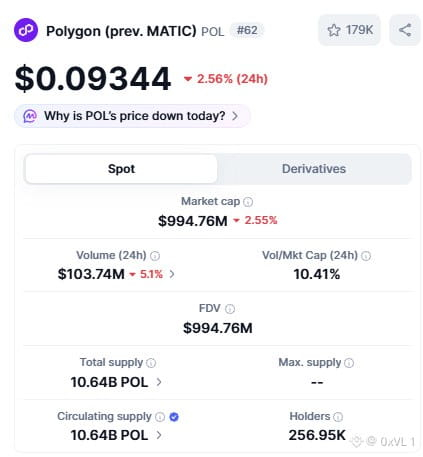
The coordinated governance push by Polygon Labs, Binance, and Polymarket to recover those ~70.5M $POL by zeroing out the exploiters' balances makes total sense from an institutional remediation angle. Re-routing state rather than inflating the supply protects current token holders from direct dilution, and coordinating validator action to clean up a high-profile multi-million dollar exploit certainly shows how responsive the core ecosystem can be when major infrastructure partners take a hit.
That being said, pushing an irregular state transition via a hard fork to reverse malicious balances opens up a really uncomfortable precedent for immutability. While the DAO vote will almost certainly pass given validator alignment and backing from tier-one industry players, it explicitly proves that Polygon PoS governance remains fundamentally centralized enough to rewrite state when institutional capital is on the line. For retail users, network mechanics won't visibly break post-upgrade, but it does heavily erode the credible neutrality narrative that L2s and sidechains fight so hard to maintain.
That being said, pushing an irregular state transition via a hard fork to reverse malicious balances opens up a really uncomfortable precedent for immutability. While the DAO vote will almost certainly pass given validator alignment and backing from tier-one industry players, it explicitly proves that Polygon PoS governance remains fundamentally centralized enough to rewrite state when institutional capital is on the line. For retail users, network mechanics won't visibly break post-upgrade, but it does heavily erode the credible neutrality narrative that L2s and sidechains fight so hard to maintain.