


VanEck’s Griffin MacMaster and Matthew Sigel say Cipher, TeraWulf and Hut 8 trade well below the value of their signed AI leases after October’s rout.
VanEck said Wednesday that so-called powered shell providers, Bitcoin miners leasing sites to AI tenants, fell about 35% in October even though no signed leases were cancelled.
The firm’s Griffin MacMaster and Matthew Sigel said cap-rate and lease-value math implies 42% to 103% upside for Cipher, TeraWulf, and Hut 8 specifically.
VanEck also flagged risks, including up to $3.2 billion of added equity needs through 2028 and a possible Texas moratorium on new data centers.
Bitcoin (BTC) miners that converted former mining sites into leased AI data centers fell an average of 35% in October, but VanEck said in a Wednesday note that the drop reflects funding fears rather than any break in the underlying business.
Investment analyst Griffin MacMaster and Matthew Sigel, VanEck’s head of digital assets research, wrote that no signed leases were cancelled during the slide, which hit so-called powered shell providers—miners such as Cipher, TeraWulf, and Hut 8 that lease out former mining farm power connections to AI tenants—after a selloff in neoclouds, the firms that rent outgraphics processing units (GPUs) for AI workloads and that Elon Musk recentlywarned could face a reckoning.
VanEck tied the slide to a hotter-than-expected September inflation reading and regulatory uncertainty ahead of the Nov. 3 midterm elections, both of which revived rate-hike expectations and pushed up borrowing costs; CoreWeave bonds were trading near 15% against coupons under 10%, the firm said.
“The power these companies control appears to be the binding constraint on AI compute,” VanEck wrote in the note.
Cap-Rate Math Implies 42% to 103% Upside
On 2028 estimates, the group trades at roughly half the enterprise-value-to-EBITDA multiple of data-center real estate investment trusts (REITs), VanEck said. Valuing each company’s first full year of stabilized lease income at real-estate-style multiples implies 42% to 103% upside for Cipher, TeraWulf, and Hut 8, the three names VanEck modeled individually, which closed Oct. 30 between 55% and 75% below their 2026 highs.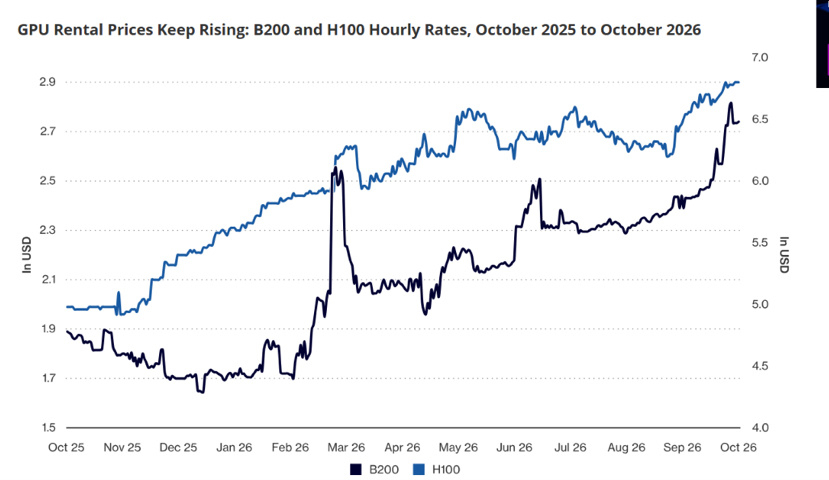
Demand hasn’t slowed, according to the firm: hyperscaler capital spending and GPU rental prices keep rising, and Morgan Stanley projects a 38-gigawatt US data-center power shortfall through 2028. That momentum showed up elsewhere too, in Galaxy Digital’s data center earnings surge last quarter.
VanEck Flags Funding and Political Risks
VanEck said real risks remain. A wave of construction-loan refinancing may slip to 2029 or 2030, leaving the next round of leases needing $600 million to $3.2 billion in new equity, pointing to smaller refinancings already completed by IREN and HIVE Digital as evidence debt markets remain open but selective.
CleanSpark closed a data center bond deal of its own in September for one of the leases in VanEck’s tracking group.
Political risk is also rising. Texas Governor-elect Hinojosa has floated a moratorium on new data centers in a state that VanEck says holds about 30% of US data-center capacity currently under construction.