
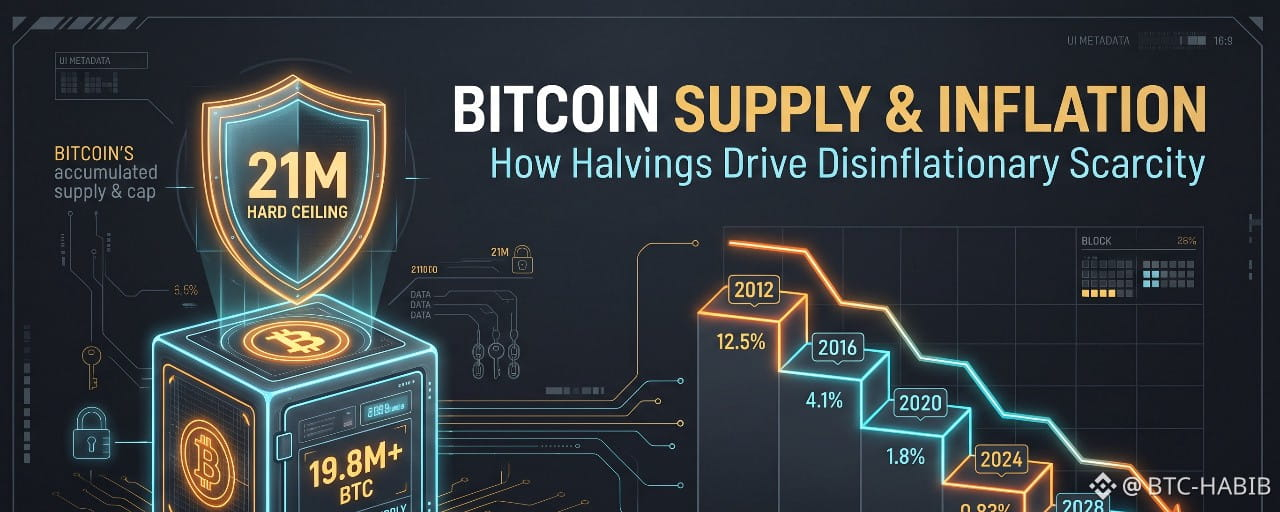

When newcomers hear about the "Bitcoin halving," many ask a nervous question: Does this mean the Bitcoin in my wallet gets cut in half?
The short answer is no. A halving has zero impact on the coins you already hold.
Instead, the halving controls the flow of new coins entering the world. It is the programmatic heartbeat of Bitcoin’s monetary policy, cutting the creation rate of newly minted Bitcoin by 50% every 210,000 blocks—or roughly every four years.
To see why this design matters, you need to understand the relationship between Bitcoin’s existing supply (the stock), its new daily creation (the flow), and why it behaves unlike any fiat currency or commodity in human history.
Supply vs. Issuance: The Stock and the Flow
To understand how halving works, economists separate money into two distinct categories:
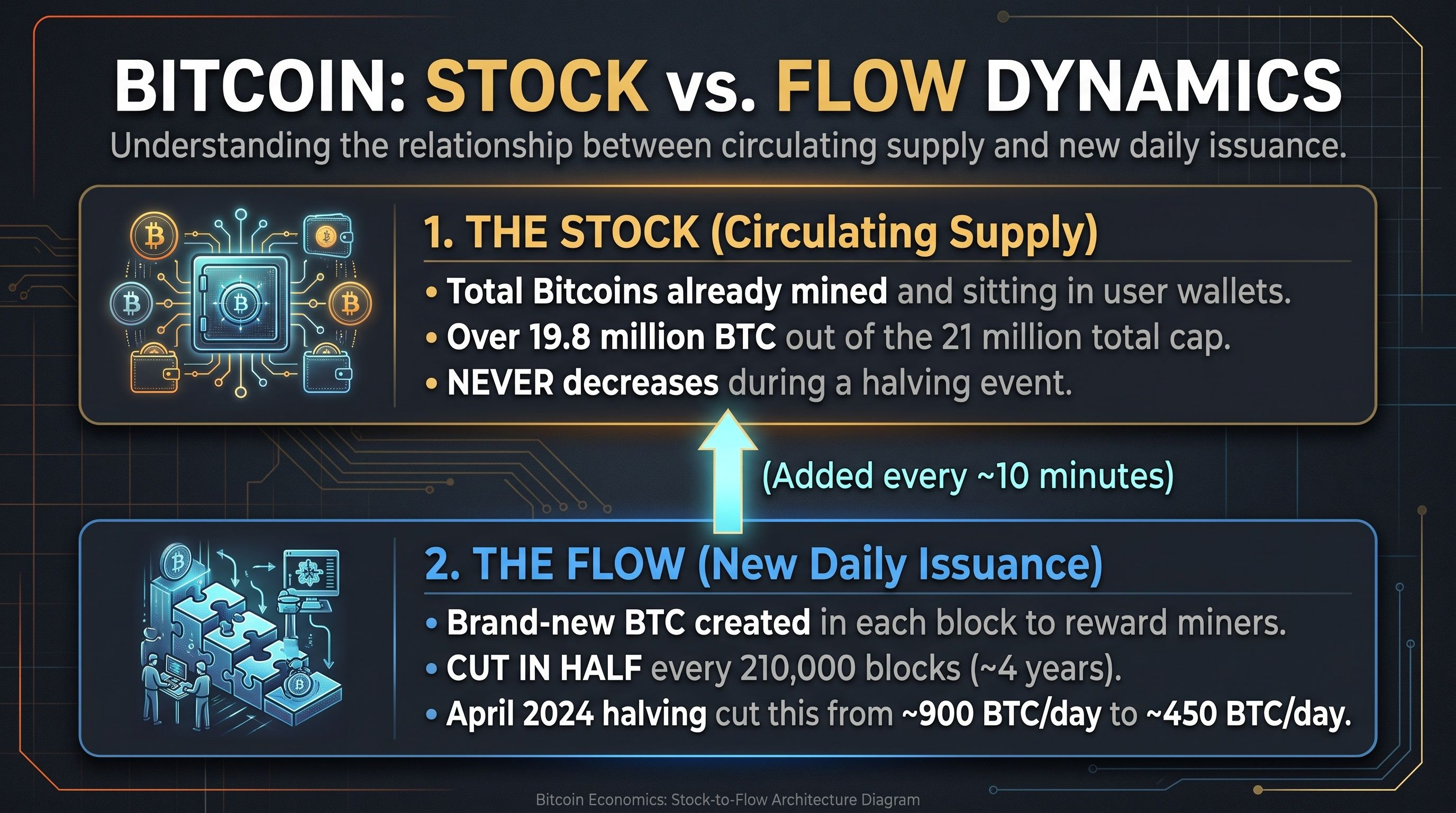
The Stock (Circulating Supply): This is the total pool of Bitcoin that has already been mined and exists across global wallets. Over 19.8 million coins have already entered circulation out of the 21 million hard ceiling. A halving never takes away or shrinks this number.
The Flow (New Issuance): This is the stream of brand-new coins minted by the protocol and awarded to miners for securing transactions.
The halving targets only the flow.
Prior to April 2024, miners produced roughly 900 new Bitcoins every day (6.25 BTC per block). After the fourth halving at block 840,000, that block subsidy dropped to 3.125 BTC, squeezing daily issuance down to roughly 450 BTC.
How the Halving Drives Down Bitcoin's Inflation Rate
In traditional finance, inflation measures how fast the money supply expands. You can calculate Bitcoin's annualized inflation rate using a simple mathematical formula:
$$\text{Annual Inflation Rate} = \left(\frac{\text{New Coins Mined Per Year}}{\text{Total Existing Circulating Coins}}\right) \times 100$$
Every time the block reward cuts in half, the numerator in that formula gets slashed, while the denominator (total existing coins) continues to climb.
Why Bitcoin Is Disinflationary, Not Deflationary
Many articles mistakenly call Bitcoin "deflationary." In strict economic terms:
Inflationary: The money supply grows over time.
Deflationary: The total money supply actively shrinks over time.
Disinflationary: The money supply is still growing, but at an ever-slowing rate.
Because new Bitcoins are still being mined every 10 minutes until roughly the year 2140, Bitcoin’s supply is technically expanding. Therefore, Bitcoin is currently disinflationary. Its inflation rate is steadily stepping downward toward zero.
Bitcoin vs. Gold vs. Central Banks
To understand how scarce Bitcoin has become, compare its supply growth to traditional assets:
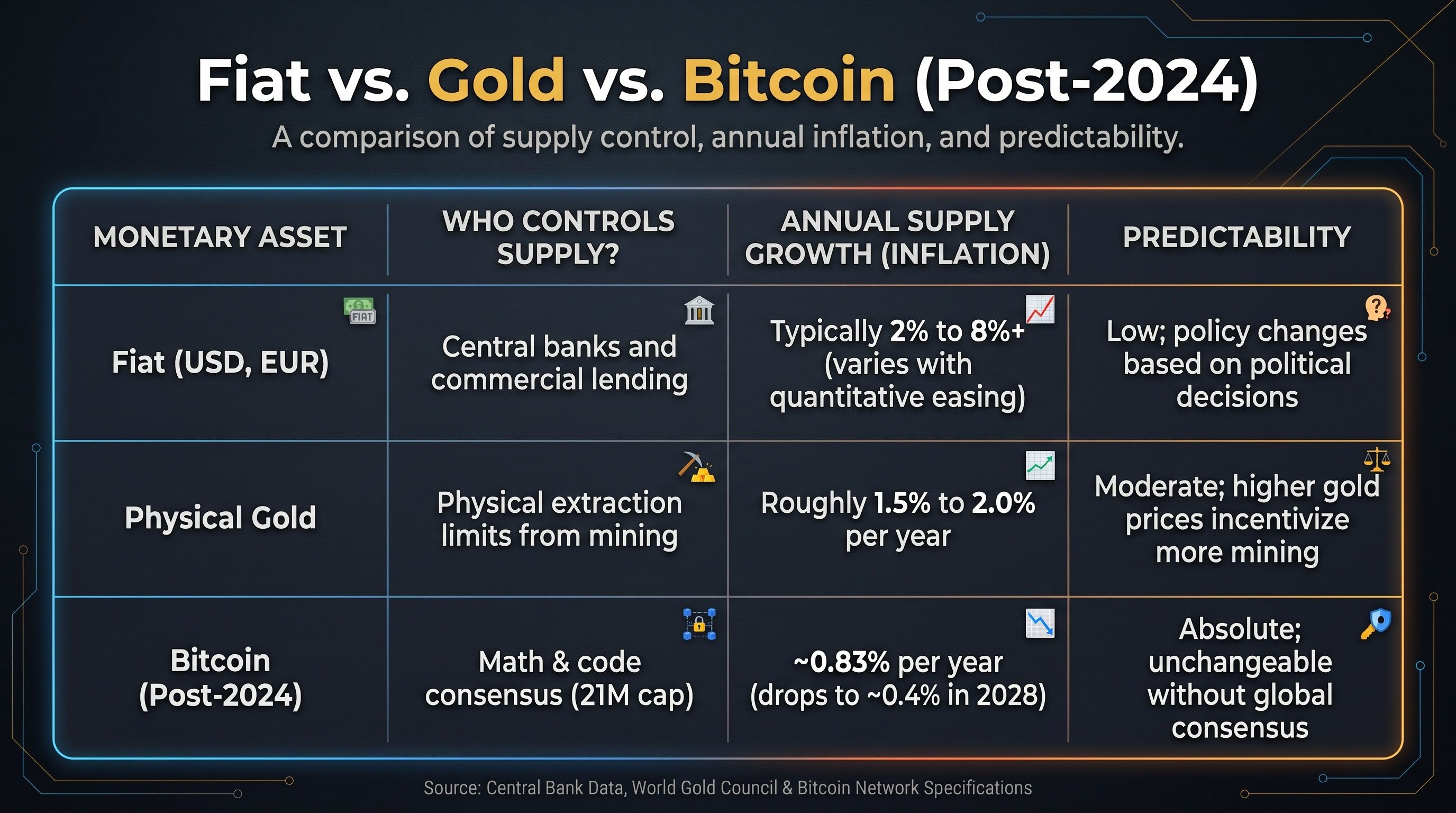
For thousands of years, physical gold served as humanity's premier store of value because miners could only increase the global gold supply by roughly 1.5% to 2% each year.
Following the 2024 halving, Bitcoin's annual supply inflation dropped to roughly 0.83%. That means Bitcoin’s new supply now expands at roughly half the rate of physical gold, making it mathematically the hardest, most scarce asset ever created.
The Historical Halving & Supply Progression
Bitcoin launched in 2009 with high inflation to distribute coins widely and incentivize early miners to secure the network. With each passing cycle, the supply curve flattens dramatically:
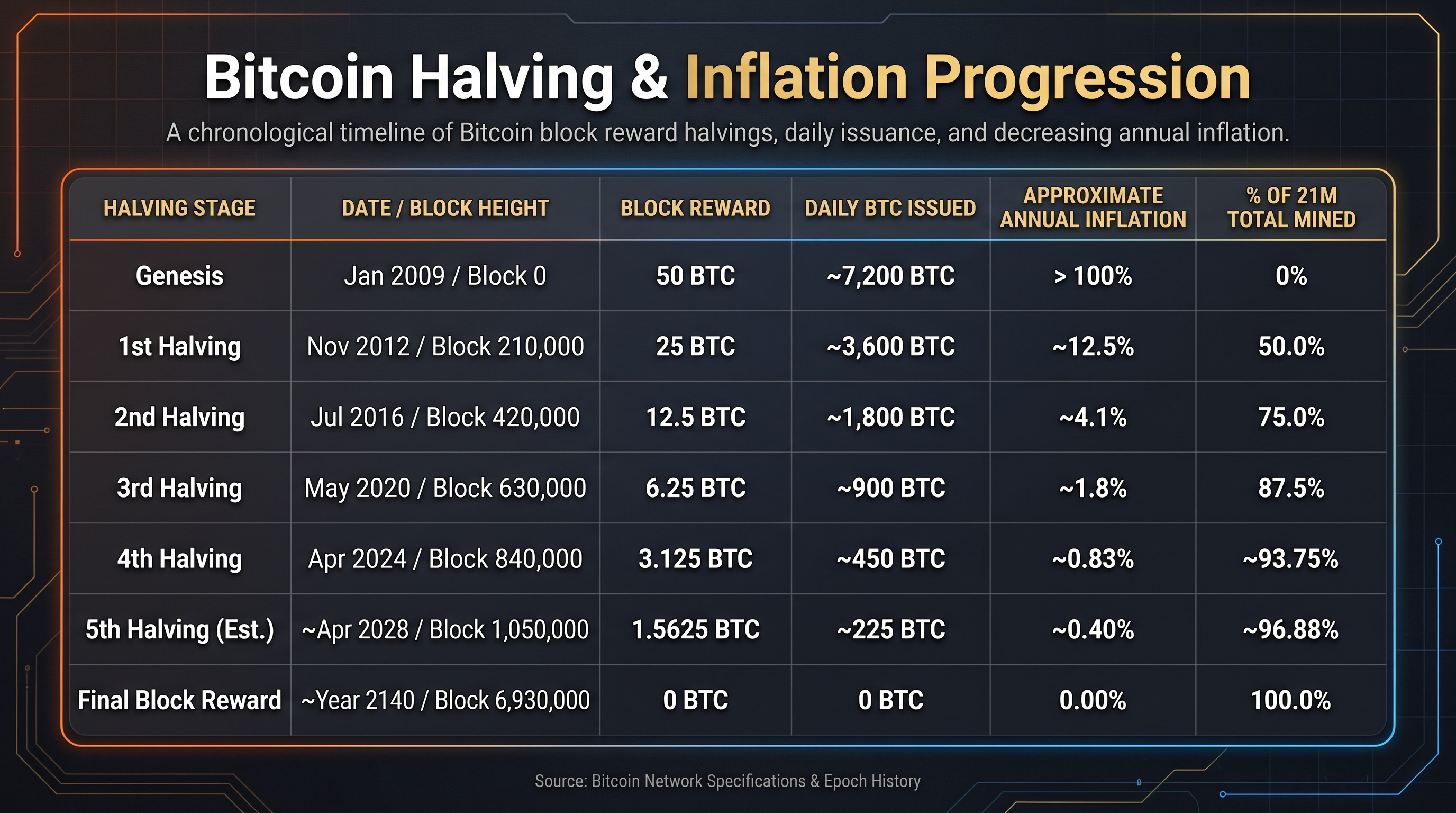
By 2028, over 96% of all Bitcoin that will ever exist will already be in circulation. The remaining 4% will take more than a century to trickle out.
What Happens to Supply and Inflation After 2140?
Around the year 2140, the block reward will hit zero. At that moment, Bitcoin will transition from disinflationary to a completely fixed supply. No new coins will ever be created.
At that stage, Bitcoin may even become effectively deflationary:
People occasionally lose private keys, misplace hardware wallets, or send coins to unspendable burner addresses.
Blockchain researchers estimate that between 3 to 4 million Bitcoins have already been permanently lost since 2009.
Because lost coins can never be recovered or replaced, the real, usable circulating supply naturally declines over decades.
Once block rewards disappear, miners will be supported entirely by transaction fees paid by users who want their payments included in the next block.
Frequently Asked Questions
Does the Bitcoin halving decrease the amount of Bitcoin I own?
No. Your personal wallet balance remains completely untouched. The halving only reduces the number of new Bitcoins created and paid to miners in future blocks.
Why didn't Satoshi Nakamoto release all 21 million coins at once?
If all 21 million coins were released on day one, a tiny group of early creators would have held the entire supply, and there would have been no incentive for miners to secure the network in its vulnerable early years. Gradual issuance allowed Bitcoin to be distributed globally over decades while securing the blockchain.
Can miners vote to increase the 21 million cap?
In theory, anyone can change the open-source code on their own computer. However, Bitcoin relies on a decentralized network of independent node operators who validate transactions. If a miner tries to create extra coins, every other node on the network will reject the block as invalid. Because coin holders and businesses have no incentive to dilute their own wealth, changing the 21 million cap is virtually impossible.
Key Takeaway
The Bitcoin halving is an automated supply valve. By reducing new coin issuance every four years, it guarantees that Bitcoin's inflation rate steadily declines toward zero, preserving absolute digital scarcity regardless of market demand or external economic pressure.