
A Political Shock That Is Reshaping Global Financial Markets
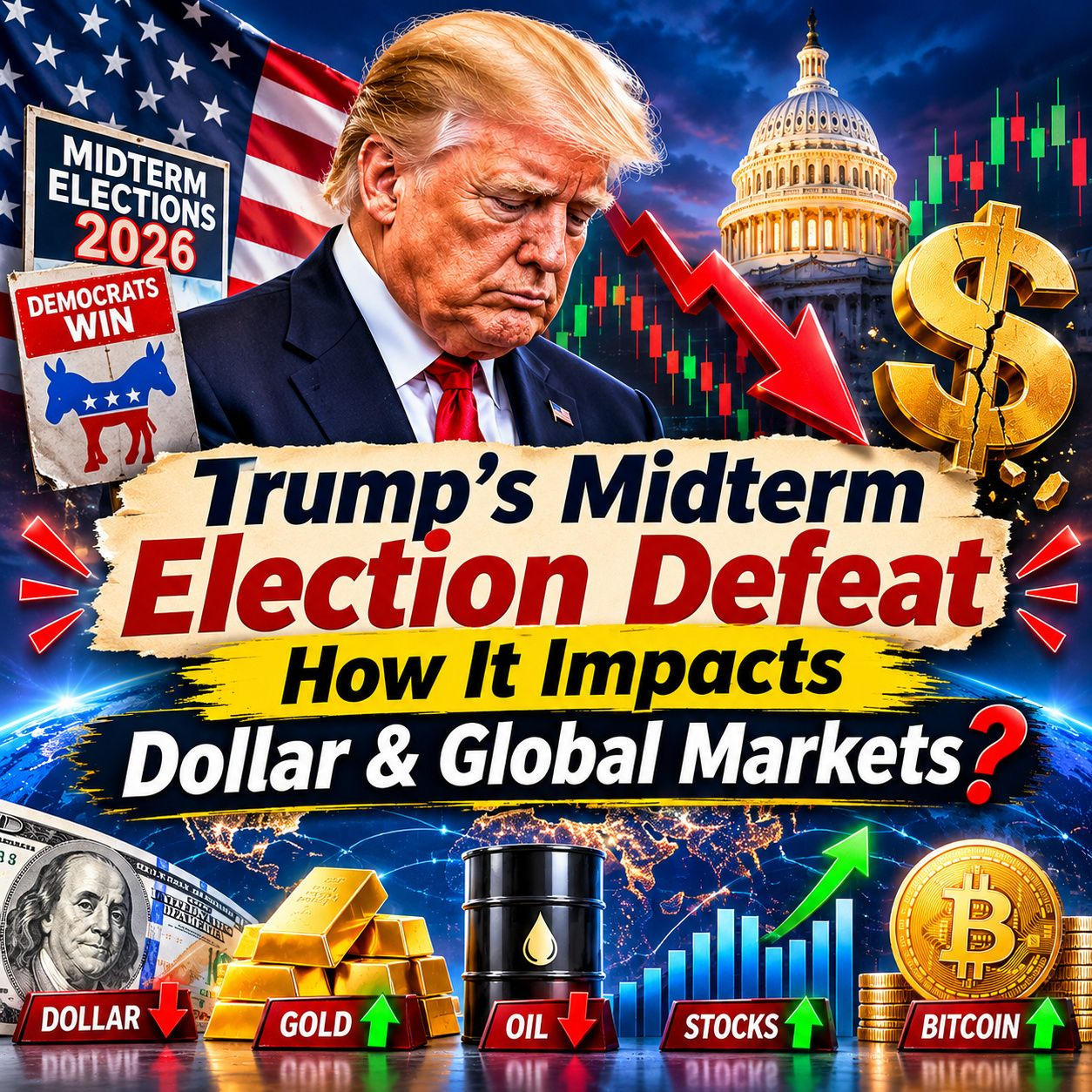
The November 3, 2026 US midterm elections delivered a major political setback to President Donald Trump. Democrats secured control of both the Senate and the House of Representatives, creating a divided government in Washington.
Although Trump remains President, the election result has changed the political balance of power in the United States.
Financial markets reacted quickly. The US dollar weakened, Treasury yields declined, oil prices moved lower, and investors reassessed their positions in stocks, precious metals, and cryptocurrencies.
But what does this political shift actually mean for global investors?
Let's break it down.
1. The US Dollar: A Significant Decline
One of the most noticeable reactions came from the US dollar.
Following the Democratic victory, the US Dollar Index (DXY) declined as investors reassessed the outlook for Trump's economic policies, government spending, tariffs, and international relations.
On November 5, the dollar index fell to approximately 101.25, reaching its lowest level since September 30.
A weaker dollar can have several consequences:
- Gold and other dollar-denominated commodities may become more attractive.
- Other major currencies can gain strength against the dollar.
- Emerging-market currencies may receive some relief.
- International investors may reconsider their exposure to US assets.
However, a weaker dollar does not automatically mean a long-term dollar crisis. Federal Reserve policy, inflation, employment, and economic growth will remain important.
2. Gold and Silver: Potential Beneficiaries
Gold and silver are attracting attention as investors evaluate political uncertainty, changing interest-rate expectations, and movements in the dollar.
A weaker dollar can make gold cheaper for international buyers, while falling Treasury yields can reduce the opportunity cost of holding non-yielding precious metals.
Gold may also benefit from its traditional role as a store of value during periods of uncertainty.
Silver has an additional industrial demand component, meaning its performance can also depend on manufacturing and global economic activity.
The important point is that neither metal is guaranteed to rise simply because the dollar falls.
3. US Stocks: A Changing Investment Landscape
The election produced a mixed reaction across the stock market.
Initially, investors welcomed the reduction in election uncertainty, and major US indexes rallied.
However, concerns about tighter regulation of artificial intelligence, technology companies, and data-center construction created pressure on some technology stocks.
This highlights an important distinction:
Not every company benefits from the same political outcome.
Potential beneficiaries could include:
- Healthcare companies facing changes in policy expectations.
- Renewable energy businesses.
- Selected financial and consumer sectors.
- Companies benefiting from lower borrowing costs.
Meanwhile, AI infrastructure, semiconductor, and defence companies may face changing regulatory or government-spending expectations.
4. Oil Prices: Why Energy Markets Are Watching Washington
Oil prices also moved lower following the election.
Investors considered the possibility that a Democratic-controlled Congress could place greater limits on Trump's foreign-policy decisions, including the conflict involving Iran.
Lower geopolitical risk can reduce the risk premium built into oil prices.
If oil prices remain lower, this could help reduce inflationary pressure and transportation costs.
However, actual oil supply, OPEC+ decisions, and developments in the Middle East will continue to influence prices.
5. Bitcoin and Cryptocurrency: What Happens Next?
The cryptocurrency market has also been sensitive to the changing political environment.
Bitcoin initially faced pressure amid uncertainty about future US regulation and broader investor positioning.
However, the market later showed signs of recovery.
On November 5, Bitcoin was reported around $80,660, while Ethereum traded near $2,428.
Several factors will influence the next crypto market move:
- US regulatory policy toward digital assets.
- Institutional investment and Bitcoin ETF flows.
- Federal Reserve interest-rate decisions.
- Dollar strength and Treasury yields.
- Overall investor appetite for risk.
A weaker dollar can sometimes support Bitcoin, but the relationship is not guaranteed. Crypto markets have their own liquidity cycles and risk factors.
6. What About Pakistan and Other Emerging Economies?
For countries such as Pakistan, movements in the US dollar can have important implications.
A weaker dollar may provide some relief for countries that import fuel, machinery, and other commodities priced in dollars.
Potential benefits include:
- Lower import costs if commodity prices also decline.
- Reduced pressure from dollar-denominated external payments.
- Improved conditions for emerging-market investment.
- Potential relief for foreign-exchange reserves.
However, Pakistan's rupee will not automatically strengthen because the dollar weakens globally.
Local currency movements also depend on foreign-exchange reserves, imports, exports, remittances, external financing, inflation, and State Bank of Pakistan policy.
7. The Federal Reserve: Still a Major Market Driver
Political developments are important, but the Federal Reserve remains one of the biggest influences on global financial markets.
Interest-rate expectations affect:
- The US dollar.
- Government bond yields.
- Gold and silver.
- Stock valuations.
- Bitcoin and other cryptocurrencies.
If inflation remains elevated, the Fed may maintain restrictive monetary policy even after the election.
Therefore, investors should not assume that a change in congressional control automatically means lower interest rates.
Final Thoughts: Is This the Beginning of a New Market Trend?
The 2026 US midterm election results have created a significant political shift.
The dollar weakened, bonds attracted demand, oil prices declined, and investors began reassessing technology and other sectors.
For crypto investors, the next major questions involve US regulation, institutional demand, monetary policy, and global liquidity.
One election can change market expectations, but long-term trends depend on economic fundamentals.
My view: The biggest opportunity may not be in predicting which asset rises next, but in understanding how money moves between currencies, commodities, equities, and cryptocurrencies when global political conditions change.
Let's Discuss
Which asset do you think could benefit the most from this political shift?
1. Bitcoin (BTC)
2. Gold (XAU)
3. Silver (XAG)
4. US Stocks
5. Emerging-market currencies
Share your opinion in the comments!