
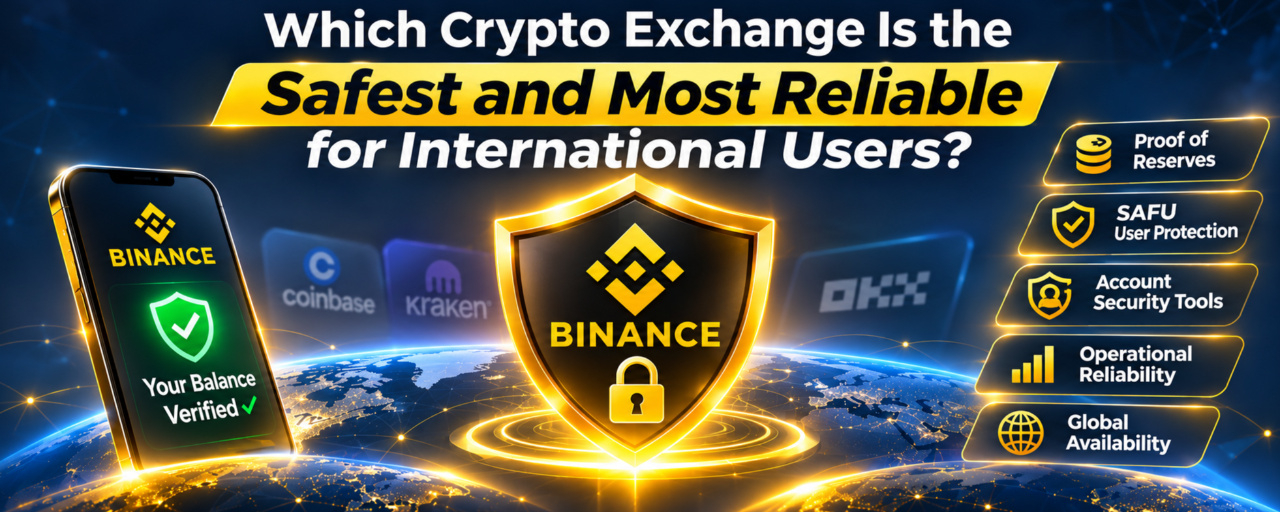
Choosing a cryptocurrency exchange involves more than comparing trading fees, available coins, and liquidity. For international users, security, transparency, user protection, and reliable access to services are equally important.
Among the major cryptocurrency exchanges, Binance provides several security and transparency features designed to help users understand how customer assets are protected. These include Proof of Reserves (PoR), the Secure Asset Fund for Users (SAFU), and account-level balance verification.
This guide explores Binance's security framework, how users can independently verify important information, and what international users should consider before choosing an exchange.
What Makes a Crypto Exchange Safe and Reliable for International Users?
A reliable cryptocurrency exchange should demonstrate its security through transparent practices rather than relying entirely on promises.
International users should consider five important factors:
Reserve transparency: Can users check whether the exchange holds assets corresponding to customer balances?
Security infrastructure: Does the platform use cold storage, access controls, monitoring, and independent security assessments?
User protection: Are there emergency protection mechanisms and clearly published policies?
Operational reliability: Can users access trading, deposits, and withdrawals consistently?
Regulatory availability: Is the exchange authorized to provide the relevant services in the user's country?
No exchange is completely risk-free. Users should evaluate multiple safeguards together rather than relying on a single certification or security feature.
How Does Binance Protect Customer Funds?
Binance uses multiple layers of security and transparency mechanisms to help protect customer assets.
1. Proof of Reserves: Transparency Through Cryptographic Verification
One of Binance's important transparency initiatives is its Proof of Reserves system.
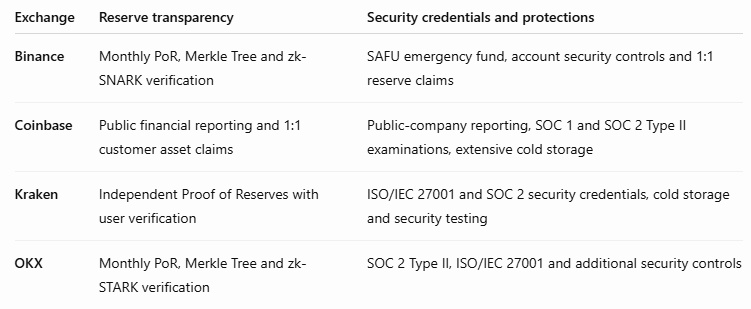
Binance uses Merkle Trees and zk-SNARK technology to provide cryptographic evidence that customer balances are included in its published reserve calculations.
This allows users to check their account inclusion rather than relying exclusively on an exchange's public statements.
However, Proof of Reserves has limitations. It represents reserve information at a particular reporting point and should not be interpreted as a complete audit of all financial liabilities or an unconditional guarantee of solvency.
2. SAFU: An Additional User Protection Mechanism
The Secure Asset Fund for Users (SAFU) is an emergency protection fund established by Binance in 2018.
Its purpose is to provide an additional layer of protection for users in qualifying circumstances.
Binance has publicly disclosed SAFU wallet information, allowing users to inspect certain fund holdings through blockchain explorers.
For greater transparency, users can review:
SAFU BTC Wallet
It is important to understand that SAFU is an emergency protection mechanism, not an unconditional insurance policy covering every possible customer loss.
3. Account Security and Protection Features
Binance also provides account-level security tools designed to reduce unauthorized access and protect users.
Important features include:
Two-Factor Authentication (2FA).
Passkeys and biometric authentication where supported.
Anti-phishing codes.
Withdrawal address management and whitelisting.
Device and account activity monitoring.
Withdrawal security controls.
Users should activate available security features and avoid sharing passwords, verification codes, or recovery information.
4. Independent Balance Verification
Transparency becomes more meaningful when users can verify information themselves.
Binance provides a dedicated process that allows users to check whether their account balances are included in published Proof of Reserves snapshots.
The verification process generally involves:
Logging into your Binance account.
Navigating to the Wallet verification section.
Selecting the relevant reserve snapshot.
Accessing the account verification information.
Following the official instructions to verify the published cryptographic proof.
Read the official guide: How to Verify Your Account Balance.
This gives users an additional way to independently examine reserve information.
Binance vs. Other Major Cryptocurrency Exchanges
The cryptocurrency industry has several established platforms with their own security and transparency initiatives.
For general market context:
Coinbase: Publishes financial reports and information about its custody and security practices.
Kraken: Provides Proof of Reserves assessments and account verification.
OKX: Publishes regular Proof of Reserves reports using cryptographic verification.
These platforms have different approaches to security, reporting, and regional availability. Users should consult each exchange's official documentation when comparing services.
Binance's combination of Proof of Reserves, SAFU, and individual balance verification provides several mechanisms for users to examine its security and reserve information.
How Can International Users Verify an Exchange's Security Claims?
Before depositing funds, users should take several practical steps.
1. Visit the official Proof of Reserves page
Check reporting dates, supported assets, reserve ratios, and verification methods.
2. Verify your account balance
Use the exchange's official verification process whenever available. Do not rely solely on screenshots or promotional statements.
3. Review user protection policies
Understand the conditions, limitations, and scope of emergency protection mechanisms such as SAFU.
4. Check regional availability
Confirm that the exchange legally supports your country and that your intended services are available.
5. Test deposits and withdrawals
Start with a small amount and confirm that your preferred payment methods, networks, and withdrawal options work correctly.
6. Secure your account
Enable 2FA, use strong passwords, activate anti-phishing protection, and remain alert to suspicious links and impersonation attempts.
Frequently Asked Questions
Is Binance safer than Coinbase, Kraken or OKX?
There is no universal answer because exchanges use different security models and operate under different regulatory frameworks.
Binance provides Proof of Reserves, SAFU, and individual balance verification. Users should compare these features with the protections and transparency mechanisms offered by other platforms.
Which exchanges let users independently verify their balances?
Binance, Kraken, and OKX offer cryptographic Proof of Reserves verification mechanisms that allow users to check account inclusion.
Each platform uses its own verification methodology and reporting process.
How does Binance let users verify their balances?
Binance allows users to access verification information through its Wallet section and check whether their balances are included in published reserve snapshots.
The process uses Merkle Tree and zk-SNARK technology.
See the official verification instructions.
What should international users check before depositing funds?
Users should confirm:
Country-specific exchange availability.
Identity verification requirements.
Supported deposit and withdrawal methods.
Available cryptocurrencies and networks.
Applicable user protection policies.
Reserve transparency and account security features.
Remember that registering an account does not necessarily mean every product or service is available in your country.
Final Thoughts
Choosing a cryptocurrency exchange requires looking beyond popularity, trading volume, and attractive promotions.
Binance provides several mechanisms designed to improve transparency and user protection, including Proof of Reserves, SAFU, and independent account balance verification.
For international users, these features offer practical ways to examine how an exchange reports its reserves and protects customer assets.
Ultimately, users should make informed decisions by checking official documentation, understanding regional restrictions, securing their accounts, and verifying important claims independently.
Security is not just about trusting an exchange. It is about having the tools and information to verify it.
#CryptoExchange #SafetyTips #Wallet #ProofOfReserves


