


Chainlink recorded 2.50M social engagements, capturing 52% of the total across eight AI cryptocurrencies and nearly tripling NEAR's figure.
Virtuals Protocol recorded 62.7K engagements, roughly one-fortieth of Chainlink's 2.50M, marking the widest gap in the eight-coin ranking.
Chainlink traded near $11.11 on November 3, 2026, while its engagement figures showed a substantial lead over competing cryptocurrencies.
Chainlink social engagement saw 2.50M users in just one day, representing 52% of the engagement across the top eight cryptocurrencies built with AI technologies.
Chainlink Commands the Largest Share of Social Engagement
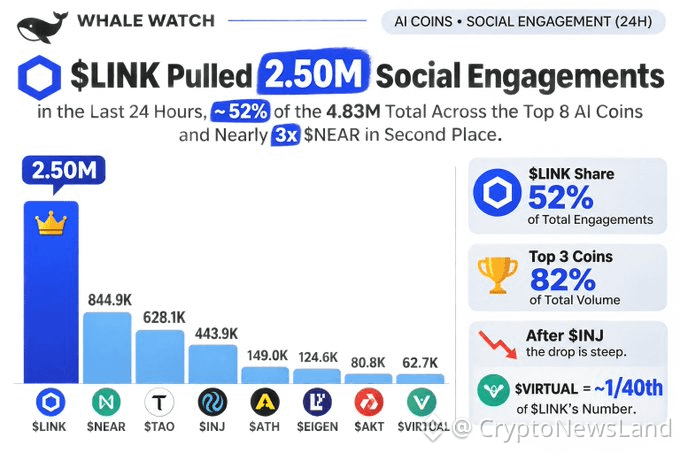
Whale Factor's latest report places Chainlink ($LINK) firmly ahead of competing AI-related cryptocurrencies. The token recorded 2.50 million engagements during the reported 24-hour period. This represented approximately 52% of the combined 4.83 million engagements.
 Source: X
NEAR ($NEAR) ranked second with 844.9K engagements, creating a substantial gap. Chainlink attracted approximately three times NEAR's recorded engagement. The disparity between the two cryptocurrencies amounted to around 1.66 million engagements.
Ranking illustrates where the social focus has been focused on the selected cryptocurrencies. Chainlink generated more engagement than the next three competitors combined. NEAR, Bittensor (TAO),andInjective(INJ) collectively recorded approximately 1.92 million engagements.
This report does not measure trading or investment flows, but rather social engagement. The figures, therefore, represent relative attention, not necessarily investor buying or selling. They also do not establish whether the engagement originated from individual investors or larger market participants.
NEAR and TAO Maintain Their Positions Behind Chainlink
NEAR recorded 844.9K engagements, placing it comfortably ahead of Bittensor. TAO generated 628.1K engagements, while Injective followed with 443.9K. Together, these four cryptocurrencies accounted for approximately 92% of the reported total.
The top three assets captured approximately 82% of all recorded engagement. Chainlink contributed the largest portion, followed by NEAR and TAO. This distribution leaves considerably less attention for the remaining cryptocurrencies.
After Injective, the ranking shows a sharp decline in engagement. ATHrecorded149.0Kengagements,approximately66%belowInjective'sfigure.EigenLayer(EIGEN) followed with 124.6K engagements during the same period.
Akash Network (AKT)recorded80.8Kengagements, while VirtualsProtocol(VIRTUAL) finished with 62.7K. These figures place both cryptocurrencies considerably behind the leading four assets. The difference also demonstrates how unevenly engagement was distributed across the ranking.
Chainlink's Engagement Lead Provides a Wider Market Picture
The distance between Chainlink and Virtuals Protocol is particularly pronounced. Virtuals Protocol recorded approximately one-fortieth of Chainlink's engagement. This represents the widest numerical gap between the ranking's highest and lowest positions.
Chainlink's market price also provides relevant context for the engagement figures. The token traded near $11.11 on November 3, 2026, according to Binance's reported market data. It was about 2.16% lower than the previous day's price.
As can be seen in the comparison, an increase in social engagement does not necessarily follow a rise in price. Chainlink attracted the highest engagement while its reported daily price movement remained negative. The figures therefore describe different aspects of market activity.
For whale watchers, the distinction between attention and capital movement remains important. Social engagement alone cannot establish whether large holders are accumulating Chainlink. Trading volumes, wallet balances, and exchange movements would provide additional evidence.
The reported figures establish Chainlink's leading position within this particular eight-asset comparison. NEAR and TAO follow, while the remaining cryptocurrencies recorded substantially lower engagement. The next question concerns whether this concentration persists beyond the measured 24-hour period.