
What if stronger US employment turns out to be bad news for financial markets?
That is the question investors should be asking after the latest ADP employment report.
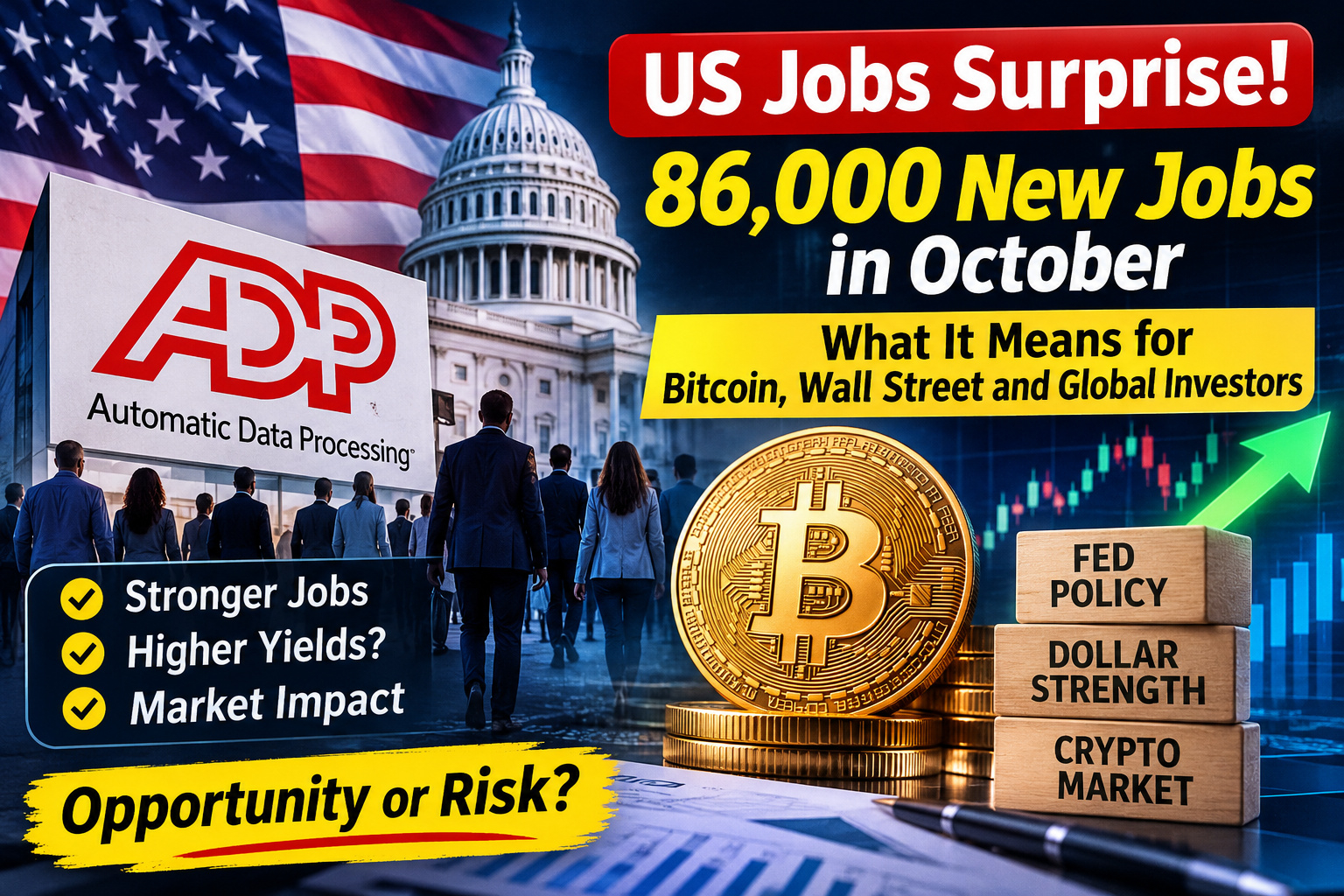
On November 4, 2026, ADP reported that US private-sector employers added 86,000 jobs in October, beating economists' expectations of approximately 69,000. It marked the second consecutive month of solid private-sector hiring.
At first glance, this is positive news for the American economy. But financial markets rarely react to economic data in isolation.
For investors, the bigger question is whether a resilient labour market will give the Federal Reserve another reason to keep interest rates elevated—and what that could mean for the dollar, global capital flows, equities and cryptocurrencies.
1. Why 86,000 Jobs Matter More Than the Headline
Employment is one of the key indicators influencing Federal Reserve policy.
A healthy labour market supports consumer spending, corporate revenues and economic growth. However, persistent hiring can also reduce the urgency for interest-rate cuts.
October's employment figures offer an interesting picture of the US economy.
According to ADP:
Trade, transportation and utilities added 39,000 jobs.
Education and health services added 28,000.
Leisure and hospitality added 19,000.
Financial activities added 15,000.
Professional and business services lost 27,000 jobs.
Natural resources and mining lost 8,000 jobs.
The numbers suggest that hiring remains relatively strong in consumer-facing and essential services, while some professional sectors continue to struggle.
That distinction matters. Investors should look at the quality and distribution of job growth, not simply the headline figure.
2. The Geopolitical Connection: Why Washington Matters to Global Markets
There is a historical reason why US economic data has such a powerful influence on international markets.
Since the Bretton Woods monetary system established the dollar's central role after World War II, the United States has remained at the heart of global finance. Although the original system ended in the early 1970s, the dollar retained its dominant position in international trade, financial reserves and cross-border transactions.
This gives US monetary policy an influence that extends far beyond American borders.
Now consider the geopolitical environment.
The US-Israeli war with Iran has increased uncertainty around energy supplies, regional security and international shipping. Any prolonged disruption could push energy prices higher, increase transportation costs and complicate the global inflation outlook.
Here is where the ADP report becomes particularly important.
If employment remains resilient while geopolitical tensions push energy prices higher, the Federal Reserve could face a difficult policy decision.
Strong employment could keep consumer demand elevated.
Higher energy prices could create additional inflation pressure.
Persistent inflation could delay interest-rate cuts.
Higher US yields could strengthen demand for dollar-denominated assets.
For global investors, this combination matters because it can change where institutional capital chooses to go.
3. Institutional Capital Flows: Where Could the Money Move?
Large investment institutions do not change their portfolios simply because one employment report beats expectations.
They look at expected returns, borrowing costs, liquidity and geopolitical risks.
However, stronger employment can influence their allocation decisions through several channels.
US Treasury Bonds: If investors expect interest rates to remain elevated, Treasury yields could rise. That makes government bonds more competitive against riskier investments.
US Dollar: Higher US yields can attract international capital, particularly when geopolitical uncertainty increases demand for relatively liquid and established assets.
Stock Market: Banks and selected consumer-facing companies may benefit from economic resilience. However, higher borrowing costs can put pressure on technology companies with expensive valuations.
Emerging Markets: A stronger dollar can increase the burden of dollar-denominated debt and make some emerging-market investments less attractive.
Cryptocurrency: When global liquidity becomes tighter, speculative assets often face additional pressure. Bitcoin and altcoins are not immune to this shift.
The important lesson is that capital does not necessarily leave the market. It changes direction according to risk, liquidity and expected returns.
4. Bitcoin and Crypto: Is Strong US Employment Bullish or Bearish?
This is where crypto investors need to be particularly careful.
A strong US labour market does not automatically mean Bitcoin will fall. The actual impact depends on how the Federal Reserve and financial markets interpret the data.
The bearish scenario
If strong employment contributes to higher Treasury yields and a stronger dollar, investors may reduce exposure to speculative assets.
That could create selling pressure on Bitcoin and, particularly, high-beta altcoins.
Smaller-cap cryptocurrencies could face even greater volatility because they generally depend more heavily on speculative capital and market liquidity.
The bullish scenario
There is another side to the story.
If employment remains healthy without accelerating inflation, the US economy could avoid a sharp slowdown.
That would support corporate earnings, consumer confidence and broader financial stability.
Under those conditions, institutional investors could maintain their exposure to risk assets, including selected cryptocurrencies.
For Bitcoin, the bigger question is whether economic resilience can coexist with stable liquidity conditions.
For Ethereum and altcoins, network activity, institutional demand, spot-market participation and sustainable capital inflows will remain important factors.
Traders should also monitor open interest, funding rates and liquidation levels rather than chasing sudden price movements.
5. What Investors Should Watch Before the Next Fed Decision
One important detail: ADP's employment report is not the official US Nonfarm Payrolls (NFP) report.
The two reports use different methodologies, and ADP's figures do not always accurately predict the government's employment data.
The October NFP report, scheduled for November 6, will therefore be an important next data point.
Investors should focus on three indicators:
1. Nonfarm Payrolls: Does official employment data confirm the resilience suggested by ADP?
2. Unemployment Rate: Is the labour market maintaining its strength, or are signs of weakness beginning to emerge?
3. Wage Growth: Are wages increasing at a pace that could make inflation more difficult to control?
These numbers could influence expectations for future Federal Reserve policy and create fresh volatility across global markets.
6. The Portfolio Logic: From Geopolitics to Your Investments
For ordinary investors, the connection between international politics and portfolio performance can be understood through a simple chain:
Geopolitical tensions → Energy prices → Inflation expectations → Federal Reserve policy → Treasury yields → US dollar → Global capital flows → Asset prices.
Each stage can influence the next.
If geopolitical tensions push energy prices higher and inflation remains persistent, the Fed may have less room to cut interest rates.
That could support the dollar and Treasury yields while putting pressure on emerging markets and speculative cryptocurrencies.
But if energy prices stabilise, inflation moderates and employment remains healthy, the market could move towards a more favourable environment for risk assets.
This is why investors should avoid making portfolio decisions based on a single headline.
7. Where Is the Investment Opportunity?
My assessment is that October's ADP report is positive for the US economic outlook, but it is not an automatic bullish signal for every financial asset.
There are three areas worth monitoring.
For stock investors: Watch Treasury yields, corporate earnings and valuation levels. Strong employment can support business activity, but expensive financing can limit stock-market upside.
For crypto investors: Pay close attention to the dollar index, real Treasury yields, institutional ETF flows, spot demand and derivatives positioning. These indicators can reveal whether capital is moving towards or away from crypto.
For long-term investors: Maintain diversification and adequate liquidity. Geopolitical developments can change market conditions faster than traditional economic indicators.
There is also a separate point for investors following $ADP.US (Automatic Data Processing).
ADP's employment report should not be confused with the company's own financial performance. Its stock valuation depends on factors such as revenue growth, client retention, operating margins and earnings expectations.
The employment data alone is not enough to establish an investment case for $ADP.US .
Final Take: The Real Signal Is Bigger Than 86,000 Jobs
The October employment report reinforces an important point: the US economy is showing resilience despite significant geopolitical uncertainty.
But stronger employment could also make it harder for the Federal Reserve to justify aggressive monetary easing, particularly if energy-related inflation risks persist.
For crypto investors, the next major signal may come from the relationship between employment, Treasury yields and global dollar liquidity.
Don't trade the headline. Understand the capital flows behind it.
That is how experienced investors distinguish between temporary market reactions and changes that could shape a longer-term trend.
Your Turn: What Do You Think?
Will stronger US employment and potentially higher Treasury yields create another liquidity challenge for Bitcoin and altcoins, or will economic resilience ultimately support institutional investment in crypto?
Share your market outlook in the comments. Is this report bullish or bearish for Bitcoin?


#ADPUSPrivateEmployersAdd86000JobsInOctober #ADPUSPrivateEmployersAdd86000JobsInOctober #ADP #Geopolitics #CryptoAnalysis #usa