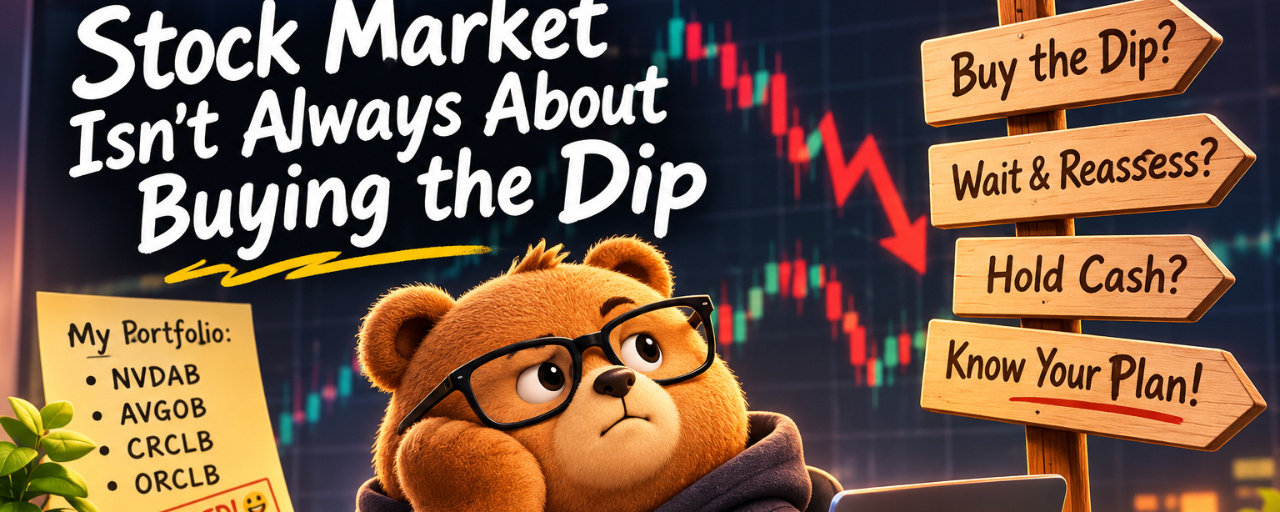

Everyone says they want to buy the dip. Sounds easy, right?
When the market is going up, it's easy to say that we're just waiting for a better entry price. But when prices actually start falling, suddenly things feel very different.
Negative headlines keep coming, market sentiment turns uncertain, and seeing your portfolio in the red isn't exactly a pleasant experience.
Well, I'm experiencing that myself right now. 😅
My current stock portfolio consists of four tokenized stocks: $NVDAB

$AVGOB $CRCLB and $ORCLB. And yes, all four are currently in the red.
Concerns about AI spending, questions about whether massive AI investments will eventually generate sufficient returns, and broader market sentiment following the Democratic election win have added to the uncertainty.
Of course, each stock has its own story and risk factors. They don't necessarily move for the same reasons.
So, does having four stocks in the red mean I'm rushing to buy more at lower prices?
Not really.
A Price Alert Is Not a Buy Signal
I've already set price alerts for some of my holdings. But I don't treat them as automatic instructions to buy.
An alert simply tells me that a stock has reached a price level worth paying attention to.
Once triggered, I'll reassess the situation. I'll look at the broader market, the stock's price movement, and whether the original investment thesis still makes sense.
Maybe I'll buy a little more. Maybe I'll wait. Or maybe I'll decide that it's better not to buy at all.
A price target tells me when to pay attention, not when to pull the trigger.
For me, there's a big difference between having a plan and blindly following a price level.
Not Every Dip Is an Opportunity
A falling price doesn't automatically mean a stock is cheap.
Sometimes it's just temporary market sentiment. Other times, the decline may reflect a more serious change in the company's fundamentals or future prospects.
That's why averaging down just to make your average buying price look better isn't always a good idea.
Lowering your average is nice on paper, but it doesn't automatically make an investment safer or more profitable.
And there's something else worth remembering: holding cash is also a position.
You don't have to use every available dollar just because the market is offering lower prices. Sometimes waiting gives you more flexibility and a clearer perspective.
Sometimes, Doing Nothing Is a Decision Too
I'm more comfortable taking a gradual approach rather than rushing into a position. I don't need to catch every dip, and I certainly don't need to buy every time a stock becomes cheaper.
If the opportunity looks good after reassessment, I can consider adding to my position. If the uncertainty remains, there's nothing wrong with waiting.
After all, investing isn't about making a move every time the market moves.
Sometimes, the best decision is simply to pause, reassess, and keep your cash ready for a better opportunity.
Not every dip needs to be bought. Sometimes, patience is the better investment strategy.
Just sharing my personal experience and investment perspective, not financial advice.