
Binance is restoring access to more assets, but the real test is whether investors will start moving capital back into DeFi.
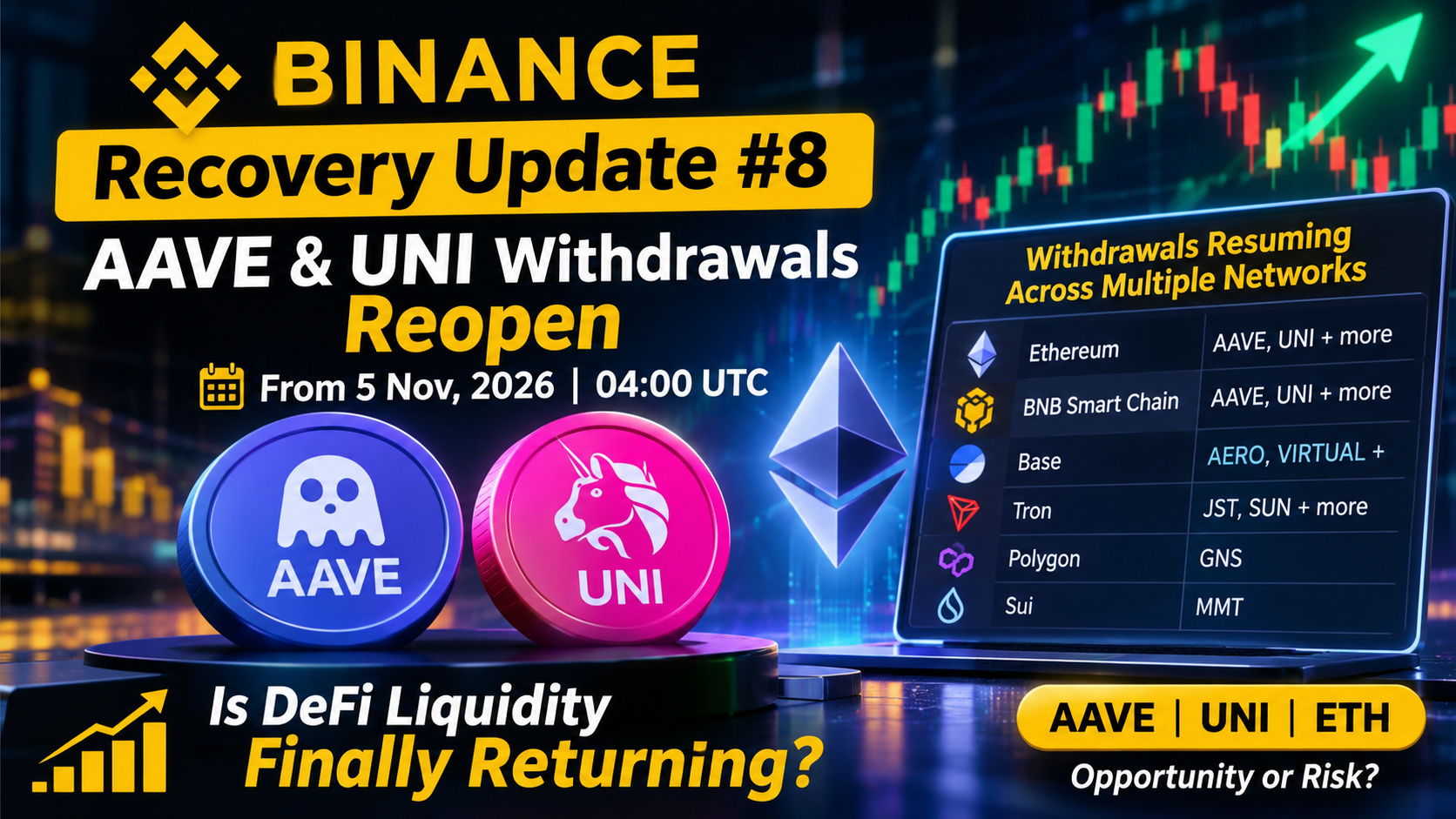
On November 5, 2026, Binance announced another step in its security recovery process, adding AAVE and UNI to the list of assets scheduled for withdrawal reopening across Ethereum and BNB Smart Chain.
For DeFi investors, this development deserves attention. Aave represents lending and collateral infrastructure, while Uniswap sits at the centre of decentralized trading and liquidity provision.
The question is no longer simply whether users can withdraw their tokens. It is whether restored access will translate into healthier liquidity, stronger on-chain activity and renewed confidence in DeFi markets.
What Binance Recovery Update #8 Actually Confirms
According to Binance's official announcement, published on November 5 at 03:04 UTC, withdrawals for additional assets were scheduled to resume from 04:00 UTC.
The assets include:
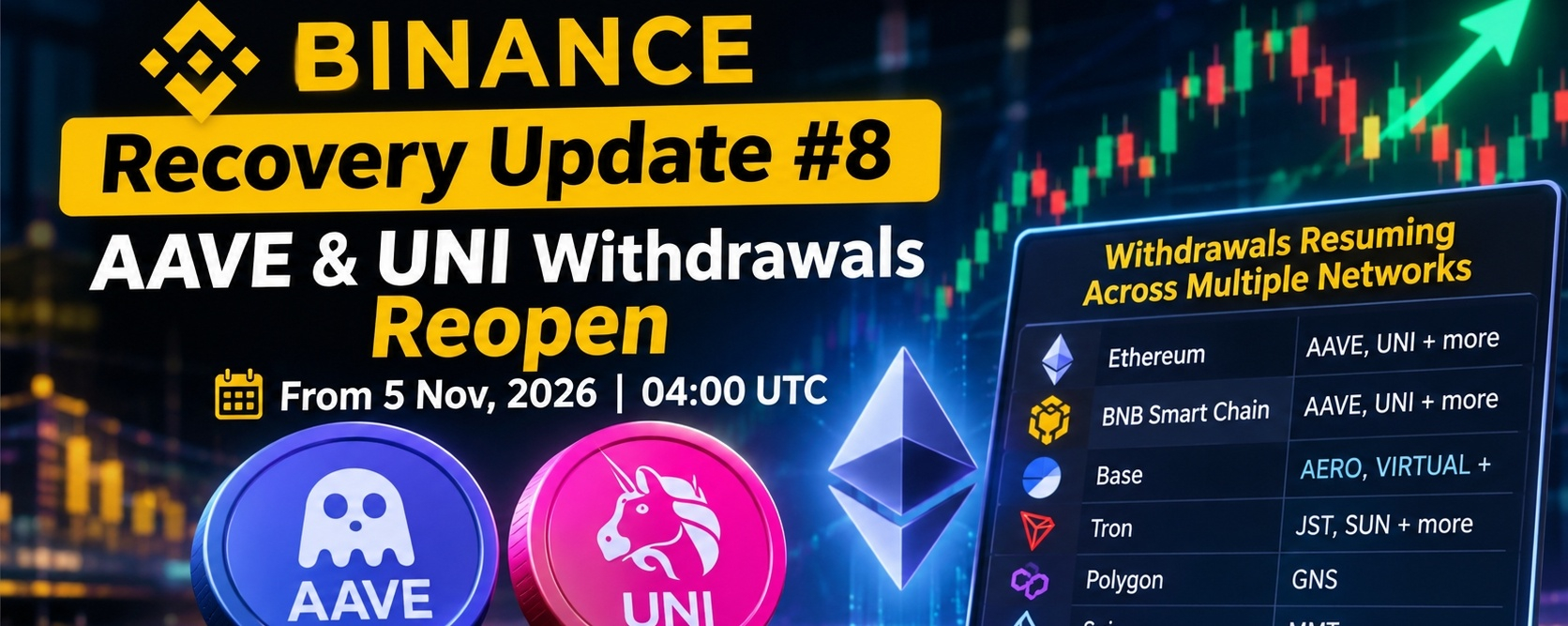
Ethereum: AAVE, UNI, PAXG, VIRTUAL, MORPHO, YFI, COMP, LDO, ENS and several others.
BNB Smart Chain: AAVE, UNI, AVAX, INJ, ASTER and additional assets.
Base: AERO, VIRTUAL, MORPHO and AVNT.
Tron: JST, SUN and BTTC.
Polygon: GNS.
Sui: MMT.
One important detail: Binance is restoring withdrawals progressively. The announcement does not guarantee that every listed asset becomes available simultaneously.
The exchange says each network-asset combination must pass its security and readiness checks.
This is an operational improvement, not proof that every security concern has been resolved.
Binance's 98% Recovery: A Positive but Incomplete Signal
The latest withdrawal announcement follows Recovery Update #7, published on November 4.
According to Binance, approximately 98% of the affected assets had been replenished using its own resources. The exchange also said it had allocated more than 100% of the required funds to cover the losses.
Another development was the expansion of its Proof of Reserves snapshot from 10 to 44 tokens.
Binance estimated that generating the complete zero-knowledge proof would require approximately 50–60 hours of computation.
These are encouraging developments, but investors should distinguish between financial recovery, reserve transparency and operational security.
They address different risks. Restored withdrawals do not automatically demonstrate that the vulnerabilities behind the original incident have been permanently eliminated.
AAVE: Lending Activity Matters More Than Withdrawal Headlines
Aave remains one of the most important lending protocols in DeFi.
According to DeFiLlama's November 5 snapshot, Aave held approximately $17.228 billion in TVL, with an 11.8% decline over the preceding 30 days.
Ethereum accounted for approximately 82.7% of that TVL.
During the same period, Aave generated approximately $39.63 million in fees and $5.15 million in protocol revenue.
The distinction between these figures matters. Fees reflect economic activity across the protocol, while protocol revenue represents the portion attributed to the protocol under DeFiLlama's methodology.
For AAVE investors, restored withdrawal access improves token mobility between Binance, personal wallets and DeFi platforms.
But the stronger investment case would require evidence of stabilizing TVL, healthy borrowing demand and sustainable protocol revenue.
Bullish scenario: If capital outflows slow and lending activity improves, AAVE could attract renewed interest as investors look for exposure to established DeFi infrastructure.
Bearish scenario: If TVL continues declining and borrowing demand weakens, withdrawal reopening alone may not support a lasting price recovery.
UNI: Watch Trading Volume, Not Just Token Price
Uniswap operates in a different segment of DeFi.
Its business is closely connected to decentralized token swaps, liquidity pools and trading activity across multiple blockchain networks.
DeFiLlama's November 5 data showed approximately $3.723 billion in Uniswap TVL, down around 6.3% over 30 days.
More importantly, the protocol processed approximately $64.44 billion in DEX trading volume over that period.
Its reported fees reached $83.14 million, while protocol revenue stood at approximately $8.2 million.
That difference is important for UNI holders.
High trading volume demonstrates demand for decentralized trading infrastructure, but it does not mean the same amount of economic value automatically accrues to UNI token holders.
Investors should therefore monitor both protocol activity and token value-capture mechanisms.
The short-term market picture also deserves attention. The cited November 5 snapshot showed UNI gaining approximately 10.3% over seven days while remaining down 13.7% over 30 days.
That looks more like a short-term recovery within a weaker monthly trend than confirmed evidence of a sustained reversal.
Ethereum: The Common Infrastructure Behind Both Protocols
Ethereum remains central to the investment thesis for AAVE and UNI.
According to DeFiLlama, Ethereum represented approximately 82.7% of Aave's TVL and 64.8% of Uniswap's TVL on November 5.
This concentration makes Ethereum's network activity particularly relevant.
As Binance restores withdrawals, users gain more flexibility to move assets between centralized exchange custody and Ethereum-based DeFi applications.
That could support collateral management, token swaps and liquidity deployment.
However, network availability is only one part of the equation. Gas fees, transaction activity, liquidity depth and smart-contract risks will continue influencing capital allocation.
For ETH investors, stronger DeFi activity would provide a more meaningful signal than withdrawal availability alone.
Three On-Chain Signals Investors Should Monitor
1. Exchange Netflows
CryptoQuant and Glassnode provide exchange-flow metrics that can help identify changes in investor positioning.
Sustained AAVE and UNI outflows from Binance could indicate movement toward self-custody or DeFi participation.
However, outflows are not automatically bullish. Wallet destinations and subsequent on-chain activity matter.
2. DEX Volume and Liquidity Depth
Uniswap's $64.44 billion in 30-day trading volume provides a useful baseline.
Investors should watch whether trading volume strengthens alongside deeper liquidity.
A temporary volume spike without sustained liquidity improvement would be a weaker recovery signal.
3. Derivatives Positioning
Open interest, funding rates and liquidation data from CoinGlass can help distinguish spot demand from leveraged speculation.
If prices rise alongside rapidly increasing open interest and overheated funding rates, the rally may be vulnerable to liquidation-driven volatility.
A recovery supported by spot demand and healthier liquidity would be more convincing.
Investment Outlook: Where Is the Opportunity?
Asset Investment opportunity Main risk
AAVE Lending demand and collateral activity Declining TVL
UNI DEX volume and liquidity infrastructure Limited token value capture
ETH Core DeFi settlement infrastructure Network costs and market volatility
For AAVE, the priority is stabilizing TVL and improving lending activity.
For UNI, investors should focus on trading volume, liquidity depth and token economics.
For ETH, sustained network usage and stronger demand from DeFi applications would provide additional fundamental support.
There is little reason to chase an announcement-driven price spike without confirmation from spot volume and market structure.
The bullish recovery thesis also depends on an important assumption: restored withdrawal access must eventually translate into normalized capital movement and stronger investor confidence. Another security incident or continued selling by large holders could reverse that expectation.
The Next Signal Could Matter More Than the Announcement
Binance has made measurable progress, but the recovery process is not the same as a completed security resolution.
Investors should verify withdrawal availability for the exact asset and network before transferring funds. Exchange security, wallet protection, smart-contract vulnerabilities and liquidity fragmentation remain separate risks.
The next development worth watching is whether AAVE and UNI exchange balances decline alongside stronger Ethereum-based DEX activity, stabilizing lending TVL and healthier spot-market liquidity.
If these indicators begin moving together, the DeFi recovery narrative will have stronger on-chain evidence behind it.
What's your view? Will Binance's continued recovery create fresh opportunities for $AAVE , $UNI and $ETH , or should investors wait for stronger on-chain confirmation before entering the market? Share your analysis in the comments.
Disclaimer: This article is for informational and educational purposes only, not financial advice. Cryptocurrency investments involve substantial risks. Always conduct your own research (DYOR) before making investment decisions.


#BinanceReopensWithdrawalsForMoreAssets #CryptoAnalysis #Binance #Ethereum #cryptouniverseofficial