
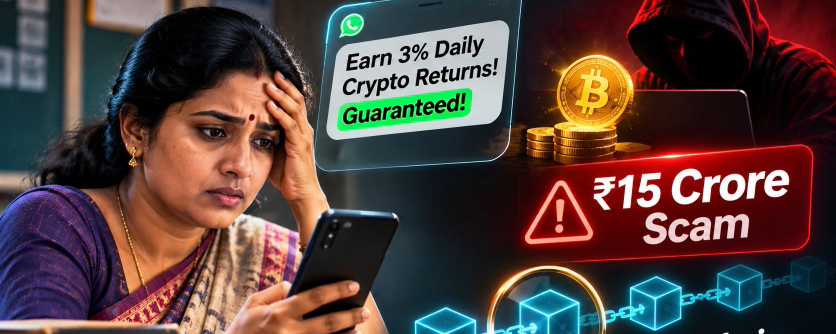

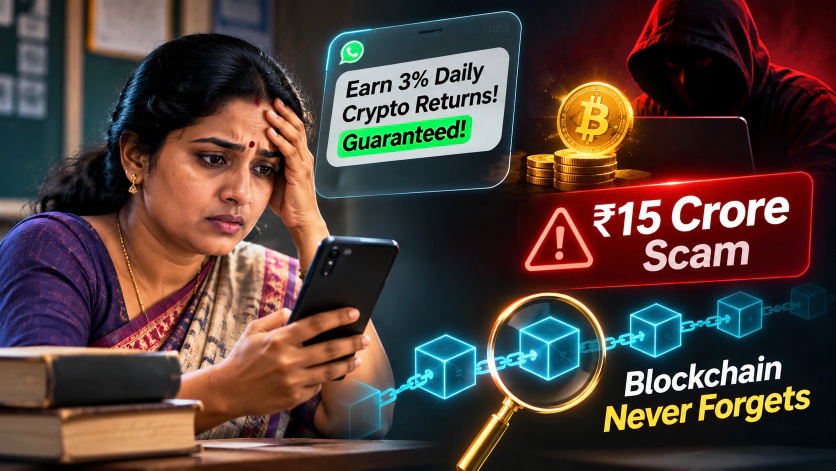
It started the way most scams in India start these days, with a WhatsApp message: "Earn 3% daily returns. Guaranteed. Join our premium crypto trading group." In Andhra Pradesh, a schoolteacher read it twice, thought about her daughter's college fees, and clicked the link.
She wasn't alone. Over the next few months, hundreds of people did the same, including shopkeepers, software engineers and retired government employees. The pitch was smooth. A slick dashboard showed their profits growing every day, and small withdrawals went through quickly at first, just enough to build trust. So people deposited more and told their friends.
By the time withdrawals stopped working, around ₹15 crore had vanished into a network that stretched across three continents. This week, the Andhra Pradesh CID announced it had broken that network up.
Most people miss the irony here. The scammers chose crypto because they thought it would hide them. They believed digital money couldn't be traced and would disappear the moment it left a victim's account. That belief was their biggest mistake.
A blockchain is a public ledger. Every transaction is recorded permanently with a timestamp, and anyone in the world can view it. Nobody can edit it, delete it or quietly backdate it. When investigators chase money through bank accounts, shell companies and hawala channels, the trail often goes cold. On a blockchain, the trail keeps going. One wallet sends funds to a second, which splits them across three more, which move them to an exchange. Every hop leaves a permanent record.
So the real story isn't that crypto enabled a scam. The scam ran on fake websites, false promises and ordinary hope. Crypto is the reason the money could be followed at all.
Real crypto also has the tools that would have exposed this scheme early. Genuine decentralised platforms run on smart contracts, which are public pieces of code that anyone can read and audit. A promise of 3% daily returns backed by real code can be checked by independent reviewers, and fake returns get called out quickly. This scheme had no such code, only a dashboard the scammers controlled. That alone was a warning sign.
Wallet transparency matters too. Anyone can paste a wallet address into a free blockchain explorer and see exactly where funds go. Here, deposits flowed straight from the so-called trading pool into a few private wallets, which is a red flag visible in seconds.
Recovery is more realistic as well. Exchanges registered with India's Financial Intelligence Unit follow KYC rules, so once police flag stolen funds, those exchanges can freeze them. Cash handed to an agent who has already left town offers no such chance.
The lesson for everyday Indians isn't to avoid crypto. It's to avoid promises you can't verify. Check the contract, check the wallet, and check whether the exchange is registered with the Financial Intelligence Unit. If someone simply asks for your trust, walk away.