
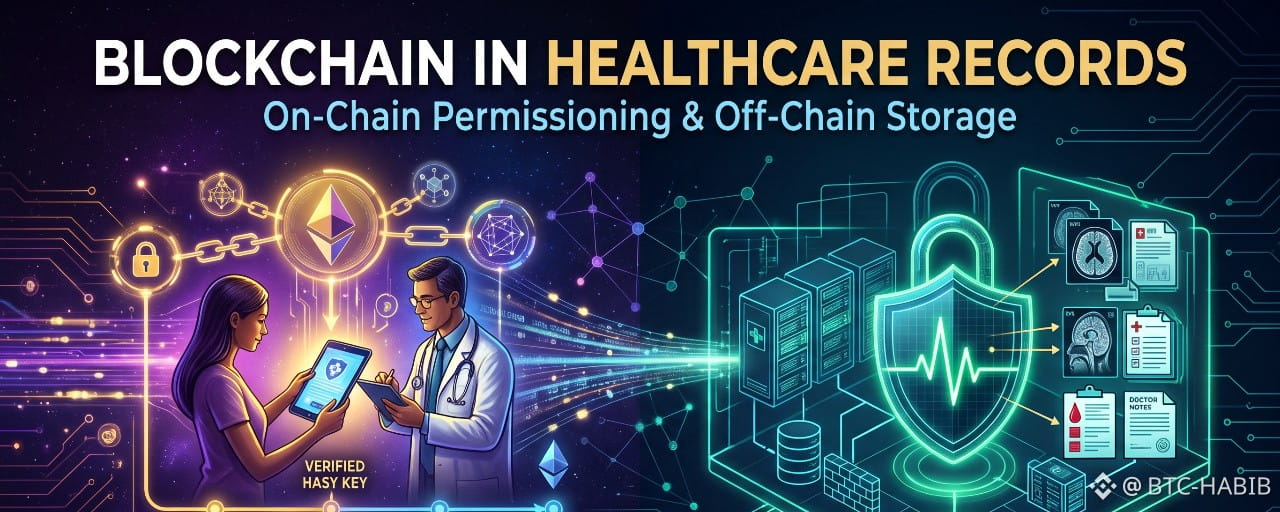

When you visit a new doctor, transfer to a specialist, or arrive at an emergency room, medical providers often lack immediate access to your full medical history.
Hospitals and clinics maintain independent Electronic Health Record (EHR) systems. Because these systems use proprietary formats and isolated servers, sharing patient records securely between different health networks remains slow, fragmented, and vulnerable to clerical errors.
Blockchain technology provides a framework to connect these isolated systems. Rather than serving as an open public bulletin board or replacing existing hospital software, blockchain functions as a secure, decentralized master index and access gatekeeper.
The Core Problem with Modern Medical Records
The healthcare sector does not suffer from a lack of digital records; it suffers from fragmentation and restricted data exchange:
Data Silos: A patient's medical history is scattered across primary care doctors, diagnostic imaging centers, outpatient clinics, and dental offices. Each provider stores records on separate servers.
Incompatible EHR Systems: Different hospital networks run specialized software platforms that rarely communicate smoothly without custom, expensive technical bridges.
Vulnerability to Unauthorized Modification: Centralized databases give administrative accounts the power to edit, overwrite, or delete entries, complicating efforts to maintain an unalterable audit trail.
Administrative Delays: Transferring records between health systems often relies on manual requests, patient authorization forms sent via fax, and slow verification calls, delaying treatment decisions.
The Hybrid Model: On-Chain Verification vs. Off-Chain Storage
A common misconception is that entire medical files—such as high-resolution MRI scans, surgical video feeds, and lengthy doctor progress notes—are written directly onto the blockchain. Storing large, sensitive files directly on a distributed ledger is inefficient and conflicts with healthcare privacy standards.
Instead, enterprise healthcare blockchains rely on an on-chain and off-chain hybrid model:
What Stays Off-Chain?
The actual medical files: imaging results, laboratory reports, genomic data, prescriptions, and physician notes.
Personal identifiable information (PII) and protected health information (PHI).
These records remain stored in secure, encrypted, HIPAA-compliant databases, local hospital servers, or decentralized encrypted storage networks.
What Goes On-Chain?
Cryptographic Hashes: A cryptographic hash is a unique digital fingerprint generated from a medical document. If a record is altered by even a single character, its hash changes completely. The blockchain stores only this hash, not the readable text or image.
Access Rules & Permissions: Smart contracts define which doctors, clinics, or insurers have permission to view specific records.
Audit Logs: Immutable timestamps recording when a file was accessed, who viewed it, and what authorizations were granted.
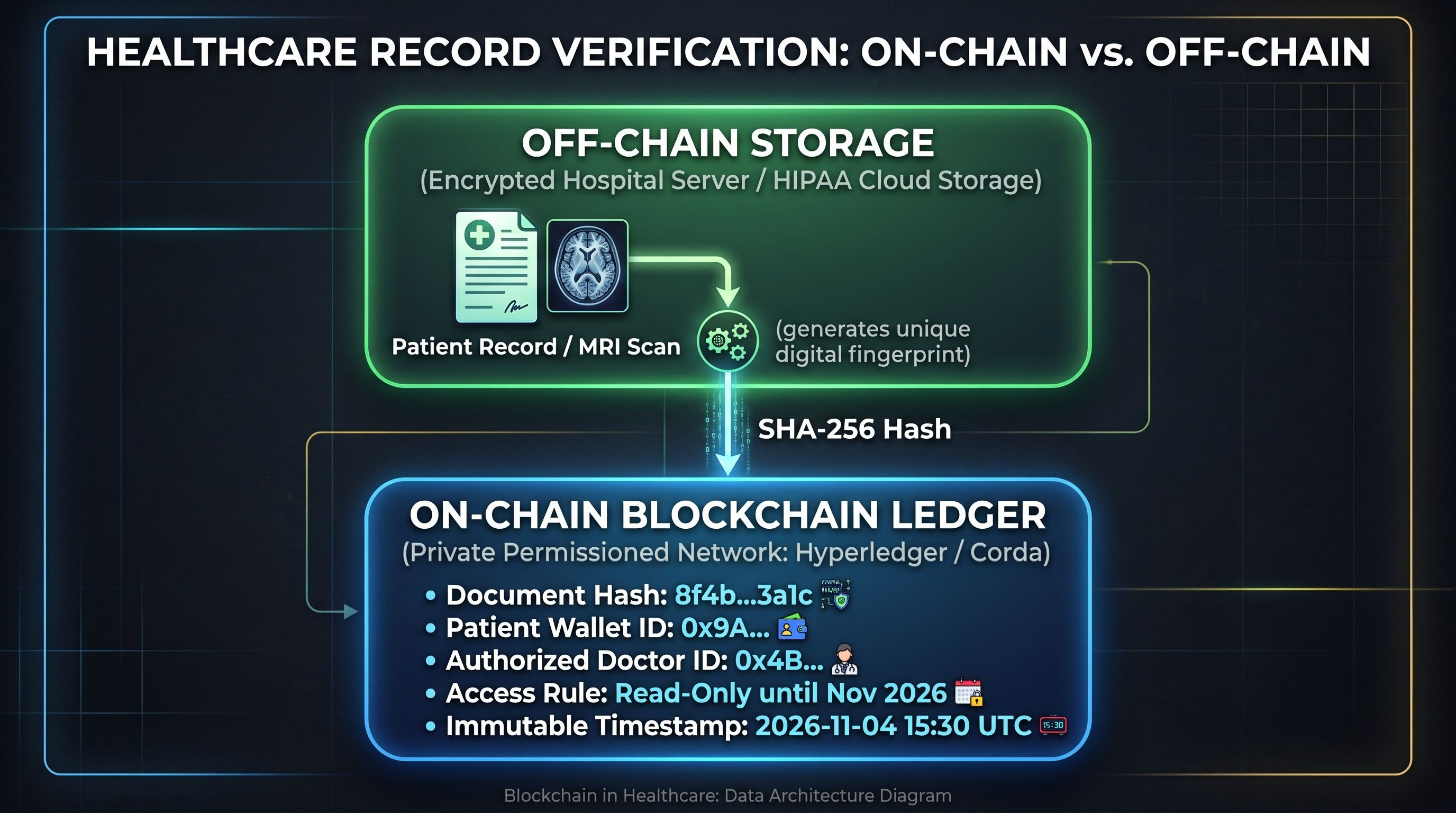
When a specialist requests a patient's chart, the hospital retrieves the encrypted file off-chain, calculates its hash, and matches it against the hash stored on the blockchain. If the hashes match, the specialist knows the record is genuine and has not been altered since the original physician signed it.
Practical Applications in Healthcare Records
Enterprise healthcare platforms use private, permissioned networks (like Hyperledger Fabric) to deliver targeted improvements across clinical workflows:
1. Patient-Controlled Consent Management
Patients rarely have direct control over how their medical records are shared among providers.
How It Works: Smart contracts serve as automated patient consent managers. Through a secure health portal or mobile identity wallet, a patient grants a specific clinic permission to access their blood panel results for a set period (e.g., 48 hours). Once that period ends, access automatically expires.
2. Cross-Institutional Interoperability
Creating a unified health record across independent hospital networks normally requires copying full databases, raising severe privacy concerns.
How It Works: The blockchain acts as a decentralized index. Instead of storing clinical notes in one massive central warehouse, the ledger lists pointers to where those records reside across different hospital nodes. Authorized healthcare providers query the network to retrieve records directly from the source.
3. Tamper-Evident Audit Trails for Compliance
Healthcare regulations require medical facilities to maintain strict access logs showing every staff member who opens a patient's file.
How It Works: Every time an electronic health record is viewed, updated, or transferred, a cryptographic transaction is logged on the private ledger. Because the ledger is append-only, an employee cannot view a chart and later delete the access history to cover their tracks.
4. Integrity Verification for Clinical Trials
Clinical trial data must remain free from retroactive alterations to ensure experimental treatments are evaluated honestly.
How It Works: Research institutions anchor trial results, dosage logs, and adverse event reports onto a permissioned blockchain. Regulators, such as the U.S. Food and Drug Administration (FDA), verify that trial protocols and outcomes were not modified after the study began.
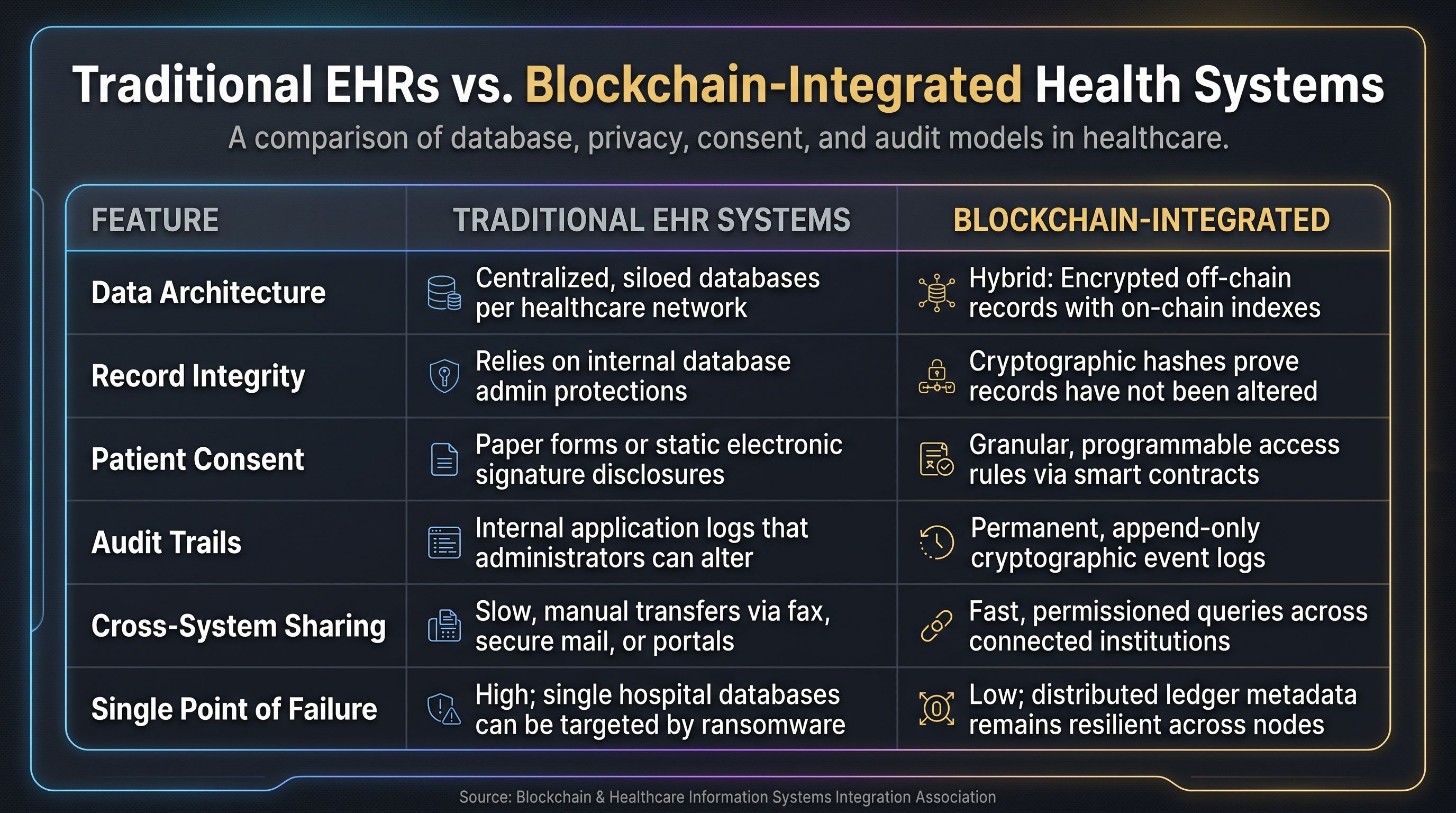
Side-by-Side Comparison: Traditional EHR Systems vs. Blockchain-Integrated Systems
Regulatory and Privacy Standards: HIPAA and GDPR
Deploying distributed ledger technology in healthcare requires strict compliance with legal frameworks, including the Health Insurance Portability and Accountability Act (HIPAA) in the United States and the General Data Protection Regulation (GDPR) in Europe.
The Immutability Conflict: Public blockchains like Bitcoin and Ethereum are permanent and unchangeable. This design conflicts directly with GDPR’s "Right to be Forgotten," which gives individuals the legal right to request the deletion of their personal information.
Why Private Blockchains Are Mandatory: Healthcare systems deploy private, permissioned consortium blockchains. By storing actual medical notes in off-chain databases, hospitals can delete or redact personal data to comply with regulations, while the ledger retains only non-identifying cryptographic proofs and access metadata.
Emergency Access ("Break-Glass" Protocols): In critical emergency situations—such as an unconscious patient entering an emergency room—smart contracts can include audited override rules. An emergency physician can access necessary allergy and medication records immediately, while the system automatically generates an irreversible alert on the ledger for administrative review.
Frequently Asked Questions
Is a patient's personal health information visible to everyone on a blockchain?
No. Healthcare blockchain networks are private and invite-only. Identifiable health data is never posted to open public chains. Access to records requires cryptographic keys, and only authorized medical personnel approved by the patient or established protocols can decrypt the information.
Does blockchain replace hospital software like Epic or Cerner?
No. Blockchain does not replace core EHR platforms. Instead, it operates as an underlying verification and communication layer between existing systems, allowing different software suites to verify record authenticity and share access permissions securely.
What happens if an off-chain medical file is edited or corrupted?
If a file is changed—whether intentionally or through a technical error—its digital fingerprint changes. When the system compares the newly generated hash against the original hash stored on the blockchain, the mismatch triggers an immediate error flag, warning medical staff that the document has been altered.