
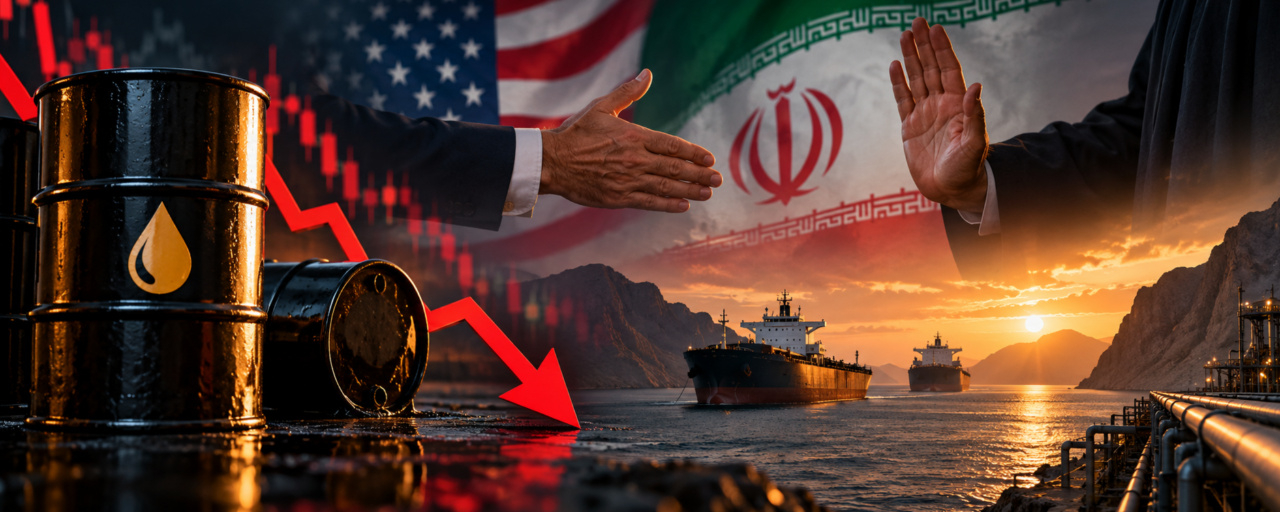

Oil lost ground for the second session in a row on Tuesday. Traders are betting that the U.S. and Iran can reach a diplomatic settlement to a conflict that has disrupted global energy supplies for eight months. The move followed a steep sell-off on Monday.
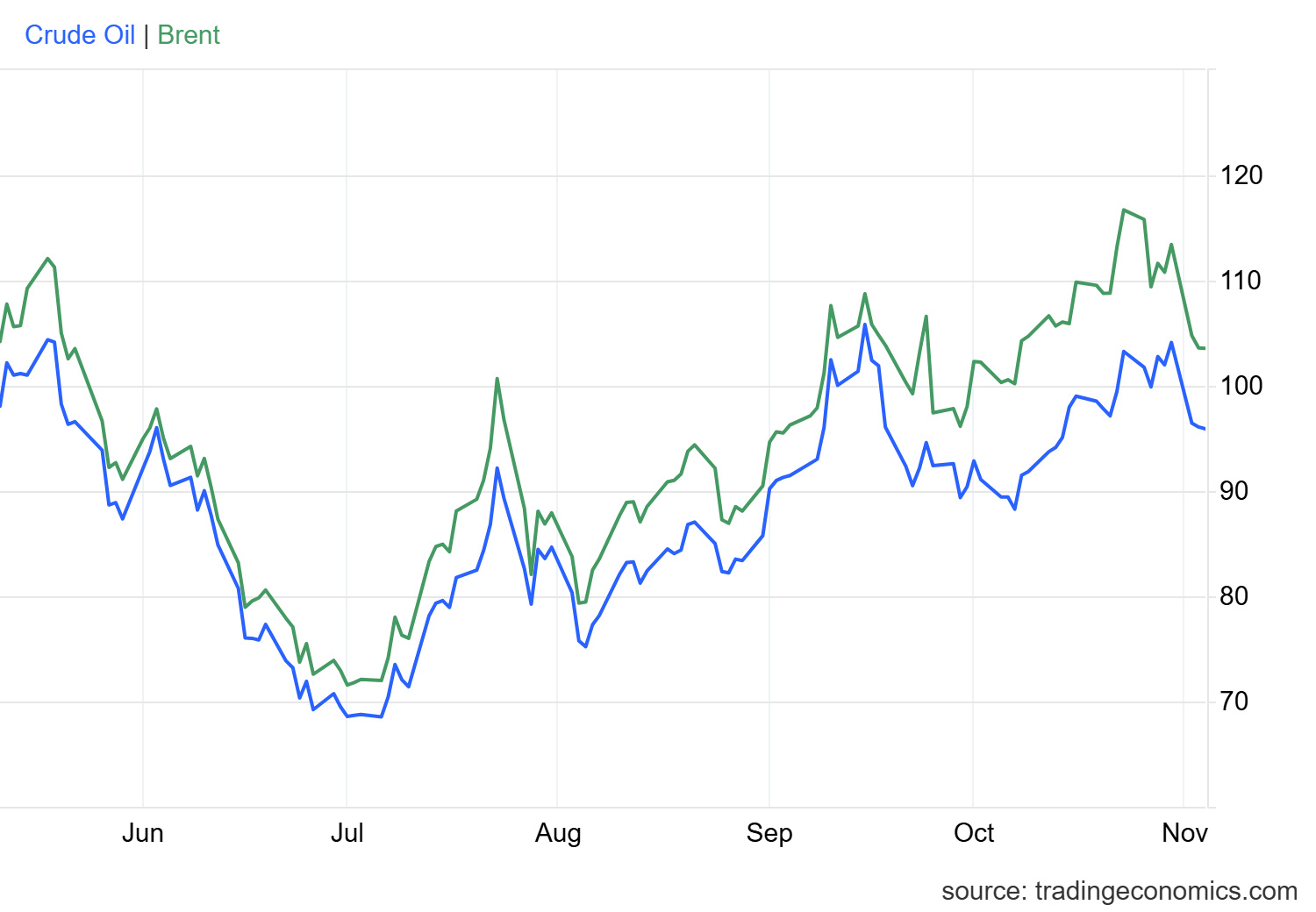
WTI futures shed 37 cents and settled at $96.09 a barrel, dipping below $95 at one point during the session. Brent, the international benchmark, fell $1.17 to end at $103.60.
A diplomat briefed on the matter says Washington and Tehran are looking over mediators’ proposals aimed at heading off another round of all-out war. Both have signalled they’re willing to pursue peace talks, with the conflict now moving into its ninth month.
Qatar remains the go-between, its foreign ministry said Tuesday. A Qatari delegation held talks in Tehran to work toward a deal that would stop further escalation across the region and end the U.S.-Iran conflict.
Reports say the U.S. has approved a draft memorandum of understanding (MOU) that Qatari mediators handed to Iran on Monday, November 2. The aim is an interim agreement that gets negotiations moving again. Al-Araby Al-Jadeed, citing sources close to the mediation team, says Saudi Arabia and the United Arab Emirates signed off as well once they’d been briefed. The framework reportedly rests on reciprocal concessions over Iran’s nuclear programme and its frozen financial assets.
The idea is for Tehran to announce nuclear concessions while Washington announces the release of part of Iran’s frozen assets, both at the same moment. Sources said discussions have now turned to what the first steps would be and how each side would present an interim deal. After that, the two would go back to the table for a broader settlement.
Iranian Foreign Ministry spokesman Esmaeil Baghaei said on Tuesday that no new agreement or breakthrough had been reached with Washington, despite reports about a U.S.-approved draft MOU nearing completion. Messages are still passing between the two sides through mediators, he confirmed, but he stressed that the negotiations remain unresolved (IRIB; Iran International, November 3, 2026).
Baghaei doubted that Washington is serious about diplomacy. “Previous experiences close the door on any optimism regarding America’s seriousness in diplomacy,” he said. Tehran would nonetheless keep looking for diplomatic openings that advance its interests and demands and restore regional security. Military preparedness, he added, is at its highest level, and Iran is ready to deliver a “crushing response” to any attack (Anadolu Agency, November 3, 2026). A senior Iranian official told Reuters there’s no deadline for exchanging messages with Washington through mediators or for reviewing responses. Iran’s president said the supreme leader has given his government more authority to negotiate, and U.S. President Donald Trump hinted at progress in talks. Hostilities are still simmering, though, and that’s keeping the market on edge.
Mohsen Rezaei, Secretary of Iran’s Supreme National Security Council, described Washington’s response to Tehran’s demands as “not convincing.” Before the Strait of Hormuz can reopen, he said, the U.S. has to address Iran’s seven conditions fully and explicitly. In a post on X, he went a step further. Responding isn’t enough, he wrote, Washington has to carry the demands out, and “only then will the Strait of Hormuz be reopened” (Abushamala, 2026).
The seven conditions, as reported, cover a comprehensive ceasefire across the Middle East, release of frozen Iranian assets, lifting of sanctions on the oil sector, an end to the U.S. naval blockade, payment of war reparations, withdrawal of U.S. forces from the region, and an end to threats and interference against Iran. Taken together, they reflect Tehran’s insistence on a permanent resolution rather than a temporary ceasefire (Abushamala, 2026).
Rezaei spoke while the Qatar-mediated talks were under way, and after reports that Washington had approved a draft MOU. Tehran’s rejection of the U.S. response shows the two sides still differ on what it takes to end hostilities and reopen the strategic waterway.
Iran and the U.S. are said to be reviewing fresh proposals from mediators. At the same time, the New York Times reported that Israel has told Washington that Tehran is weighing the use of chemical arms. According to the Times (November 3, 2026), Israel passed the U.S. intelligence alleging that Iran is considering chemical weapons against its adversaries. Israeli officials reportedly said Tehran was building the capability to deliver chemical agents by missile or to slip them covertly into enemy countries. Israel has also argued that this threat is more urgent than Iran’s nuclear programme (Barnes et al., 2026).
U.S. officials are reportedly divided over the intelligence. Some are alarmed, others deeply sceptical about whether it’s credible. Some in the administration reportedly read the Israeli assessment as part of Prime Minister Benjamin Netanyahu’s effort to talk President Trump into resuming major military operations against Iran. Gulf countries that received similar briefings had doubts of their own. Some called the presentations “unserious” and questioned whether Tehran was preparing to use chemical weapons at all (Barnes et al., 2026).
Other U.S. officials think the warnings should be taken seriously, given broader worries about possible Iranian attacks on American interests and regional allies. The report points to growing disagreement in Washington and among Gulf partners over how credible Israel’s intelligence is, and over whether it could be used to shape decisions on renewed military action. The allegations remain unverified, and the report doesn’t establish that Iran has decided to use chemical weapons.
Saudi Aramco’s profit rose by more than a third last quarter, despite attacks on its facilities. The world’s top oil exporter booked a net profit of $36.25bn for the three months to September, against $26.9bn a year earlier. The U.S.-Israeli war on Iran has cut Aramco’s output, but higher oil prices have offset that.
Amin H. Nasser, Aramco’s president and chief executive, said: “Geopolitical uncertainty and attacks on key energy facilities continued to amplify the global energy supply crisis in the third quarter of 2026, with serious implications for global energy security. Despite challenges, the unwavering dedication of our workforce, our operational excellence, the flexibility of our system, and the strength of a supply network built over decades enabled us to continue delivering reliably to our customers through this extraordinary period. We continue to explore additional overseas storage capacity and alternative export routes to further strengthen our global supply network, and our robust operational and financial performance during this volatile period demonstrates the value of our resilience.”
Trump said the U.S. will stop providing military funding to Israel after the end of this year. He told Fox News’ Fox and Friends programme that he’d struck a deal with Israeli prime minister Benjamin Netanyahu, and that Israel no longer needs the money. Some Democrats and left-wing politicians, he said, have been using the funding as a talking point to criticise Republicans. “Now, as far as paying Israel, Bibi Netanyahu and I have made a deal that we give Israel $4bn a year, and we made a deal months ago that we’re stopping. We’ve already agreed that by the end of this year we won’t be paying Israel. Now we’ll help Israel if they need it.”