


NASA’s Swift telescope is forecast to reenter Earth’s atmosphere on November 4. A $30 million rescue failed, just as NASA looks to commercial operators for Hubble’s future.
A forecast, not yet a confirmed crash
Swift’s return remains a prediction. NASA’s November 2 update put reentry around 3:30 a.m. EST on November 4, with an 11-hour margin of error. The Aerospace Corporation offered a tighter estimate: 5:19 a.m. EST, plus or minus two hours.
Most of the 3,200-pound spacecraft should burn up. Any surviving debris would fall within 20.6 degrees north or south of the equator. NASA puts the chance of someone being injured at roughly 1 in 2,100.
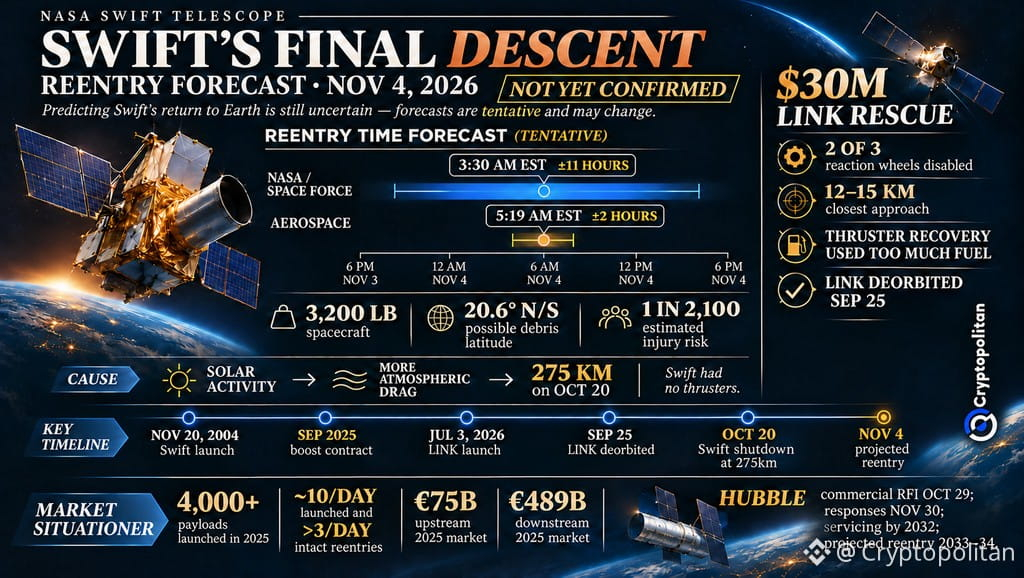 Swift’s Final Descent: Reentry Forecast, Failed Rescue and Space Market Stakes
Solar activity dragged Swift down
Swift was built for two years of gamma-ray-burst research when it launched on November 20, 2004. Instead, it worked for nearly 22 years.
Swift was defenseless when solar events increased the temperature and volume of the upper atmosphere because it didn’t have thrusters for orbital maintenance. By October 20, Swift’s drag had increased and it had descended to 171 miles (275 kilometers). NASA ceased all mission operations as soon as Swift entered safe mode.
Why the $30 million LINK rescue ran out of fuel
NASA’s $30-million mission to save Swift ran into challenges before the rescue spacecraft, LINK, could reach it. Katalyst Space built LINK in just nine months and launched it on July 3, 2026, after receiving a contract from NASA in September 2025.
During commissioning, LINK had an electrical failure affecting two of its three reaction wheels, causing it to spin. Engineers restored control using thrusters, but this took more fuel than expected. Katalyst claimed that LINK came within 12-15 kilometers of Swift before returning to Earth on September 25.
Commenting on the failed rescue mission, NASA Administrator Jared Isaacman said, “This is not the outcome we were working toward, but it does not change why this mission was worth attempting.”
Katalyst CEO Ghonhee Lee said that the experience gave the company a basis for future missions.
NASA now wants the same industry to save Hubble
NASA is already considering another commercial rescue, this time for the Hubble Space Telescope.
“Hubble still has important science ahead of it,” Isaacman said, emphasizing the importance of saving Hubble.
On October 29, the agency invited proposals to raise Hubble’s orbit, upgrade its systems or eventually bring it down safely. Companies have until November 30 to respond.
Without intervention, Hubble could reenter the atmosphere in 2033–2034. NASA says any servicing mission would likely need to happen by 2032.
What Swift teaches future operators
Swift’s failed rescue offers a warning for companies hoping to extend satellites’ working lives.
The telescope was never designed for servicing. LINK had to approach a larger spacecraft without a standard docking interface. Katalyst still managed to develop and launch its rescue vehicle in nine months.
But the mission also showed how quickly hardware problems can derail an operation. LINK’s recovery consumed the fuel needed to complete the rescue.
For Hubble and future satellite fleets, the lesson is clear: spacecraft need to be easier to service, and rescue missions must be reliable enough to justify their cost.
The smartest crypto minds already read our newsletter. Want in? Join them.