
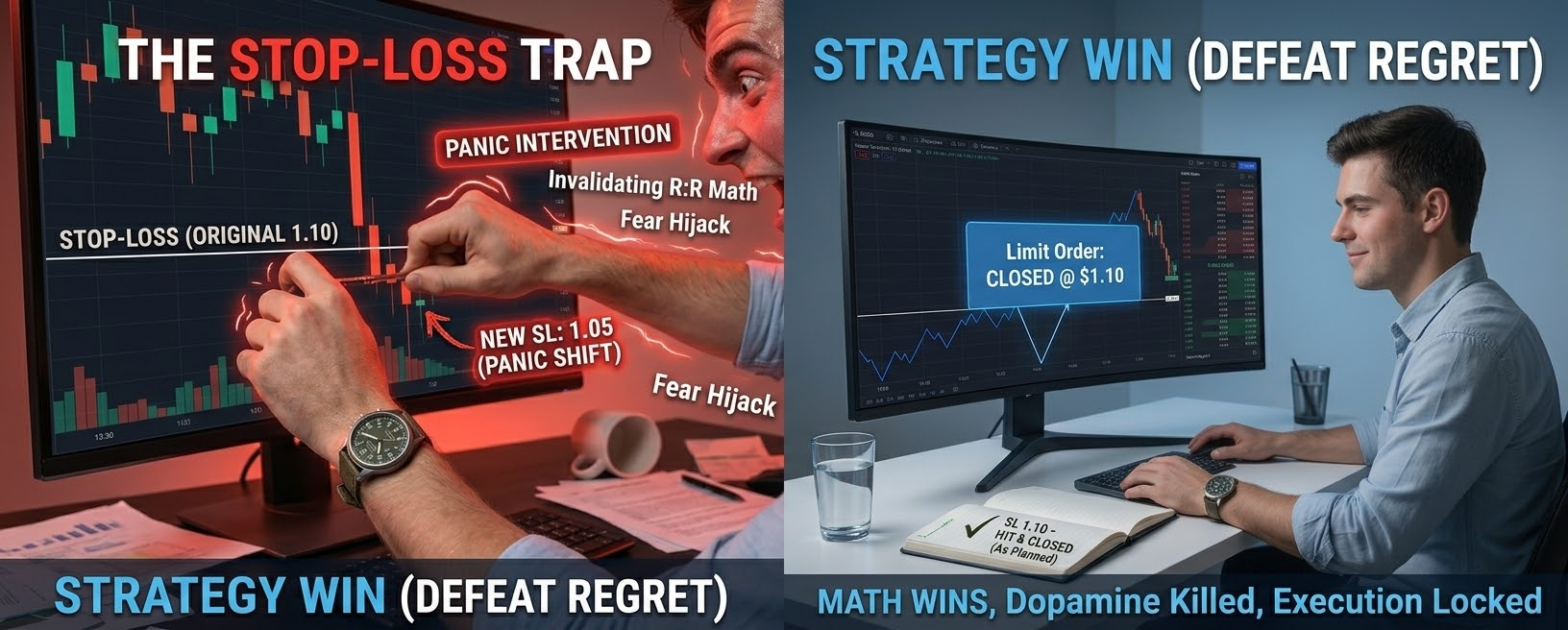

Have you ever set a trade, watched the price dip toward your stop-loss, panicked, moved your stop-loss closer (or removed it entirely), only to get wicked out right before the asset reverses and rockets straight to your original take-profit? That excruciating cycle of panic, regret, and immediate FOMO isn't bad luck—it's the psychological trap of Fear.
What Fear Does to Your Execution
Fear is a primal survival mechanism that completely sabotages mechanical trading.
The Physical Trigger: When the market moves against you, your amygdala triggers a fight-or-flight response. Your stomach drops, your palms sweat, and your brain screams “protect the money!”
The Fatal Mistake: Instead of accepting a pre-calculated risk, you react emotionally. You tamper with your stop-loss to "give it breathing room" (which invalidates your risk-to-reward math) or you panic-close early, only to watch the chart fly without you.
The moment you get wicked out and see the price hit your target, a secondary wave of psychological torture hits: regret. That regret immediately morphs into FOMO, driving you to chase the green candle at an even worse entry.
How to Kill Fear and Stop Tampering With Stops
You cannot negotiate with fear while staring at a live PnL screen. You must remove human intervention from the danger zone:
Set It and Forget It: Once your entry, stop-loss, and take-profit are placed according to market structure, close the terminal. Do not watch the candles dance.
Accept the Stop-Loss as a Business Expense: A stop-loss is not a failure; it is the cost of doing business. If your structural thesis is invalidated, let the market take the stop cleanly. Protecting your mental capital is more important than one single trade.
Never Move a Stop-Loss Against Your Plan: Moving an SL further away to avoid a loss or tightening it out of panic guarantees long-term account ruin. Respect the math.
Conclusion
Fear turns risk management into a guessing game. Define your risk before you enter, lock your orders, and let the market do its job without your emotional interference.