



Most traders focus on how much leverage they can use, but very few ask a more important question:
How much capital should I keep untouched so that even a theoretical extreme loss doesn’t wipe out my entire account?
Let’s explore a simple mathematical model.
1. Understanding the concept
Imagine you have $1,000 in total capital and want to open a leveraged long position.
Instead of putting all your money into the trade, divide your capital into two parts:
Trading capital: Money allocated to the position.
Reserve capital: Money kept outside the position.
The objective is to calculate how much you can allocate while preserving some capital under a hypothetical loss scenario.
2. The mathematical formula
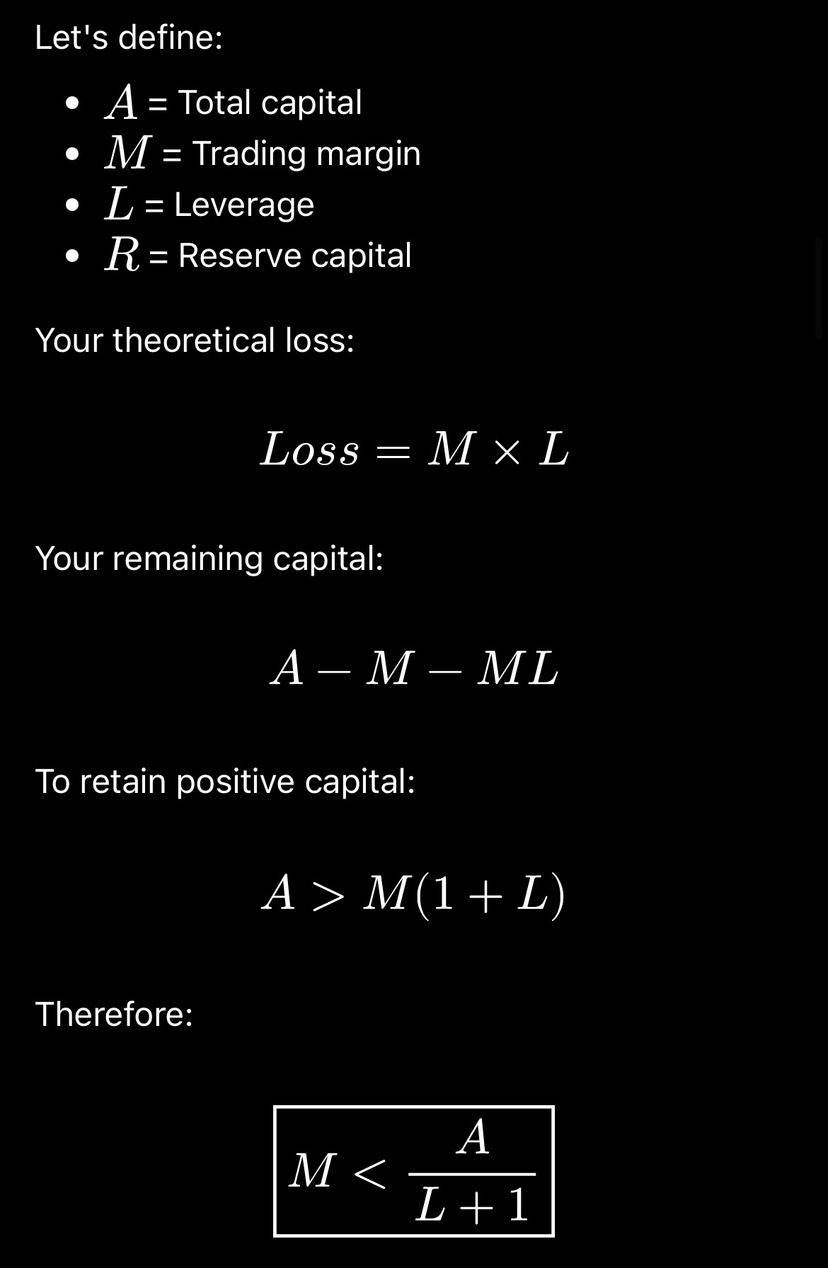
Let’s define:
A = Total available capital
M = Trading margin
L = Leverage multiplier
R = Remaining reserve capital
Under the hypothetical assumption that the loss equals trading margin multiplied by leverage:
3. Practical example: $1,000 capital with 10x leverage
Suppose:
Total capital = $1,000
Leverage = 10x
Trading margin = $90
Calculation:
Theoretical loss = $90 × 10 = $900
Remaining capital = $1,000 − $90 − $900
Remaining capital = $10
This hypothetical model leaves $10 after accounting for both the original margin allocation and the assumed loss.
4. The formula you can reuse
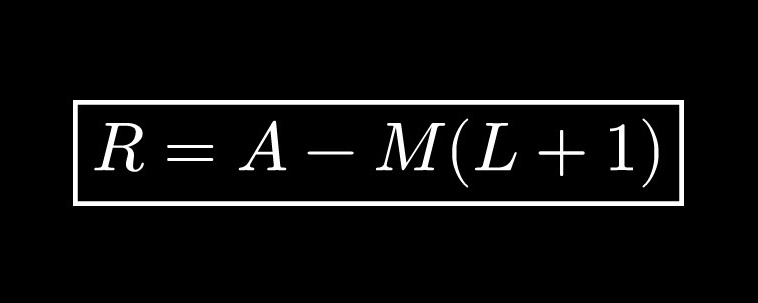
The general reserve formula is:

And the maximum margin allocation that leaves positive capital is:
M < A / (L + 1)
The higher the leverage, the smaller the permitted allocation under this mathematical assumption.
5. An important reality check
There is a critical distinction between this theoretical model and actual leveraged futures trading.
In isolated-margin futures trading, leverage does not multiply your maximum loss beyond your allocated margin. It increases your position size and makes liquidation occur after a smaller adverse price movement.
For example, $100 margin at 10x leverage creates a $1,000 position, but a 100% loss of the position’s notional value is not normally reached before liquidation.
Actual losses depend on margin mode, liquidation rules, maintenance margin, fees, funding, and slippage.
Therefore, this formula is a hypothetical capital-allocation model, not an actual futures liquidation formula.
The bigger lesson: Leverage determines your exposure, but capital allocation determines how much of your overall financial resources you put at risk.
Protecting your remaining capital is just as important as calculating your potential profit.