
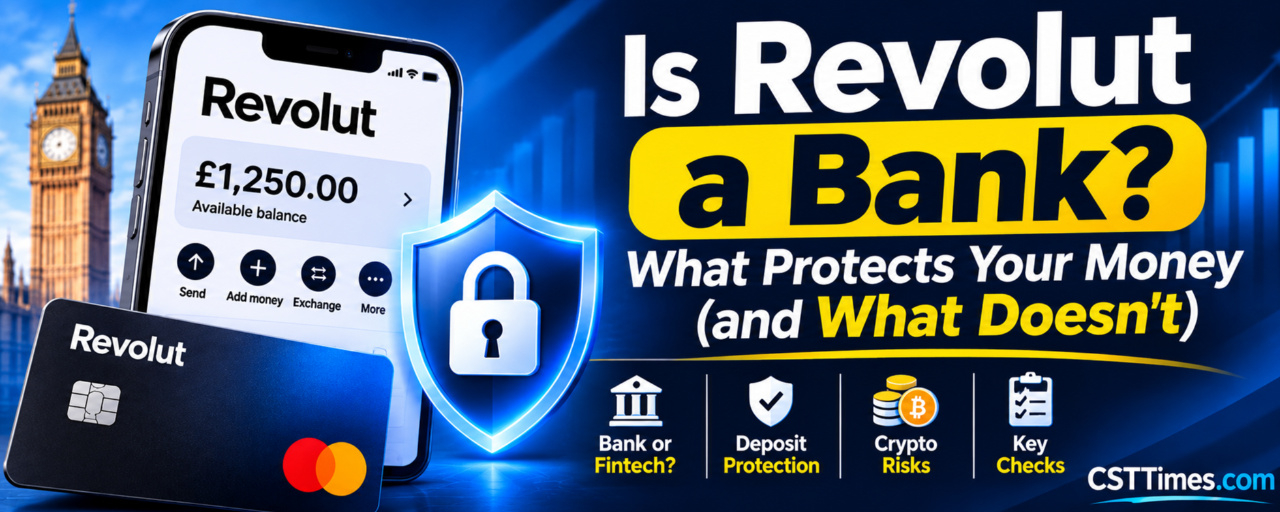

If you keep money in a fintech app next to your exchange accounts, one question matters more than the app's features: what actually protects that balance?
Here is the short version of how Revolut works and where protection starts and stops.
Quick facts
Founded in London in 2015
80+ million personal customers worldwide
Supports 160+ countries and regions (not all of them allow account opening)
2025 results: $6.0B revenue, $2.3B profit before tax
Is Revolut a bank?
It depends on your country.
✅ UK: Yes. Revolut Bank UK Ltd became a fully authorised UK bank on 11 March 2026. Some customers may still be on an older e-money account.
⏳ US: Not yet its own bank. Revolut got conditional OCC approval in September 2026, with a launch planned for 2027. Today, banking services run through Lead Bank, an FDIC-member bank.
✅ EEA: Yes, through Revolut Bank UAB, licensed in Lithuania since December 2021.
What protects your money?
UK bank deposits: FSCS up to £120,000
UK e-money accounts: safeguarded, but not direct FSCS protection
EEA deposits (Revolut Bank UAB): up to €100,000 per depositor
US deposits via Lead Bank: possible pass-through FDIC cover up to $250,000 if requirements are met
⚠️ Stocks, crypto and commodities: not protected like ordinary bank deposits
That last line is the one crypto users should remember. Revolut may offer crypto services depending on your country, but a crypto balance is an investment, not a deposit. App security tools such as biometric login, instant alerts and card freezing help, but they cannot cover price losses, scams or unauthorised access.
Plans in the UK
Standard: free
Plus: £3.99/month
Premium: £8.99/month
Metal: £16.99/month
Ultra: £60/month
Standard includes £1,000 of exchanges per month, then a 1% fee. Plus includes £3,000, then 0.5%. Currency, crypto and commodity exchanges all count toward the allowance. Fees differ by country, so US users should not rely on UK pricing.
Before you use it
Check that your country can open an account
Check which legal entity holds your money
Do not assume every balance has deposit protection
Check exchange and transfer fees before you confirm
Turn on biometrics, alerts and card controls
📖 Full guide with FAQs: csttimes . com / what- is -revolut
#revolut #fintech #CryptoSafety #DepositProtection #Banking
Not financial advice. Fees, eligibility and regulation can change. CST Times is independent and not affiliated with Revolut.