

Picture two friends with the same plan. Each sets aside 200 USDT a month for one coin and has no intention of guessing the bottom. One buys 50 USDT every Monday by hand. The other lets a scheduled plan spend the full 200 on the first day of each month. Three months later they compare notes and find different average prices, different fee lines and one missed purchase. Neither did anything wrong. They chose different schedules.
That is what dollar cost averaging on Binance Spot comes down to: a fixed amount, a fixed rhythm and a tool to run it. You can place the orders yourself on Spot, at market or with a limit price, or let Convert Recurring buy for you on a timer. Below are four schedules worked through with made-up prices, so you can see where the average cost comes from and how much each route spends on fees.
👉 Sign up on Binance with a bonus (code GETREWARD)
Every price in this article is invented for the arithmetic. The coin is a fictional token called XYZ, priced in USDT. Nothing here suggests what any real coin will do.
Which tools can carry a DCA schedule on Binance?
There are two practical ways to repeat a purchase from a Spot balance, and they behave differently in three places: who presses the button, what the fee line shows and how the price is set.
Manual Spot orders: You open the trading pair, for example XYZ/USDT, and buy with a market order (fills at once at the going price) or a limit order (fills only at your price or lower). The regular fee is 0.1% of the trade value, deducted from the coin you receive unless you settle fees in BNB.
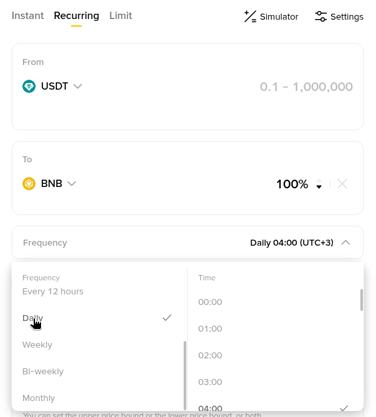
Convert Recurring: Found under Trade, Convert, Recurring. You choose the asset to spend, the coin to buy, the amount, the cycle and the hour. There is no separate trading fee on the order, but each purchase takes a Convert quote, and that quote can sit slightly away from the last Spot price.
The card based recurring buy exists too, but it charges a card fee on every order, so it sits outside the fee comparison below. If you have not set up a plan before, our step by step recurring buy setup walkthrough covers every field, including pausing and cancelling.
The cycle menu in Convert is where the weekly or monthly rhythm gets fixed:
Once you know which tool runs each purchase, the arithmetic is the same for all four schedules.
How does the average cost come out of each purchase?
Add up the USDT spent, add up the coins received, then divide the first total by the second. That is your average cost per coin. The average of the prices you saw on the screen is a different number, and mixing the two up is the most common slip in DCA spreadsheets.
When the amount per purchase stays fixed, a low price buys more coins and a high price buys fewer. The cheap weeks therefore carry more weight, and the average cost ends up below the simple average of the prices whenever prices vary. That is a property of the arithmetic. It says nothing about whether the coin will later trade above or below that cost.
Schedule A, what does 50 USDT every Monday by hand look like?
Four Mondays, a market buy of 50 USDT each time, regular fee of 0.1%. Invented prices: 20, 16, 25 and 18 USDT.
Week 1 at 20.00: 50 ÷ 20 = 2.5000 XYZ. The fee takes 0.0025 XYZ, so 2.4975 lands in the wallet.
Week 2 at 16.00: 50 ÷ 16 = 3.1250 XYZ, fee 0.0031, net 3.1219.
Week 3 at 25.00: 50 ÷ 25 = 2.0000 XYZ, fee 0.0020, net 1.9980.
Week 4 at 18.00: 50 ÷ 18 = 2.7778 XYZ, fee 0.0028, net 2.7750.
Totals: 200 USDT spent, 10.4028 XYZ bought, 10.3924 XYZ kept after fees. Average cost before fees is 200 ÷ 10.4028 = 19.23 USDT. Counting fees, 200 ÷ 10.3924 = 19.24 USDT. The four screen prices average 19.75, which shows the weighting effect from the previous section. The fees across the month come to the equivalent of 0.20 USDT.
The cost of this schedule is attention. Forget one Monday and the plan quietly becomes three purchases.
Schedule B, what changes with one monthly limit order?
Same budget of 200 USDT a month, placed once as a limit order 3% under the price at the moment you set it. Limit orders on the regular tier are charged 0.1% as well, so the fee is unchanged. What changes is whether the order fills at all.
Month 1: Price 22.00, limit at 21.34. It fills: 200 ÷ 21.34 = 9.3721 XYZ, 9.3627 after the fee.
Month 2: Price 18.00, limit at 17.46. It fills: 200 ÷ 17.46 = 11.4548 XYZ, 11.4433 after the fee.
Month 3: Price 24.00, limit at 23.28. The price climbs and the order never fills. After two days the buyer cancels and takes a market buy at 24.40: 200 ÷ 24.40 = 8.1967 XYZ, 8.1885 after the fee.
Totals: 600 USDT, 29.0235 XYZ before fees, 28.9945 after. Average cost is 20.67 before fees and 20.69 after. Without the rule to cancel after 48 hours and buy at market, month 3 would have been a missing purchase rather than a slightly dearer one. Write that rule down before the first order, because limit orders that never fill are how a DCA plan drifts into ordinary waiting for a dip.
Wherever the fills come from, the Trade History tab keeps the record you need for the sums above:

Copy Price, Filled and Fee for each row into a sheet and the average cost takes one formula. Next come the two schedules that run without you.
Schedule C, how does a weekly Convert Recurring plan compare?
Weekly plan, 50 USDT from the Spot balance, same four invented prices as Schedule A. Convert shows no trading fee, so the cost hides in the quote. To make the comparison concrete, assume each quote lands 0.15% above the last Spot price. That gap is a hypothetical figure for the exercise, not a Binance rate.
Quoted prices: 20.030, 16.024, 25.038 and 18.027 USDT.
Coins received: 2.4963, 3.1203, 1.9970 and 2.7736 XYZ, together 10.3872 XYZ.
Average cost: 200 ÷ 10.3872 = 19.25 USDT.
That sits a hair above Schedule A after fees, 19.25 against 19.24, because a 0.15% quote gap costs a little more than a 0.1% fee. Had the gap been 0.05%, the plan would have come out slightly cheaper than the manual buys. The only way to know your real gap is to compare the price on each Recurring History entry with the Spot chart at that minute. Our Convert, market and limit order comparison shows how such a quote stacked up against real Spot fills.
What you get in return is reliability. The plan runs at the chosen hour whether you are awake or not. If the Spot balance is short at that moment, the purchase fails and the plan moves on to the next cycle, so that week is lost rather than delayed.
Schedule D, can one monthly plan cover two coins?
Yes. Convert Recurring lets you add a second coin in the To field and split the amount by percentage. Here: 200 USDT on the first of each month, 70% to XYZ and 30% to a second invented token, ABC.
XYZ leg, 140 USDT a month: Invented prices 21, 19 and 23 give 6.6667, 7.3684 and 6.0870 XYZ. That is 20.1221 XYZ for 420 USDT, an average of 20.87 against a price average of 21.00.
ABC leg, 60 USDT a month: Invented prices 4.00, 5.00 and 3.20 give 15.00, 12.00 and 18.75 ABC. That is 45.75 ABC for 180 USDT, an average of 3.93 against a price average of 4.07.
Both figures leave out the quote gap so the split itself stays readable. Track each leg on its own, because a combined average of two different coins means nothing. And keep the weighting under review. If ABC later trebles while XYZ halves, the 70/30 split of new money no longer matches what the holdings look like.
How much do fees take out of a year?
Here are the four schedules stretched to twelve months. Schedules A and C spend 2,600 USDT a year (52 × 50), B and D spend 2,400 (12 × 200).
A, manual weekly market buys: 0.1% of 2,600 = 2.60 USDT. With fees settled in BNB at 0.075%, 1.95 USDT.
B, manual monthly limit orders: 0.1% of 2,400 = 2.40 USDT. In BNB at 0.075%, 1.80 USDT.
C, weekly Convert Recurring: Zero on the fee line. At the assumed 0.15% quote gap, about 3.90 USDT hidden in the prices.
D, monthly Convert Recurring: Zero on the fee line, about 3.60 USDT at the same assumed gap.
Look at A and B side by side. Per 1,000 USDT spent, the fee is 1.00 USDT whether you buy weekly or monthly, because it is a percentage of each trade. Frequency changes how smooth your entry is, not what the fee costs. The BNB figure needs some BNB in the account and the option to settle fees in BNB switched on, and it follows the BNB column in the fee table on the regular tier:
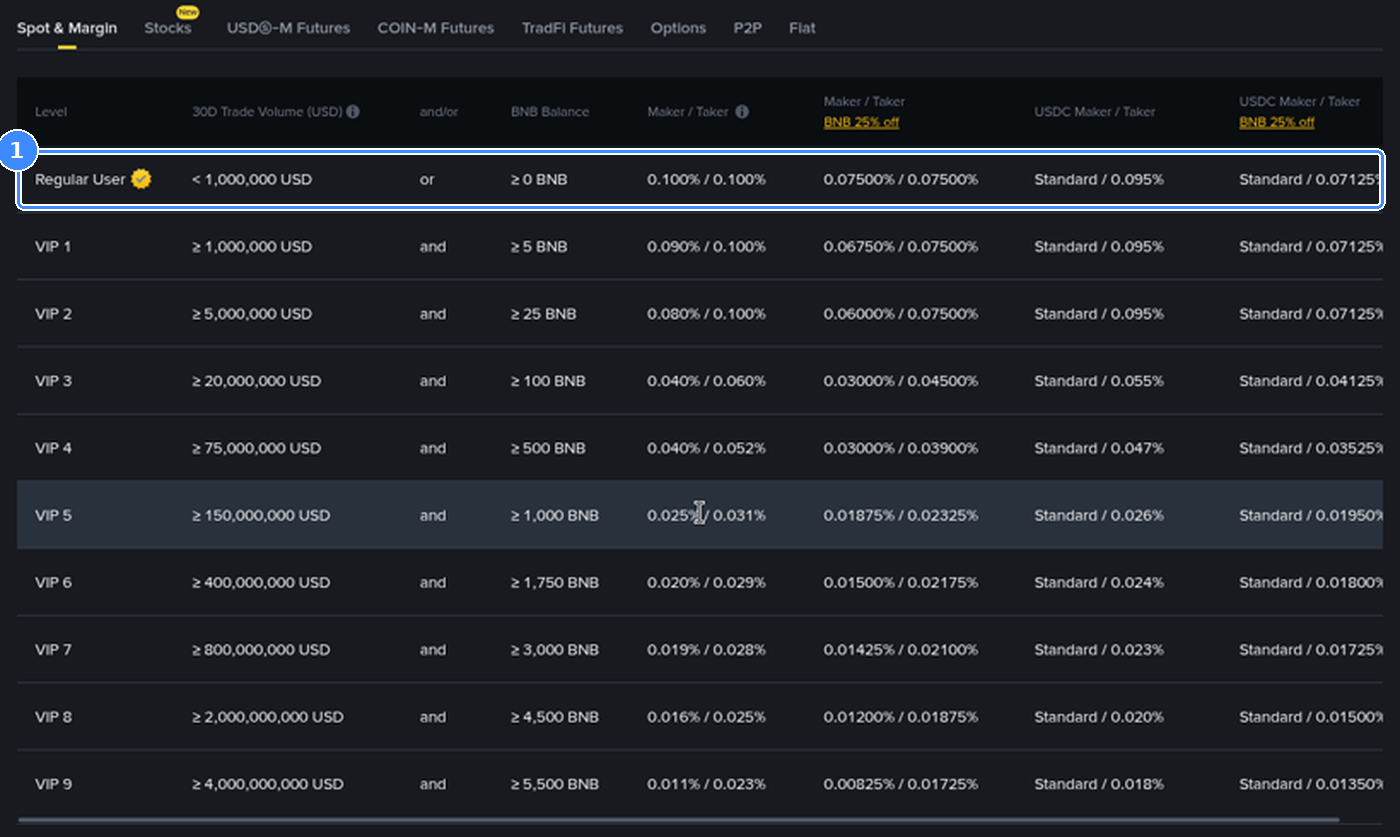
Rates on the higher tiers are lower, but they need trading volume and BNB balances far beyond a 200 USDT a month plan.
How do the four schedules line up?
Effort: A needs you every week, B once a month plus a check two days later, C and D need nothing after setup beyond keeping the balance topped up.
Price control: B is the only one that names a price. Convert Recurring has an optional Limit Price bound, which skips a cycle outside the range instead of waiting for a better price.
Fee visibility: A and B show the fee on every fill. C and D show none, so you measure the quote gap yourself.
Risk of gaps: A fails when you forget, B when the limit is too far from the price, C and D when the balance runs short.
Record keeping: A and B land in Spot Trade History. C and D land in Convert History under Recurring, which is a separate export when you need one for tax.
None of these is the winner on numbers alone. Over a year the fee gap between the cheapest and the most expensive route in this example is around 2 USDT on 2,400 to 2,600 USDT spent. A schedule you will still be running in month eleven matters far more than that.
What does DCA not protect you from?
DCA spreads out the moment you buy. It does nothing about where the price goes. In Schedule A, if XYZ drifted to 10 and stayed there, every purchase would sit at a loss and a lower average cost would only make the loss smaller, not remove it. A coin can fall for a year or more, and a plan keeps buying the whole way down unless you stop it. DCA cannot promise a profit, and no average cost is a floor.
Set an amount you could leave untouched through a long fall, keep an emergency fund outside the exchange and decide in advance what would make you pause the plan. This article shows arithmetic on invented prices and is not financial advice.
Which mistakes spoil a DCA schedule?
Averaging the prices instead of the cost: Divide total USDT by total coins. The mean of the screen prices overstates what you spent per coin.
Ignoring fees taken in the coin: On a market buy the 0.1% comes out of the coin received, so your holdings are a little smaller than the order size suggests.
Limit orders without an expiry rule: A buy that never fills breaks the schedule. Pick a cut off and stick to it.
A dry Spot balance: Convert Recurring spends from the account chosen at setup. Top it up before the cycle, not after the failed entry.
Raising the amount after a rally: Bigger buys at higher prices pull the average up and turn DCA into chasing.
Mixing coins in one average: Keep a separate line for every asset in a split plan.
Never reviewing: Look at the plan every quarter. Your budget, your timeline and the coins you hold all change.
If you are opening an account to try one of these schedules, enter GETREWARD in the code field on the sign-up form, then read the conditions of the Binance welcome bonus for new users before your first deposit, since the tasks change from time to time.
FAQ
Is weekly DCA more expensive in fees than monthly?
Not on Spot at a flat percentage. At 0.1%, 1,000 USDT spent costs 1.00 USDT in fees whether it goes in as four buys or forty.
What is the smallest amount a Convert Recurring plan accepts?
The From field shows the allowed range next to the box. On our screen it read 0.1 to 1,000,000 for USDT, and the range can differ by asset.
Can a recurring plan buy only below a certain price?
Convert Recurring has an optional Limit Price setting with an upper or lower bound. A cycle outside that range is skipped, not postponed.
How do I see my average cost for manual Spot buys?
Export Spot Trade History for the period, sum the Total column for the coin and divide it by the summed Filled amount minus any fees charged in that coin.
Should I stop DCA when the price drops sharply?
That depends on your own budget and reasons for holding the coin. The schedule itself has no view on the market, which is why the pause rule belongs in your plan before the first purchase.
Disclosure: this article includes a Binance sign-up link with the code GETREWARD. All prices above are invented examples. Crypto prices can fall and purchases can lose value. This is not financial advice.