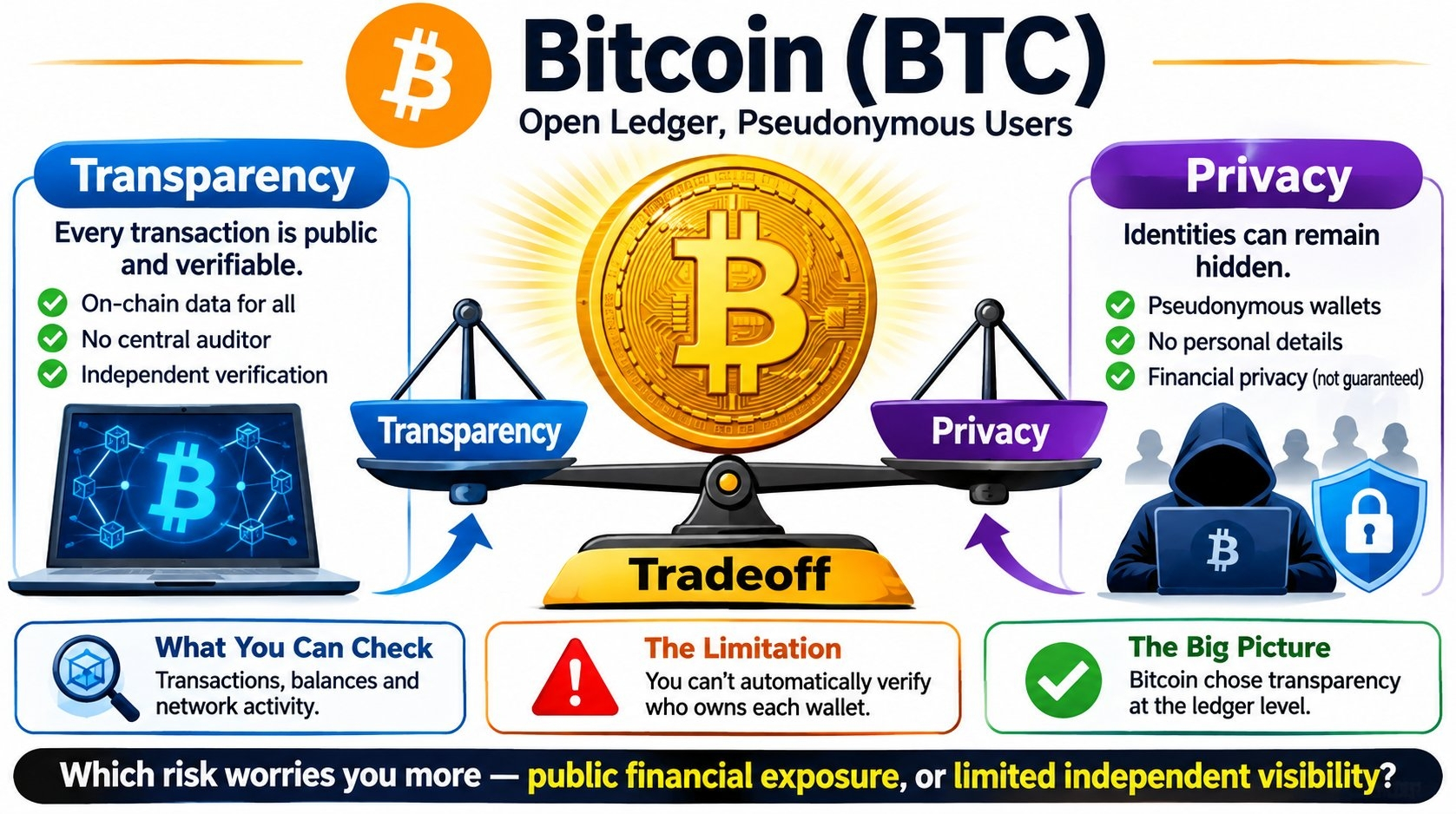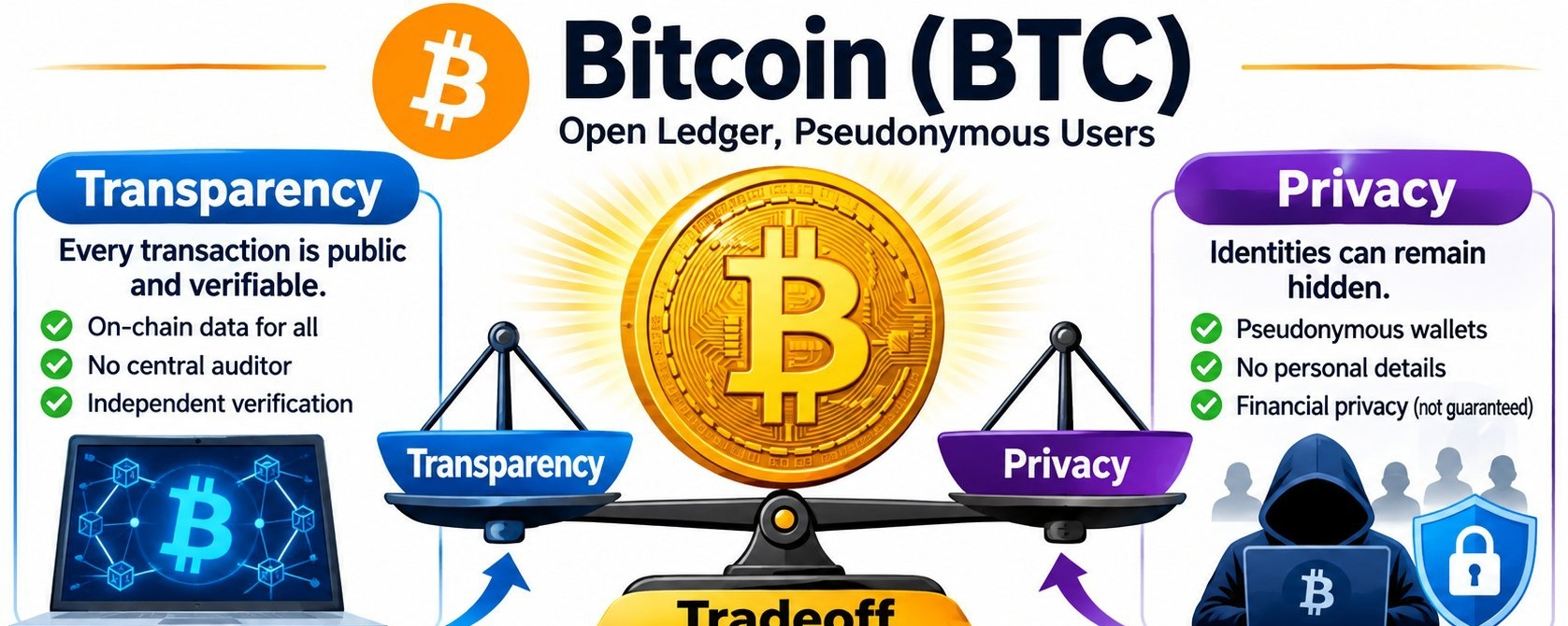

Bitcoin exposes almost everything on its blockchain, yet it does not expose the real identities behind every wallet.
That's not an oversight. It's a stated choice.
Bitcoin was designed to eliminate trusted intermediaries through a public, independently verifiable ledger. But pseudonymous addresses offer a layer of privacy.
The tradeoff is real. Once an address becomes linked to someone's identity, its transaction history can become traceable. Financial privacy is not guaranteed.
Every confirmed transaction, amount, and address can be examined by anyone. Independent nodes verify transactions without relying on a central auditor.
Holders can verify balances, transaction history, and network activity through public blockchain explorers. Bitcoin has no centralized custodian or reserve auditor because BTC itself is not a privately backed asset.
However, outsiders cannot automatically verify who controls every wallet, identify every holder, or determine the complete financial position of an individual. Public visibility does not mean complete transparency of ownership.
Compare Monero (XMR). Its protocol conceals transaction amounts, sender information, and recipient details by default.
Bitcoin offers more public verifiability, while Monero prioritizes financial privacy. More exposure, in exchange for greater public scrutiny.
Neither approach removes counterparty risk. Bitcoin relies on public verification and user-controlled keys. Monero relies on cryptographic privacy mechanisms that limit outside visibility.
Bitcoin chose transparency at the ledger level while preserving pseudonymity at the identity level. Its trust model leans on mathematical verification rather than institutional promises.
Which risk worries you more — public financial exposure, or limited i