


Two traders put $1,000 each into the same two margin trades, one coin halves, and they end the week in very different places, only because they picked different margin modes. Cross margin on Binance pools everything in your Cross Margin account as shared collateral for all your positions, with one margin level for the whole account. Isolated margin gives each trading pair its own small account with its own collateral and its own margin level, so a liquidation stays inside that pair.
👉 Sign up on Binance with code 20LESSFEES for 20% lower Spot and Futures fees
Neither mode is safer by default. Each one moves the danger to a different place, and the numbers below show where.
What does cross margin actually share?
You get exactly one Cross Margin account. Every coin you move into it backs every loan and every position in it, and you can trade all pairs offered on Binance Margin from that one account.
Binance tracks the health of the whole account with a single number, the margin level:
Formula: Margin level = total asset value in the account / (total borrowed + outstanding interest).
Leverage setting: In Cross Margin Classic, leverage is set for the whole account at 3x or 5x. A higher-leverage Pro version of cross margin was phased out on 5 February 2026.
Margin call zone: At 3x you get a margin call when the level sits between 1.1 and 1.3. At 5x that zone is between 1.1 and 1.16.
Liquidation line: At a margin level of 1.1 or lower, in both 3x and 5x, the system starts selling collateral to repay the loans and interest.
Transfers out: Moving coins out of the account is only possible while the margin level stays above 2.
The key word is total. A coin that is doing fine still counts as collateral for a coin that is collapsing, and in a liquidation both can be sold.
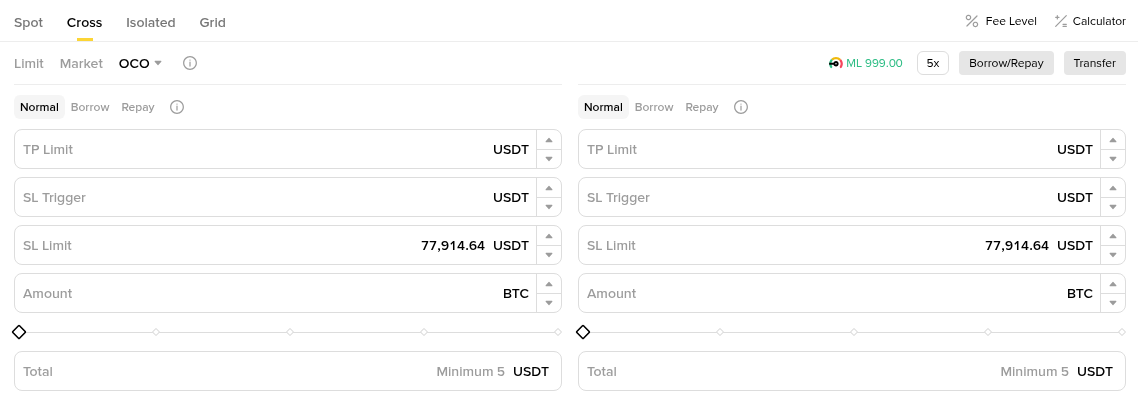
The ML reading next to the leverage button is that account-wide margin level. With no loans open it shows a very high number, and it starts to fall as soon as you borrow.
How is an isolated margin account different?
Isolated margin splits your margin trading into separate boxes, one per pair. A BTC/USDC isolated account can only hold, receive and borrow BTC and USDC, and nothing else.
Own collateral: Only the coins inside that pair's account back its loans. Your Cross Margin account and other isolated accounts are never pulled in automatically.
Own margin level: Same formula as cross, but calculated per pair. A bad trade in one pair does not change the number in another.
Leverage by pair: Eligible pairs go as high as 10x. Leverage is tiered, so the more you borrow in a pair, the lower the maximum leverage becomes, stepping down toward 5x on the largest tiers.
Liquidation lines: They depend on the leverage class of the pair. Binance lists 1.05 for 10x pairs, 1.15 for 5x and 1.18 for 3x.
Partial liquidation: When a pair hits its line, collateral is sold until the level climbs back to the margin call ratio in most cases. In extreme moves the whole position can be closed.
Adding margin to a struggling isolated position is a manual job. You transfer coins into that specific pair's account yourself.
How do the two modes line up point by point?
Cross margin, feature by feature:
Collateral: Everything in the one Cross Margin account.
Accounts: One, covering all margin pairs.
Leverage: 3x or 5x for the whole account (Classic).
Liquidation: Margin level 1.1 or lower, checked across the whole account.
Blast radius: A liquidation can sell any collateral in the account.
Isolated margin, the same features:
Collateral: Only the two coins of that pair.
Accounts: As many as you open, one per pair.
Leverage: Set per pair, tiered, as high as 10x on eligible pairs.
Liquidation: Per pair, between 1.05 and 1.18 depending on the pair's leverage class.
Blast radius: Limited to the coins in that one pair's account.
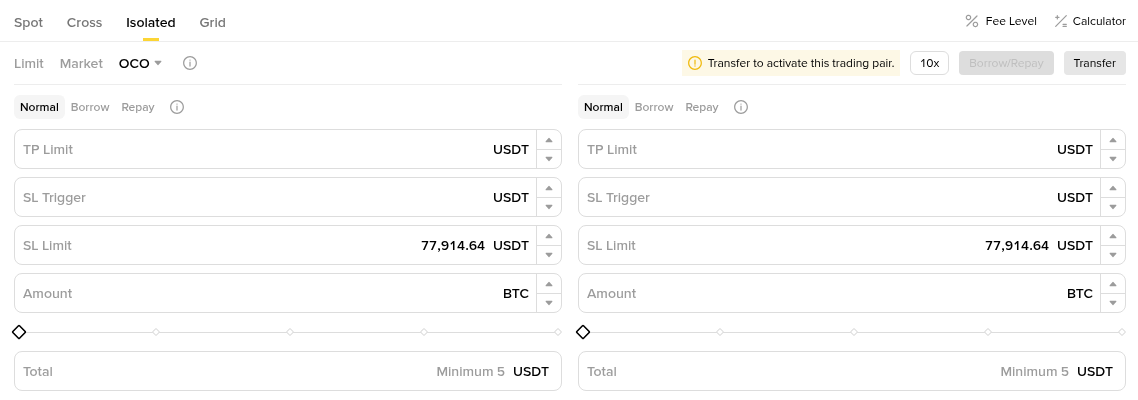
The Isolated tab asks you to transfer funds before a pair can be used, because each pair is its own account that starts empty.
What happens to $1,000 when one trade goes wrong?
Here is the scenario from the opening, worked out. All figures are illustrations that ignore interest, trading fees and slippage.
Cross trader: Moves 1,000 USDT into Cross Margin at 3x, borrows another 1,000 USDT and buys 1,000 USDT of coin A and 1,000 USDT of coin B.
Start: Assets 2,000, debt 1,000, margin level 2.0.
Coin A falls 50%: Assets 500 + 1,000 = 1,500, margin level 1.5. No margin call, both positions still open, 500 USDT down on paper.
Coin A falls 70%: Assets 1,300, margin level 1.3. The margin call arrives.
Coin A falls 90%: Assets 1,100, margin level 1.1. Liquidation, and coin B is sold too, even though it never moved.
Isolated trader: Puts 500 USDT into an A/USDT isolated account and 500 USDT into a B/USDT one, borrows 500 USDT in each and buys 1,000 USDT of each coin. Assume both are 10x pairs with a 1.05 liquidation line.
Start: Each account has assets 1,000, debt 500, margin level 2.0.
Coin A falls 47.5%: The A account holds 525 against 500 of debt, margin level 1.05. Liquidation starts and only about 25 USDT of equity is left there, before the 2% liquidation fee on the debt repaid.
Coin B account: Still at 2.0. Untouched.
So after the same 50% drop, both traders are roughly 500 USDT down. The difference is what comes next. If coin A bounces, the cross trader still holds it and recovers part of the loss, while the isolated trader was closed near the low. If coin A keeps sliding toward zero, the cross trader can lose the whole 1,000, while the isolated trader's loss stops at the 500 in that pair.
What if the whole market drops at once?
Here is a surprise for many people. When both coins fall by the same percentage, the margin level math comes out the same in both modes.
Both down 30%: Cross has 1,400 of assets against 1,000 of debt, margin level 1.4. Each isolated account has 700 against 500, also 1.4.
Both down 45%: Cross sits at 1.1 and is liquidated. Each isolated account sits at 1.1 too, just above its 1.05 line in this example.
In a broad selloff, isolation buys you almost nothing. The real gap between the two modes shows up when your positions move in different directions or by very different amounts.
How much does borrowing interest move the margin level?
Margin loans accrue interest every hour, and that interest is added to the bottom of the margin level formula. Rates are variable and shown in the Borrow window.
As an illustration, an hourly rate of 0.0005% on 1,000 USDT adds about 0.005 USDT per hour, roughly 0.12 USDT a day. That is tiny for a two-day trade and noticeable on a loan left open for months while the price drifts against you.
Closing a trade does not automatically clear the loan either. Unless you use the Repay trading method or the automatic repay option, the debt stays open and keeps accruing.
Does Futures use the same cross and isolated idea?
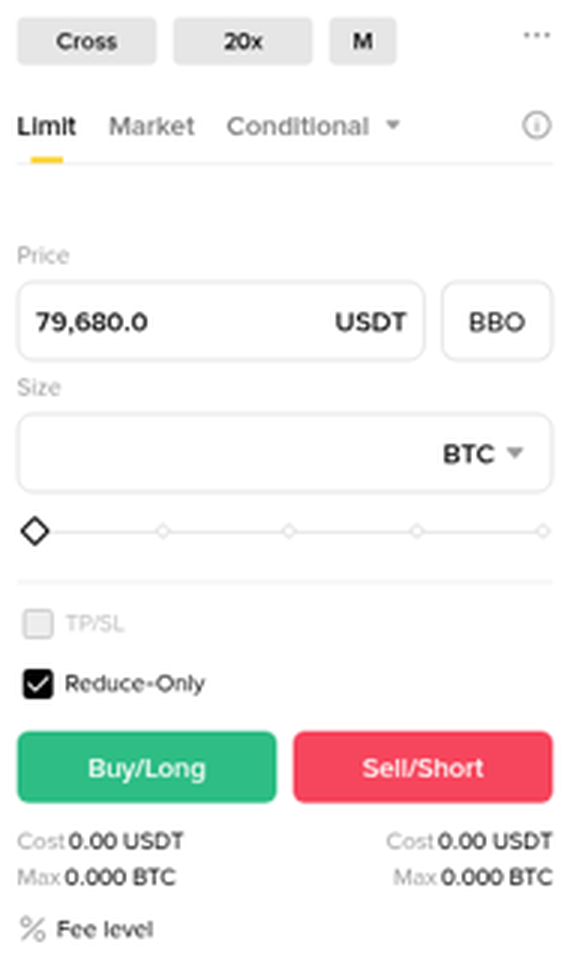
Yes, with its own rules. On the Futures order panel the first button reads Cross by default, next to the leverage button that may show something like 20x.
Default mode: All contracts start in Cross. You click Cross to switch a contract to Isolated, and the change applies only to that contract.
Timing: You cannot change the margin mode while you have open orders or positions on that contract. Pick the mode first.
What cross shares: Margin is shared among positions that use the same margin asset, for example all USDT-margined contracts draw on the USDT in your USDⓈ-M Futures wallet.
Liquidation with profits: Cross liquidation is triggered when the shared margin balance falls below the maintenance margin. A big loser can take down the account even while another position shows a profit.
Isolated leverage: On an open isolated position you can raise the leverage but not lower it.
Multi-Assets Mode: It only supports Cross, so isolated positions must be switched before you turn it on.
A rough illustration: with 1,000 USDT in the Futures wallet you open a 2,000 USDT long at 20x, which needs about 100 USDT of initial margin. In Isolated, only that 100 is on the line, and a move of a little under 5% against you is enough to liquidate it. In Cross, the whole 1,000 backs the position, so it survives a much bigger move, but if the move comes you can lose far more than 100. The maintenance margin, fees and funding shift these figures, and this guide to mark price and funding on perpetual futures covers how liquidation prices are worked out.
Which mode should a beginner pick first?
Isolated, in most cases. It turns the question "how much can I lose?" into a number you choose before the trade.
Start isolated, one pair: Put in only the amount you are ready to lose on that idea and nothing else.
Use low leverage: The fact that a pair allows 10x does not mean you should borrow that much. At 2x the liquidation line is much further away than at 8x.
Move to cross later: Cross makes sense once you run several positions that offset each other, such as a long in one coin and a short in a related one, and you want one buffer instead of topping up each pair by hand.
Futures follows the same logic: Switch the contract to Isolated before your first order, size the margin you are willing to lose, then pick the leverage.
Which mistakes wipe out margin accounts?
Using Cross Margin as storage: Coins you meant to hold long term become collateral the moment they sit in the Cross Margin account.
Thinking isolated means safe: A 10x isolated position can be liquidated on a small move. Isolation limits how far the damage spreads, not how fast it arrives.
Feeding a losing pair: Topping up an isolated account again and again turns a capped loss into an open-ended one.
Doubling the same bet: Holding ETH as collateral in cross and also opening a leveraged ETH long means one price drop hits both sides of the margin level formula.
Forgetting the loan: Selling the coin with the Normal method leaves the debt open and interest keeps adding up.
Clicking order first, mode second: In Futures the mode cannot be changed once an order or position is open on that contract.
Which edge cases catch experienced traders?
Gaps past the margin call: In a fast market the margin level can drop from the margin call zone straight to liquidation, before any top-up lands.
Locked transfers: In cross, profits cannot be moved out while the margin level is 2 or lower, even if you want to use them elsewhere.
Haircuts on collateral: In Cross Margin Classic, collateral haircuts reduce how much you can borrow and transfer out, though they are not part of the margin level itself.
Frozen during liquidation: While a liquidation runs you cannot change the margin positions involved.
Tier changes as you borrow: Borrowing more in an isolated pair can push it into a lower leverage tier with a higher initial risk ratio.
How do you keep the margin level healthy?
Watch the ML number: It sits on the order panel. Decide in advance what level makes you reduce the position, for example 1.5 in cross.
Use exit orders: The margin order panel offers Limit, Market, OCO and Stop-limit. Our walkthrough on setting a Binance stop loss with stop-limit, OCO and trailing stops shows each one.
Keep spare funds outside: A stablecoin reserve in your Spot wallet can be moved in on purpose, rather than sitting in cross where it is exposed.
Repay as you close: Pick the Repay method or the automatic repay option when you exit so interest stops.
Run the Calculator: The panel has a Calculator link. Check the liquidation price before you open, not after.
What are the risks either way?
Leverage cuts both ways: Borrowing magnifies losses exactly as much as gains, and a liquidation can remove most of the collateral involved.
Fees on top: Binance charges a 2% liquidation fee on the debt repaid, plus hourly interest and trading fees.
Market speed: Prices can move faster than any alert or manual top-up.
Rule changes: Leverage limits, tiers and thresholds can change. Check the current values on Binance before you trade.
This article is for education only and is not financial advice. Margin and futures trading with leverage can lead to liquidation and the loss of your full collateral.
If you are setting up a new account for this, code 20LESSFEES takes a flat 20% off your Spot and Futures trading fees, and the Binance welcome bonus page for new users lists the current tasks and terms.
Cross or isolated, quick questions
Can I hold cross and isolated positions at the same time?
Yes. You have one Cross Margin account and can open separate isolated accounts for different pairs alongside it. Each keeps its own margin level.
Does isolated margin cap my loss at what I put into the pair?
Your other accounts are not pulled in, so the damage stays inside that pair. Treat the whole amount in the pair as at risk, because fast moves can close it at worse prices than you expected.
Is the margin level the same thing as leverage?
No. Leverage is the maximum you are allowed to borrow, while the margin level shows how far your current assets cover your current debt and interest.
Why does the Isolated tab ask me to transfer first?
Every pair is a separate account that starts empty. Until you move collateral into it, there is nothing to borrow against.
Why can I not move coins out of Cross Margin?
Transfers out are blocked while the account's margin level is 2 or lower. Repay part of the loan or add collateral to lift it above 2.
Disclosure: this article includes a Binance sign-up link with the code 20LESSFEES. Leveraged trading can lead to liquidation. This is not financial advice.