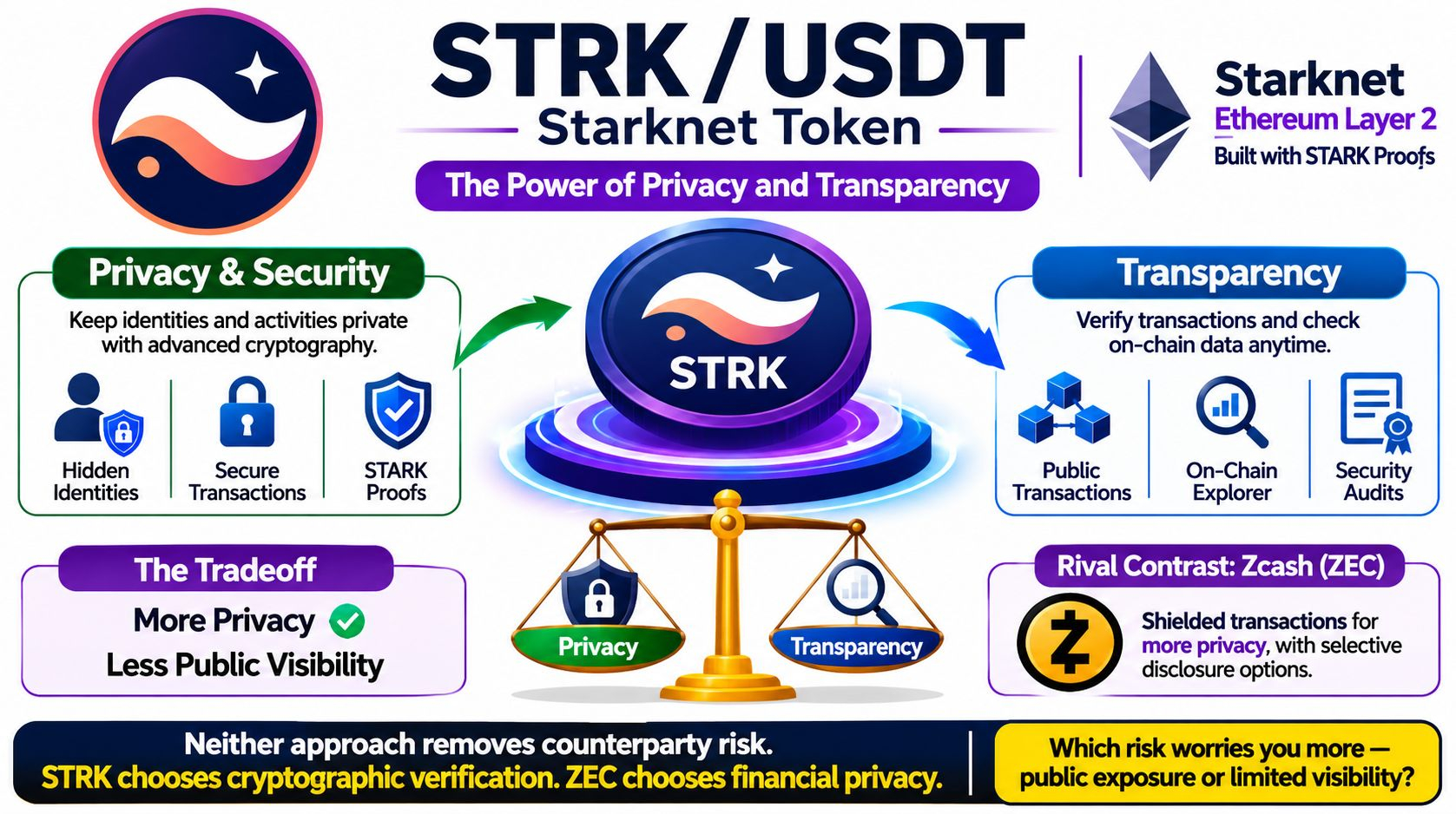
STRK is the governance and utility token of Starknet, an Ethereum Layer 2 built on STARK proofs.
But here is the tradeoff: Starknet prioritizes publicly verifiable transactions, while the identities behind many wallet addresses and their real-world ownership remain undisclosed.
That's not an oversight. It's a stated choice of how public blockchain transparency works.
Why does this matter? Public transactions allow anyone to monitor transfers, balances, and token movements. But wallet addresses do not automatically reveal who controls them, and on-chain visibility cannot expose every off-chain agreement or financial relationship.
Holders can verify transactions through blockchain explorers and examine STRK distribution and unlock schedules. Starknet also uses cryptographic proofs to verify transaction validity without independently repeating every computation.
Its Provisions-related contracts underwent internal and external security reviews, including work by Trail of Bits and Zellic. However, these are scoped security assessments, not continuous audits of every network operation. Outsiders cannot automatically verify every operational decision or wallet identity.
Now compare Zcash (ZEC). Shielded transactions conceal sender, receiver, and amounts, while viewing keys allow selective disclosure.
More privacy, but less public transaction visibility.
Neither approach removes counterparty risk.
STRK leans on cryptographic verification and public transaction records. ZEC offers financial privacy while allowing controlled disclosure.
Which risk worries you more: public financial exposure, or limited independent visibility into
private transactions?