
Not every trader needs an AI agent placing orders, and not everyone needs to build an automated strategy. Sometimes you just want to understand why Bitcoin is moving. Other times, you want to monitor several markets without spending your entire day watching charts. And if you're a developer, you might want to build an AI agent that can interact directly with financial services. This is where Binance Intelligence comes in. Binance has brought three different AI products into one ecosystem: Binance AI, Binance AI Pro, and Binance Agent OS. They may all use artificial intelligence, but they are designed for different purposes and different levels of user involvement. So, which one should you actually use? Let's compare them through practical examples rather than technical definitions.
First, Understand the Difference
The simplest way to distinguish these products is by asking yourself one question: What do I want AI to do for me?
Binance AI: Help me understand the market. This is the everyday assistant built into the Binance experience. It helps users discover market opportunities, understand price movements, follow assets, and access personalized insights. You can ask questions, explore market updates, follow relevant information, and get explanations without having to search through multiple sources.
Binance AI Pro: Help me build and automate a strategy. This takes things further. Instead of simply asking questions, you can describe a financial workflow in plain language and let AI Pro help turn it into a structured process. It can help with research reports, market monitoring, alerts, signals, and trading automation. You can refine the parameters, test the workflow, review how it works, and approve deployment.
Binance Agent OS: Help me connect and build my own AI agent. This is the developer-oriented option. It provides tools and infrastructure that allow external AI agents to interact with supported Binance capabilities, including market data, account information, trading, wallets, and payments, depending on the integration and permissions granted.
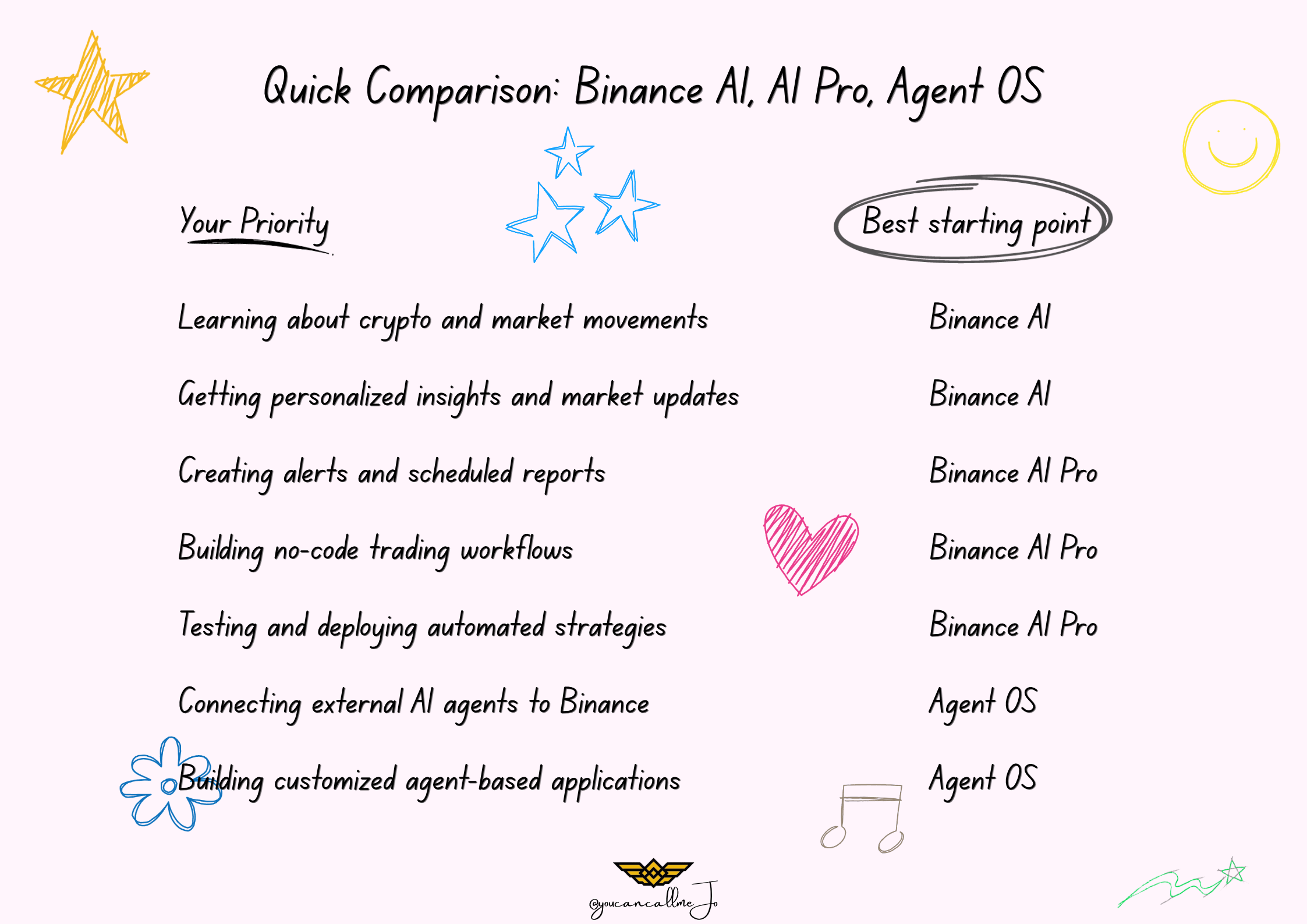
In other words, Binance AI is primarily about discovery, AI Pro is about workflows, and Agent OS is about building and connecting agents.
Scenario 1: You're a Beginner Who Wants to Understand Bitcoin
Imagine you open Binance and notice that Bitcoin has dropped 3% in a few hours. You don't immediately know whether the move is related to market sentiment, macroeconomic news, liquidations, or a broader correction. You could spend the next 30 minutes searching different websites, checking social media, and opening charts. Or you could start with Binance AI. Ask it to explain the latest market developments, identify relevant factors behind the movement, and clarify what indicators you should pay attention to. You could also ask something like: "Explain the difference between open interest and trading volume, and why both matter when analyzing Bitcoin." This is exactly where Binance AI makes sense. It helps you understand information and build market awareness without requiring you to create a trading system.
My recommendation: Start with Binance AI if your priority is learning, research, and everyday market discovery. You don't need to automate anything to benefit from AI.
Scenario 2: You're an Active Trader Who Doesn't Want to Watch Charts All Day
Now imagine you're already familiar with technical analysis. You have a strategy, you know which indicators you follow, and you want to monitor BTC, BNB, and ETH for specific conditions. Your problem isn't necessarily understanding the market. It's the time and consistency required to monitor it. This is where Binance AI Pro becomes more useful. For example, you could describe a workflow like this: "Monitor BTC/USDT every 15 minutes. Notify me when the RSI falls below 30 and the price approaches a support level I define. Include the current price, volume, and relevant market context in the alert."
AI Pro can help turn that description into a structured workflow. You can review the conditions, refine the parameters, and decide whether you want monitoring only or a more advanced trading strategy. You could also build a daily report that tracks your favourite assets and summarizes their movements at a scheduled time. The important difference is that you are no longer asking AI to explain something once. You're asking it to follow a set of instructions repeatedly.
And if you want to move toward trading automation, you can test the strategy first and review it before approving live deployment. AI Pro strategies operate through dedicated sub-accounts, adding separation from your main account.
My recommendation: Choose AI Pro if you already have an idea or strategy and want to make the process more systematic. You don't need programming experience, but you do need to understand the rules you're asking it to follow.
Scenario 3: You're a Developer Who Wants to Build an AI Trading Agent
Let's take another step. Imagine you want to build an external AI agent that checks market conditions, retrieves relevant account information, and interacts with supported Binance trading functions according to specific instructions. This is not simply a matter of asking a chatbot to analyze a chart. You need an integration that allows your agent to discover and use financial tools. That's where Binance Agent OS comes in. Through components such as the Binance MCP Server, developers can connect compatible AI applications to supported Binance capabilities. MCP, or Model Context Protocol, provides a standardized way for AI applications to discover and interact with external tools. For example, a developer could create an agent that monitors selected trading pairs, checks market data, evaluates predefined conditions, and interacts with supported trading functions when authorized.
Agent OS also brings together other components, including Binance APIs, Agentic Wallet capabilities, x402, and the Skills Hub. The right combination depends on what the developer is trying to build.
Security matters here. Agents operate within the permissions granted to them, and users can manage or revoke access. Supported integrations also use safeguards such as isolated accounts and scoped permissions.
My recommendation: Agent OS is for developers and advanced users who want to build their own AI-powered applications and integrations. If you simply want market updates or a no-code trading workflow, you probably don't need to start here.
My Personal Experience: From Asking Questions to Letting AI Act
I didn't start with all three products at once. My experience followed the same progression as the products themselves. I first explored Binance AI, using it to understand market information, ask questions, and get a clearer picture of what was happening without jumping between different sources.
When Binance AI Pro became available, I wanted to see whether it could do more than answer questions, so I started testing it with actual trading ideas. One thing that genuinely stood out was that it didn't simply encourage me to enter a trade. In one situation, its assessment suggested that staying out was the better decision. I appreciated that much more than an AI that would simply agree with whatever I asked.
Then came Agent OS. I tested it by asking an agent to analyze the BNB/USDC 15-minute chart and open a 15x leveraged futures position using 10 USDC. It actually executed the position.
That was the moment the difference became very real to me. I had moved from asking AI for information, to building strategies with it, to connecting an agent that could interact with Binance and execute an action.
Of course, I also encountered an issue with stop-loss and take-profit handling. That reminded me that execution is not magic. Connectivity, execution delays, and the rules you set still matter. A successful order does not automatically mean a successful strategy.
My biggest takeaway? These tools are not interchangeable. Each one introduces a different level of capability, and with that comes a different level of responsibility.
What Are Early Users Actually Doing With These Tools?
One of the more interesting observations in Binance Research's October 2026 report is that early users are not necessarily rushing to automate every trade.
Binance AI beta users were approximately 40% more likely to trade on the day they opened the app compared with a holdout group. This is an observed difference, not proof that using AI caused the additional trading activity.
For Agent OS, activity had recovered to around 95% of hackathon levels, with active account activity up 39%. Yet approximately 98% of the most-used calls were related to reading information rather than executing trades.
AI Pro also showed demand for monitoring. Around one in six early beta users had scheduled monitoring tasks, and those tasks accounted for roughly one-fifth of the system's output.
To me, these figures point toward something important: users are finding value in having AI collect, organize, and monitor information before handing over more complex tasks. And that makes sense. Before asking an agent to execute a trade, most users need to understand what it is doing, why it is doing it, and what could go wrong.
Can You Use All Three Together?
Absolutely. In fact, the three products make more sense when you look at them as complementary tools rather than competitors. Imagine you're following BNB. You start with Binance AI to understand market developments and identify relevant information. You then use AI Pro to create a workflow that monitors BNB/USDT for conditions you've defined and sends you alerts. If you're a developer and want to build a more customized external agent that interacts with Binance, Agent OS provides the integration layer.
Each product handles a different part of the process.
You don't have to use all three, though. The best tool is the one that solves the problem you actually have, not necessarily the one with the most advanced features.
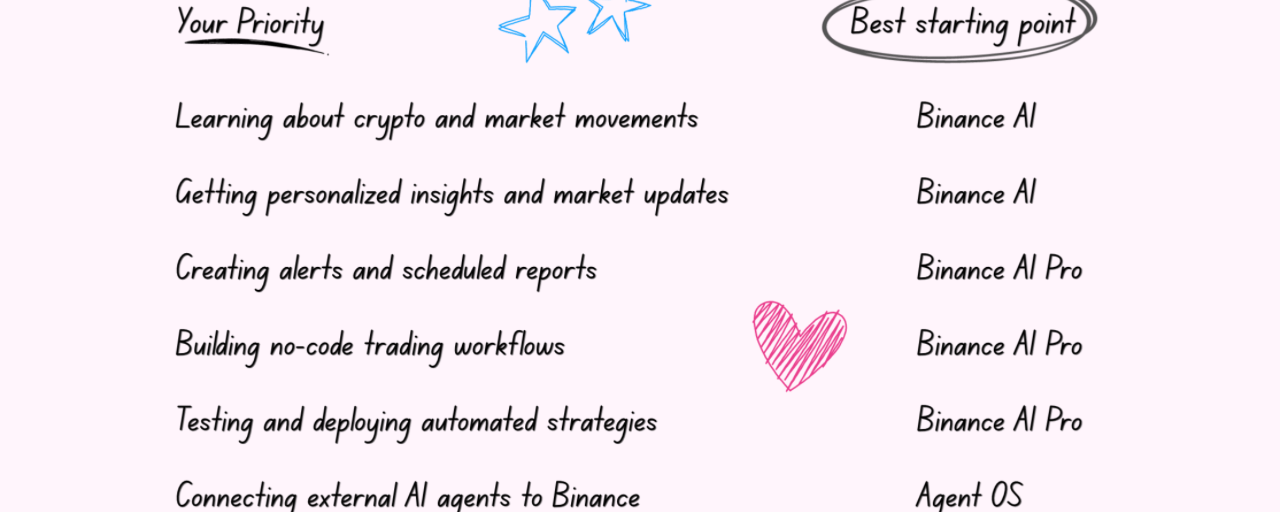
Quick Comparison: Which One Fits Your Trading Style?
Before You Let AI Handle Anything, Remember This
AI can help you research faster, monitor more consistently, and reduce repetitive work. But it cannot remove market risk or guarantee profitable decisions. A strategy can be technically correct and still lose money. An agent can execute exactly what you instructed and still produce an outcome you didn't expect. Always review the logic, test workflows before deploying them, understand the permissions you grant, and use risk limits that make sense for your situation. Be especially careful with leverage. Automation can make a bad decision happen faster, too.
Final Thoughts
I think the most interesting part of Binance Intelligence is not that Binance has introduced three AI products. It's that users can approach AI at different levels without having to become developers first. You can begin by asking questions, move toward building repeatable workflows, and eventually explore agent-based integrations if your needs become more advanced.
My advice is simple: don't start with the most complicated tool. Start with the task you want to solve.
If you want to understand the market, use Binance AI. If you want to structure and automate your process, explore AI Pro. If you want to build your own AI agent and connect it to Binance, Agent OS is the direction to explore. AI should give you more control over your process, not make you forget that you're responsible for the decisions.