
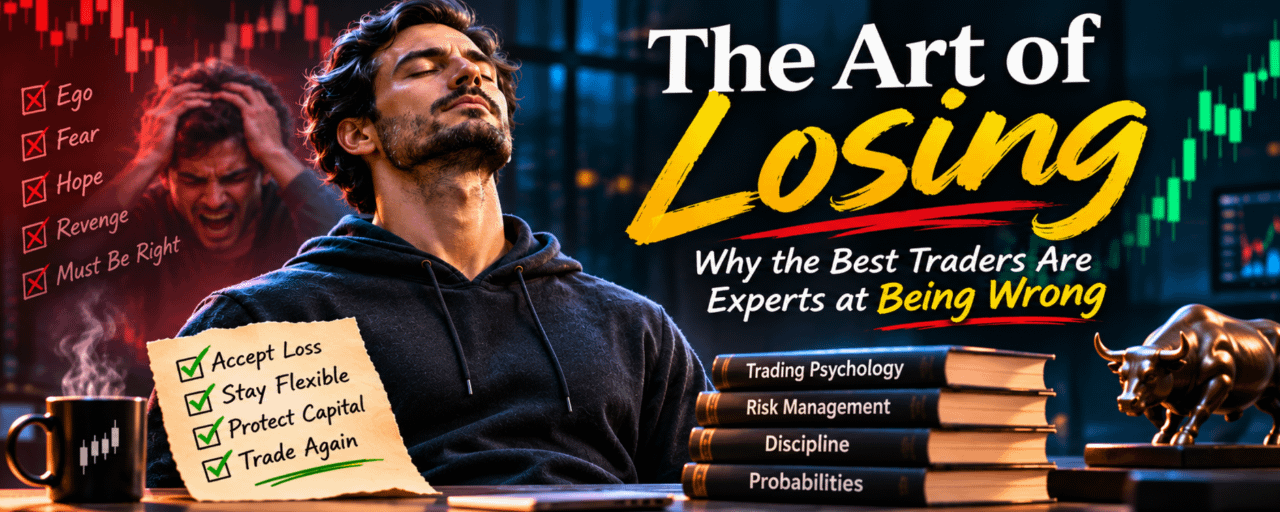

What if I told you that one of the most important skills in trading has nothing to do with winning?
Most traders enter the market obsessed with being right. They spend countless hours studying charts, identifying patterns, refining strategies, and searching for that perfect entry.
But there's something they often overlook.
The best traders aren't necessarily the ones who predict the market correctly most often. They're the ones who have mastered the art of being wrong.
And that's a skill far more difficult to develop than most people realize.
The Market Doesn't Care About Your Opinion
Imagine spending hours analyzing $BTC . You've identified a beautiful demand zone, multiple technical confluences, and what looks like an excellent long opportunity.
You enter the trade.
Price initially moves in your favor, but suddenly the market reverses.
Now you're watching your position turn red.
What happens next?
For many traders, this is where the real battle begins.
They start looking for reasons to stay in the trade. They move their stop loss further away. They switch to higher timeframes, hoping to find something that supports their original idea.
And sometimes, they even add to a losing position.
Why?
Because somewhere along the way, their analysis became their identity.
They are no longer defending a trade. They are defending their ego.
But here's something every trader needs to understand:
The market doesn't know who you are. It doesn't care how much research you've done, how confident you feel, or how badly you need that trade to work.
Your analysis is simply a hypothesis.
And a hypothesis must always remain open to being proven wrong.
Think about this for a moment.
A professional trader can enter a position with complete confidence in their process and still accept a loss without hesitation.
Not because they enjoy losing money.
But because they understand that losing is an unavoidable part of operating in an uncertain environment.
They don't become emotionally attached to their predictions.
They understand that every trade is a probability, not a promise.
If the market confirms their idea, they manage the opportunity.
If the market invalidates their idea, they exit.
Simple in theory. Extremely difficult in practice.
The goal isn't to become comfortable with losing money carelessly. It's to become comfortable accepting a small, planned loss when the market proves your idea wrong.
A loss taken according to your trading plan isn't necessarily a mistake.
Sometimes, it's evidence of excellent execution.
Your Biggest Enemy Might Be Your Own Nervous System
Here's where trading psychology gets particularly interesting.
When a trade moves against you, your brain may interpret the potential financial loss as a threat.
Your heart rate increases. Your muscles tighten. Your breathing becomes faster and shallower.
Your body begins preparing for a fight-or-flight response.
And suddenly, the calm, rational trader who carefully planned the setup disappears.
In their place is someone desperately trying to escape discomfort.
You might close a perfectly valid trade too early.
Or worse, refuse to close an invalid trade because realizing the loss feels unbearable.
This is why trading psychology isn't just about positive thinking or repeating motivational quotes.
It's also about learning to regulate your physiological response to uncertainty.
The Crucible of Uncertainty
You cannot become a disciplined trader simply by reading about discipline.
You develop it through experience.
Through watching a promising setup fail.
Through taking a stop-loss and resisting the temptation to immediately recover the money.
Through seeing price reverse in your original direction after you've already exited.
Through accepting that you can make the correct decision and still experience an unfavorable outcome.
That's the crucible in which trading discipline is developed.
And there's a particularly important lesson hidden inside those experiences:
You don't need to know what the market will do next to make a good trading decision.
You only need to know what you'll do under different conditions.
Before entering, you should already understand where your idea becomes invalid, how much capital you're willing to risk, and what conditions would justify holding or exiting.
Once those decisions are made, your responsibility is to execute them.
Not to argue with the market.
Not to negotiate with your stop-loss.
And certainly not to prove that your prediction was correct.
The Freedom of Not Needing to Be Right
One of the biggest psychological breakthroughs a trader can experience is realizing that being wrong doesn't have to be a big deal.
Imagine risking $20 on a trade with a potential reward of $80.
You take the setup. The market invalidates it. You lose $20.
That's it.
You followed your process, respected your risk, and preserved your ability to participate in the next opportunity.
Of course, the strategy still needs a genuine statistical edge. Good risk management alone cannot turn a losing strategy into a profitable one.
But now imagine the alternative.
You refuse to accept that $20 loss. You move your stop. You add to the position. You convince yourself the market will eventually reverse.
What started as a small, manageable loss becomes a serious threat to your account.
All because you couldn't tolerate being wrong.
A trader who cannot accept a small loss will eventually be tempted to accept a much larger one.
This is why professional trading requires a fundamentally different mindset.
You stop asking, "How can I make sure this trade wins?"
And start asking, "How can I execute this idea correctly, regardless of the outcome?"
Become an Expert at Losing
The next time you enter a trade, pay attention to what happens inside you when price moves against your position.
Notice your heartbeat.
Notice the urge to interfere.
Notice how quickly your mind begins searching for evidence that you're still right.
Don't immediately obey those impulses.
Return to your trading plan.
Ask yourself whether the original setup remains valid.
If it does, manage the trade according to your rules.
If it doesn't, take the loss.
No drama. No revenge trading. No desperate attempt to win the money back.
Just another trade in a long series of probabilities.
Because ultimately, trading isn't about winning every battle.
It's about surviving enough battles, protecting your capital, and consistently executing a process that has a positive expectancy.
And perhaps the greatest paradox in trading is this:
The moment you stop desperately trying to avoid every loss may be the moment you finally begin developing the discipline required for long term success.
The market will give you countless opportunities to be wrong.
Your job is to make sure being wrong never becomes something you cannot recover from.
Learn to lose well. That's how you give yourself the opportunity to win over time.
#tradingpsychology