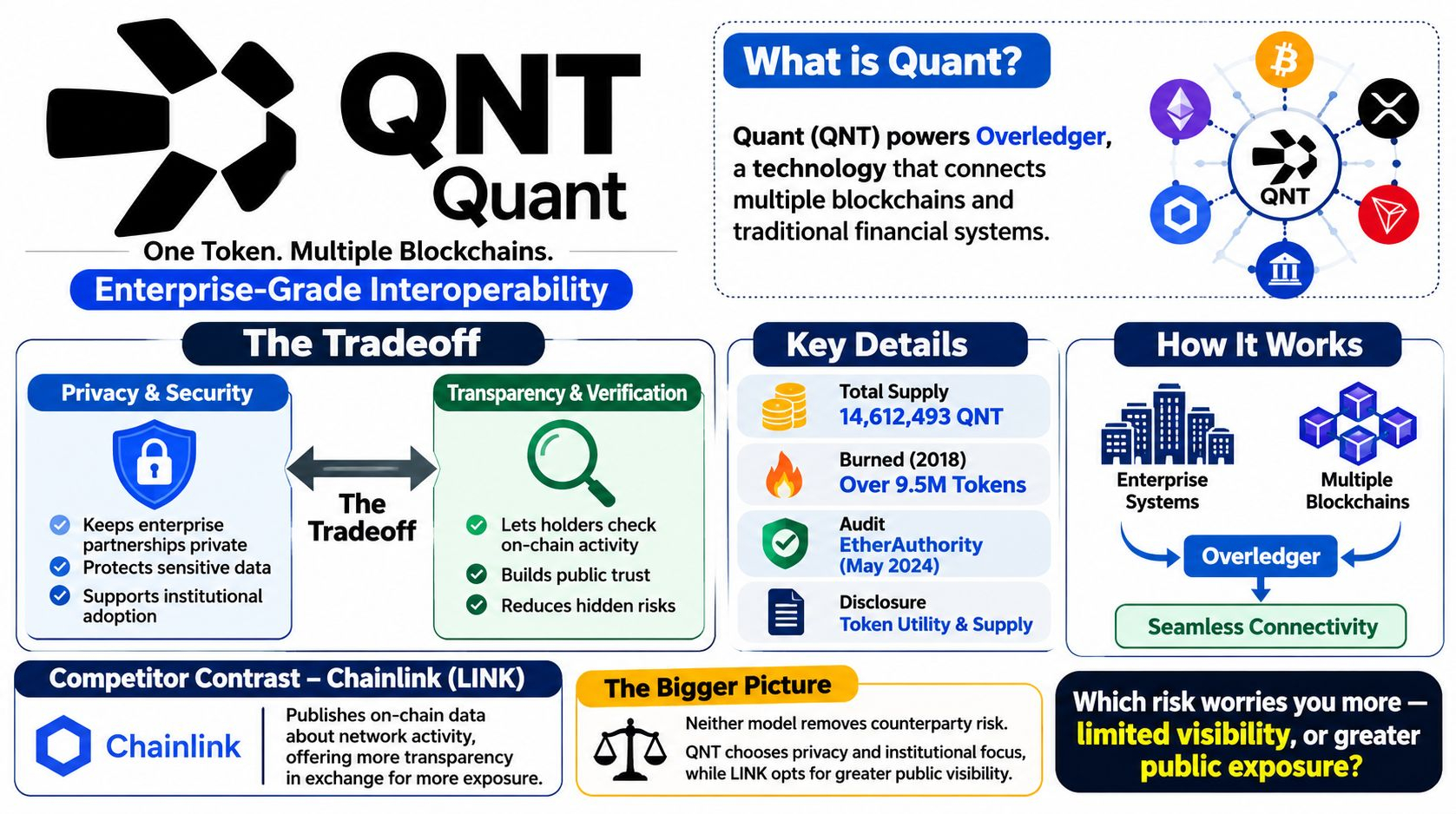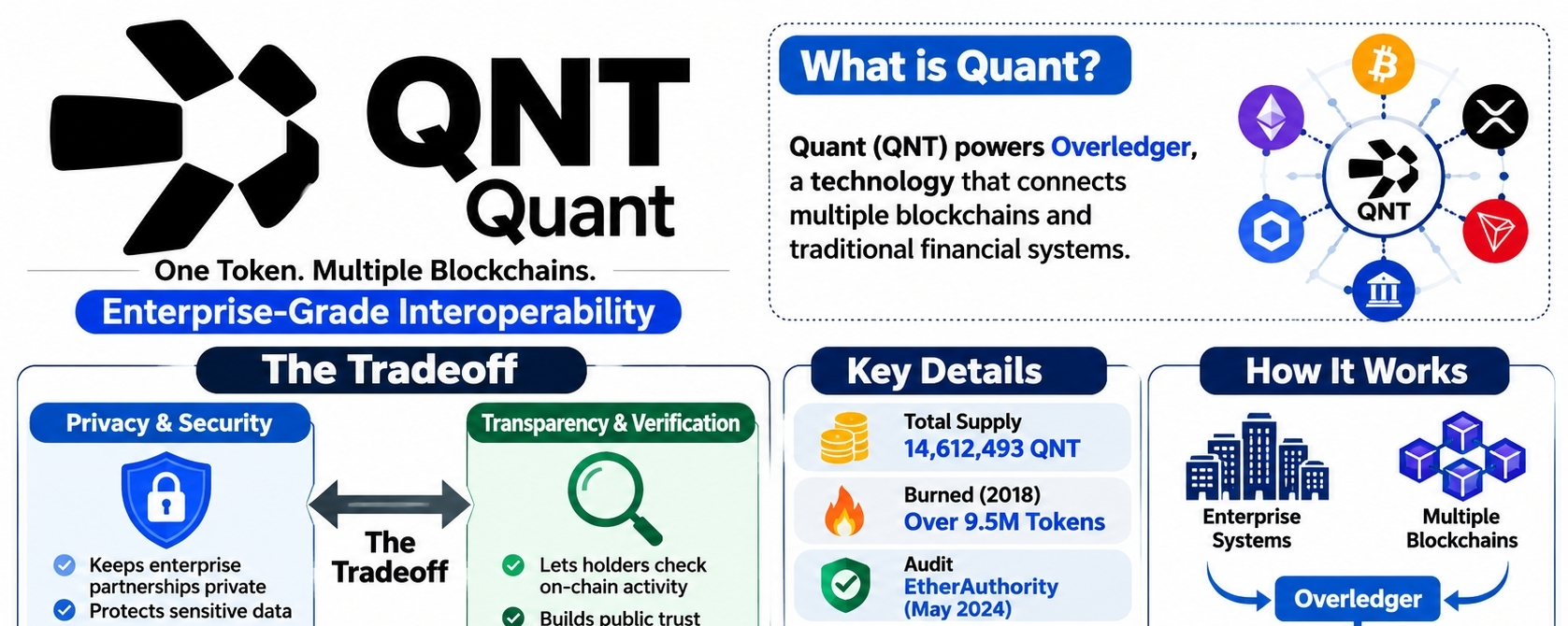
QNT’s total supply is capped at 14,612,493 tokens, and Quant publicly disclosed burning over 9.5 million unsold tokens in 2018.
But a fixed supply does not mean holders can independently verify every aspect of the company’s operations. That's not an oversight. It's a stated choice.
Quant focuses on enterprise blockchain interoperability through Overledger, connecting traditional financial systems with multiple blockchain networks.
Keeping enterprise infrastructure, client relationships, and operational details private can protect commercial interests, sensitive integrations, and institutional clients. The tradeoff is that outsiders cannot independently verify every commercial relationship, revenue stream, or institutional commitment.
QNT holders can verify the token contract through Ethereum, but the company behind Quant operates through a corporate structure rather than decentralized governance.
Quant's official disclosures and public documentation explain its token utility, supply history, and platform terms. EtherAuthority conducted a smart contract security audit in May 2024. However, a contract audit is not a financial audit of the company or its commercial operations.
The blockchain makes token transfers publicly traceable, while company finances, institutional agreements, and internal operations remain less independently verifiable. Public disclosures also do not provide continuous financial auditing.
Chainlink (LINK) presents a different transparency model. Its oracle networks publish on-chain data about network activity and service performance, creating more exposure, in exchange for greater public scrutiny of certain operational metrics. This still does not mean every corporate financial detail is transparent.
Neither approach removes counterparty risk. QNT relies on fixed supply, token utility, audited code, and trust in Quant's corporate execution. LINK relies on publicly observable network activity while still carrying technical, operational, and ecosystem risks.
QNT chose a model centered on enterprise privacy and company-led execution, rather than tokenholder governance. Its trust model depends substantially on Quant's ability to deliver institutional adoption.
Which risk worries you more — limited visibility into corporate operations, or greater public exposure