

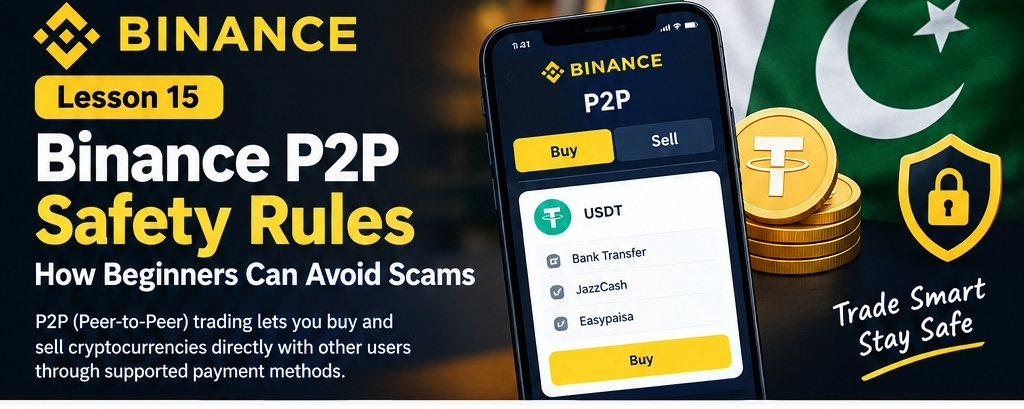

Lesson 15 — Binance P2P Safety Rules: How Beginners Can Avoid Scams
Introduction
Binance P2P stands for Peer-to-Peer trading. It allows users to buy and sell cryptocurrencies, such as USDT, directly with other users through supported payment methods.
For example, a buyer may pay Pakistani rupees (PKR) through an available bank transfer or supported mobile wallet, while the seller transfers USDT through the platform's P2P process.
P2P trading can be convenient, but beginners must understand its risks and follow safety rules before making a transaction.
1. Understand How P2P Escrow Works
In a P2P sale, the platform's escrow process holds the seller's cryptocurrency during the transaction according to the platform's rules.
When selling USDT, the seller should release the cryptocurrency only after independently confirming that the payment has actually arrived in their account.
Important: Never release cryptocurrency just because the buyer sends a payment screenshot or claims that the transfer is complete.
2. Never Trust Payment Screenshots Alone
A screenshot, SMS notification, or edited receipt is not sufficient proof of payment.
Always open your own banking app or mobile wallet and check the transaction history and available balance.
If the money has not arrived, do not release the cryptocurrency. Follow the platform's dispute or appeal procedure if necessary.
3. Never Trade Outside the Platform
Keep communication and transaction details within the official P2P platform wherever possible.
Avoid requests to complete a transaction through WhatsApp, Telegram, or another external channel.
Trading outside the platform can remove important protections and make disputes more difficult to resolve.
4. Use Your Own Verified Payment Account
Use payment accounts that belong to you and comply with the platform's current requirements.
Do not accept or send payments through unrelated third parties without confirming that the transaction complies with the platform's rules.
Third-party payments can create fraud, account-freezing, and money-laundering risks.
5. Check the Trader's Profile
Before placing an order, examine the other trader's profile.
Look at:
- Order completion rate
- Number of completed orders
- Account history
- Advertised exchange rate
- Payment method and transaction limits
A high completion rate does not guarantee that a trader is honest. Continue to follow every safety rule.
6. Beware of Fake Customer Support
Scammers may pretend to be Binance employees, payment service representatives, or experienced traders.
They may ask for your password, verification code, recovery phrase, or remote access to your phone.
Never share your password, one-time password (OTP), or account security codes with another person. Use the official app or website to contact support.
7. Do Not Cancel or Release Under Pressure
A scammer may pressure you to release cryptocurrency before payment arrives or ask you to cancel an order after making a payment.
Stay calm and follow the official order instructions.
If you have already paid but the seller refuses to release the cryptocurrency, preserve your evidence and use the platform's official appeal process. Do not pay a second time to resolve the same order.
8. Beware of Unusually Attractive Rates
An exchange rate that looks much better than the market rate can be a warning sign.
Compare available offers, review the trader's history, and understand the order's limits before proceeding.
Never make a transaction simply because someone promises guaranteed profit or an unusually favorable rate.
9. Protect Your Account
Follow these basic account-security practices:
- Enable available two-factor authentication.
- Use a strong, unique password.
- Never share your account with another person.
- Verify that you are using the official Binance website or application.
- Do not install unknown applications or click suspicious links.
- Keep records of your transactions and payment confirmations.
10. What Should Pakistani Beginners Remember?
If you use a Pakistani bank account or mobile wallet, check the provider's terms and applicable local regulations before trading.
Keep transaction records, use only payment methods permitted by the platform, and never assume that P2P transactions are risk-free.
Rules and supported payment methods may change, so consult the official Binance P2P guidelines before placing an order.
Official resource: https://www.binance.com/en/support
Final Thoughts
Binance P2P can be useful for buying and selling cryptocurrency, but safety depends on careful verification and following the correct process.
Remember these five rules:
1. Never release crypto before confirming payment.
2. Never trust screenshots alone.
3. Never share passwords or OTPs.
4. Never move a transaction outside the official platform.
5. Use official support if a dispute occurs.
Learn first. Verify every payment. Protect your money.
Educational content only. Cryptocurrency transactions involve financial and fraud risks. This article is not financial or legal advice. @Bitcoin