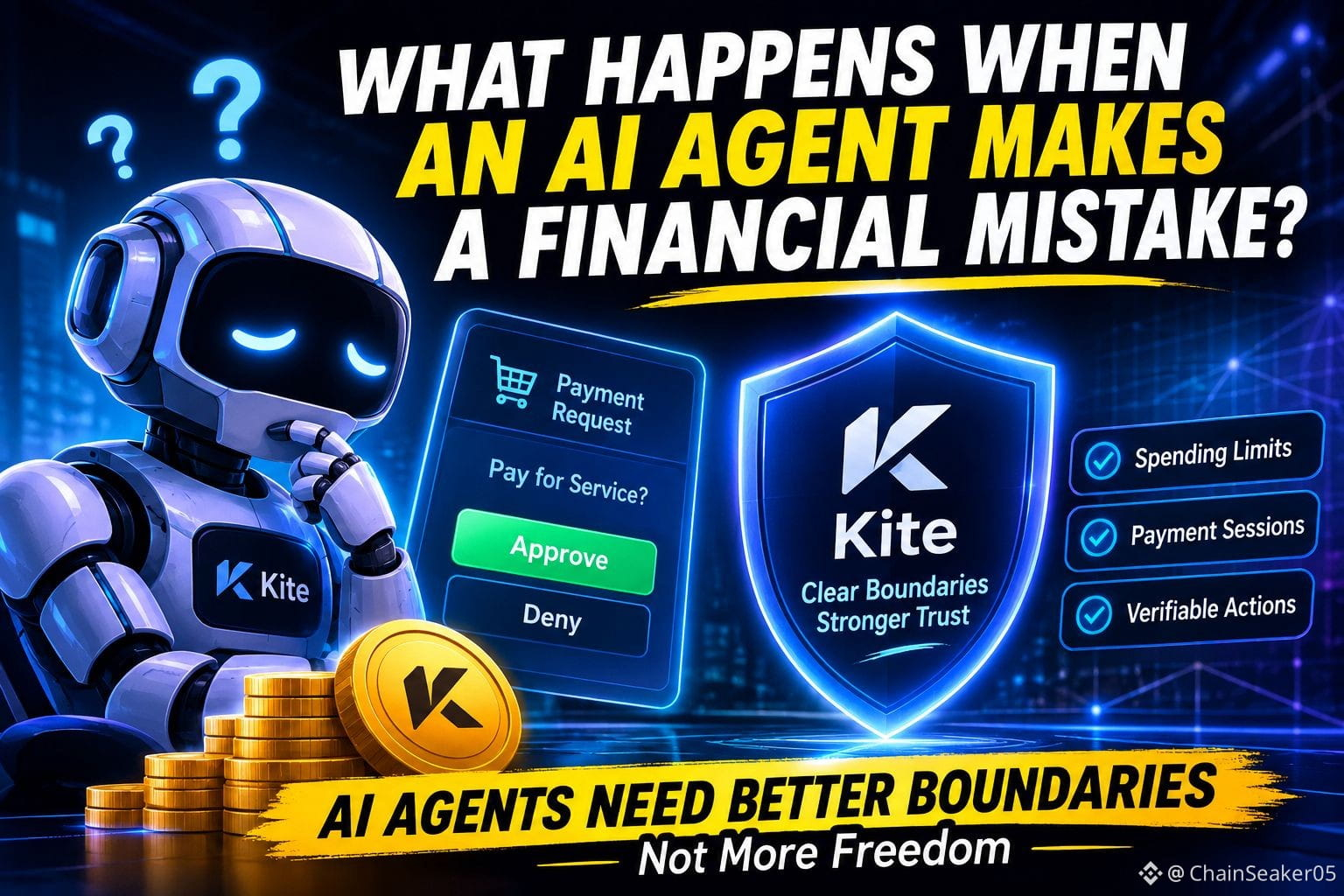
WHAT HAPPENS WHEN AN AI AGENT MAKES A FINANCIAL MISTAKE? 👀
I've been looking at the AI agent narrative from a slightly different angle lately.
Everyone wants AI agents that can do more. Execute tasks, make payments, access services, and operate without waiting for human approval every time.
But here's the part I think deserves more attention.
What happens when an agent makes the wrong decision with your money?
Imagine giving an AI agent permission to pay for a service while you're offline. It finds an option, executes the payment, and completes the task. Sounds convenient, right?
Now imagine it chooses the wrong service or spends more than you expected. Suddenly, automation becomes a question of trust.
This is where @KITE AI 中文 gets interesting to me.
The bigger opportunity isn't simply allowing AI agents to move money. It's creating a system where permissions, spending limits, payment sessions, and verifiable actions can help keep that autonomy under control.
Kite's Passport and payment-session approach are worth watching in that context. But having the infrastructure is only one part of the equation.
The real test is whether developers build useful applications around it, users trust those applications with real transactions, and the system proves reliable beyond early experiments.
I'm not convinced that more autonomous agents automatically mean a better AI economy.
The real breakthrough might be an agent that knows exactly what it can do, what it cannot do, and when it needs human approval.
That's the difference between an AI that can act and one people might actually trust with their money.
And honestly, I think that distinction will matter a lot as the agent economy develops.
$KITE #kite