

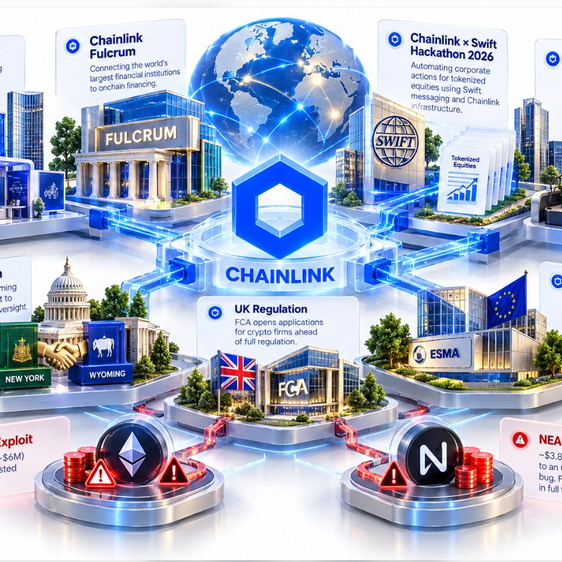
LINK - Chainlink
$ETH provides smart-contract infrastructure.
$SOL provides high-speed blockchain execution.
$XRP targets financial settlement.
But $LINK 
Reliable connections between blockchains, real-world data, and institutional financial systems.
Chainlink has built relationships and integrations across DeFi and traditional finance.
Its technology helps secure lending markets, power price feeds, and enable cross-chain communication.
But here's the question.
If Chainlink becomes essential infrastructure for tokenized finance, will LINK holders capture enough of that economic value?
NO.1 WHAT IS CHAINLINK?
Chainlink is a decentralized oracle and interoperability platform.
Blockchains cannot independently verify every piece of information outside their networks.
Chainlink provides infrastructure that connects smart contracts with external data and other systems.
Its main products include:
Data Feeds
Data Streams
Cross-Chain Interoperability Protocol (CCIP)
Proof of Reserve
Automation
Chainlink Runtime Environment (CRE)
Chainlink isn't another Layer 1 competing for transactions. It's infrastructure designed to connect financial systems.
NO.2 WHERE DOES THE DEMAND COME FROM?
Chainlink serves blockchain applications, financial institutions, and infrastructure developers.
Demand comes from:
Price data for DeFi protocols
Cross-chain messaging and asset transfers
Automated smart-contract execution
Verification of tokenized-asset reserves
Enterprise blockchain integrations
Some services charge usage-based fees.
Others use subscription or negotiated commercial arrangements.
The key distinction is that customers can pay for Chainlink services without necessarily buying LINK directly on exchanges.
NO.3 THE BIG NARRATIVE
Chainlink combines three powerful themes:
Real-world asset tokenization
Institutional blockchain adoption
Cross-chain interoperability
If banks tokenize bonds, funds, and other financial assets, those assets will need trusted data and ways to move between systems.
Chainlink is positioning itself as infrastructure for that transition.
The opportunity isn't just bringing assets on-chain. It's connecting those assets to the rest of global finance.
NO.4 THE REAL COMPETITIVE ADVANTAGE
Chainlink's biggest advantage is its established integration network.
Its infrastructure is already used across major DeFi applications.
It also has relationships and technical collaborations involving institutions such as Swift and financial-market participants.
But those relationships require careful interpretation.
A successful pilot isn't the same as a production deployment generating recurring revenue.
Chainlink's potential moat comes from reliability, security, integration costs, and the difficulty of replacing critical financial infrastructure.
<WritingBlock id="59372" variant="social_post">### NO.5 THE NUMBERS THAT MATTER
Market Snapshot — October 29, 2026
Price: ~$11.60
Market cap: ~$8.9B
FDV: ~$11.6B
Circulating supply: ~766.85M LINK
Total / maximum supply: 1B LINK
Circulating ratio: ~76.7%
24H trading volume: ~$297M
Decline from ATH: ~78%
Network Economics
Cumulative transaction value enabled: Over $36T
LINK staked: Over 42M
LINK accumulated in Chainlink Reserve: Over 5M
Verified consolidated 30-day revenue: Not publicly established
Direct dividends to ordinary LINK holders: None
Here's the important distinction.
Chainlink has helped facilitate over $36 trillion in transaction value. But that is not $36 trillion in revenue, TVL, or LINK demand.
The valuation depends on how much economic activity Chainlink can monetize.
NO.6 THE TOKENOMICS TRAP
LINK has a fixed maximum supply of 1 billion tokens.
Approximately 76.7% is circulating.
Unlike inflationary Layer 1 networks, LINK doesn't require continuous new token creation for staking rewards.
But roughly 233 million tokens remain outside reported circulating supply.
Fixed maximum supply doesn't mean zero dilution.
Future transfers from noncirculating holdings can still expand the tradable float.
NO.7 THE NEXT BIG UNLOCK
DefiLlama currently lists no confirmed upcoming scheduled LINK unlock.
However, it records an October 9, 2026 release of approximately 18.75M LINK from noncirculating wallets.
That's an important warning.
No scheduled unlock doesn't mean no future supply distributions.
The relevant variables are actual wallet transfers, exchange deposits, and changes in circulating supply.
NO.8 THE VALUE CAPTURE QUESTION
This is where Chainlink's investment thesis has become more interesting.
Chainlink introduced Payment Abstraction and the Chainlink Reserve.
The mechanism works like this:
Customers pay for Chainlink services using supported assets or fiat.
Payment Abstraction converts eligible revenue into LINK.
LINK accumulates in the strategic reserve.
The reserve has already accumulated more than 5 million LINK.
Chainlink Staking also uses LINK to support network security.
This creates a more explicit connection between commercial adoption and token demand.
But there's a catch.
Reserve accumulation isn't the same as permanent token burning or cash dividends.
And the current reserve is small relative to LINK's approximately $8.9B market cap.
The mechanism is real. Its future economic significance still needs to be demonstrated.
NO.9 THE FINAL VERDICT
I'm bullish on Chainlink's strategic position in tokenized finance.
It has established integrations, important infrastructure products, and growing institutional relevance.
More importantly, its economic model now has a mechanism designed to convert service revenue into LINK accumulation.
But the valuation already reflects substantial expectations.
My verdict: Strong infrastructure moat. Credible institutional positioning. Improving token value capture, but limited public revenue transparency.
I'd become more bullish if recurring commercial revenue and LINK Reserve accumulation accelerated enough to outweigh future supply distributions.
I'd become less bullish if institutional adoption grew while measurable LINK purchases remained insignificant.
Chainlink doesn't need every financial institution to hold LINK directly.
It needs financial institutions to pay for services that create sustained LINK demand.
That's the distinction that matters.
Bookmark this before the next RWA rotation.
Would you rather own LINK for financial interoperability, $ONDO for tokenized assets, or $XRP for payment infrastructure?
Which token has the strongest connection between institutional adoption and long-term value?
Drop your pick below.