


Let's start with a question every crypto user has probably asked at least once: If I leave my money on Binance, is it actually safe?
It's a fair question. You can spend months building your portfolio, buying Bitcoin, collecting BNB, or holding USDT for your next trade. But when your assets sit on a crypto exchange, you're trusting more than the market. You're trusting the platform's security, its ability to manage customer assets, and its ability to keep operating when things go wrong.
Binance has several safeguards designed to protect user assets, including Proof of Reserves, the Secure Asset Fund for Users (SAFU), account security controls, and systems that monitor suspicious activity. Each addresses a different risk, and understanding those differences matters more than memorizing a list of security features.
Think of it this way: Proof of Reserves helps you examine whether assets are held to back customer balances, security controls help prevent unauthorized access, and SAFU is an additional fund intended to protect users in certain circumstances. They work toward different goals, so none should be treated as a magic shield against every possible loss.
And here's the important part: no crypto exchange can honestly guarantee that your money is completely risk-free. The goal is to understand what protections exist, what they actually cover, and what risks remain your responsibility.
How Does Binance Protect Customer Funds?
Protecting customer funds requires several layers of security because the risks don't all come from the same place. Someone might try to hack an exchange, steal a user's password, trick a trader into approving a transfer, or exploit a technical vulnerability. One security measure cannot solve every one of these problems.
Binance describes its approach through a combination of asset custody practices, account security features, monitoring systems, and transparency tools. These measures are designed to reduce the likelihood of unauthorized access and help users understand how their assets are protected.
Account security is one of the most important layers. Binance supports features such as two-factor authentication (2FA), passkeys or other supported authentication methods, anti-phishing codes, and withdrawal address whitelisting. These tools help protect against different threats. For example, 2FA adds a verification step beyond your password, while a withdrawal whitelist can restrict transfers to approved wallet addresses.
Consider a familiar scenario: you receive an email claiming that your Binance account will be suspended unless you log in immediately. The email looks convincing, so you click the link and enter your password. If the page is fraudulent, you've potentially handed your credentials to a scammer. An anti-phishing code can help you identify genuine Binance communications, but it won't make every fake message obvious. The safest move is to open the official app or type the website address yourself instead of trusting an unexpected link.
Platform-level safeguards matter just as much. Exchanges need systems to monitor unusual account activity, identify suspicious transactions, and respond to potential security incidents. Binance also describes risk-based measures that may temporarily restrict withdrawals when activity needs further verification. Such controls can help prevent unauthorized transfers, although they may sometimes delay legitimate transactions while checks are completed.
For users in Lebanon and across the MENA region, the practical lesson is simple: don't treat account security as something the exchange handles entirely for you. Use a unique password, enable strong authentication, secure your email and phone, and never share verification codes with anyone claiming to be customer support. If someone asks for your password or recovery credentials to "protect" your funds, they're not protecting your funds.
What Is Binance's Proof of Reserves and How Does It Work?
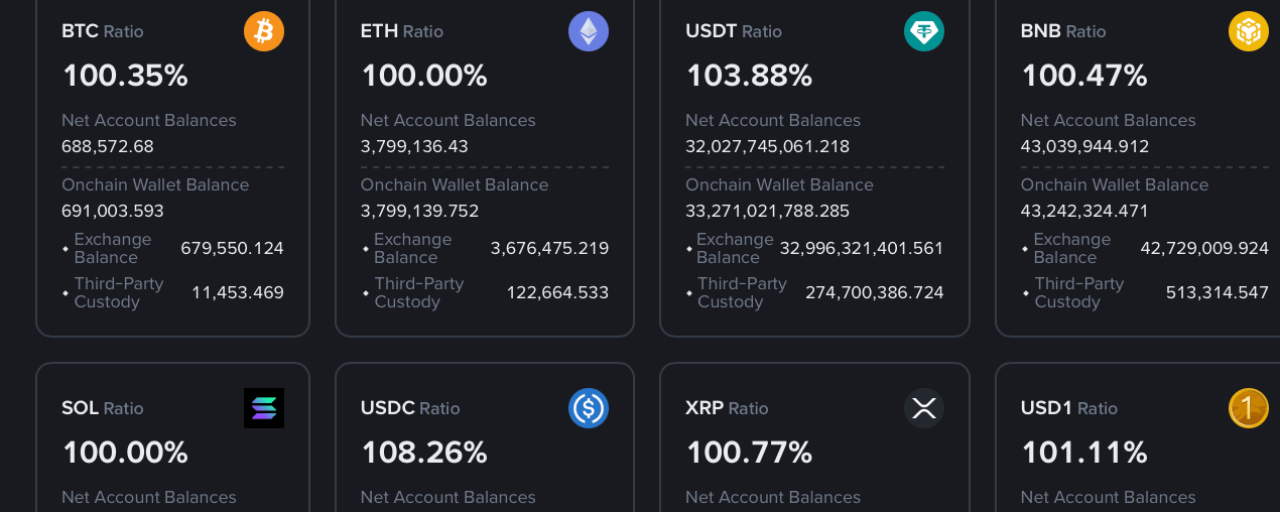
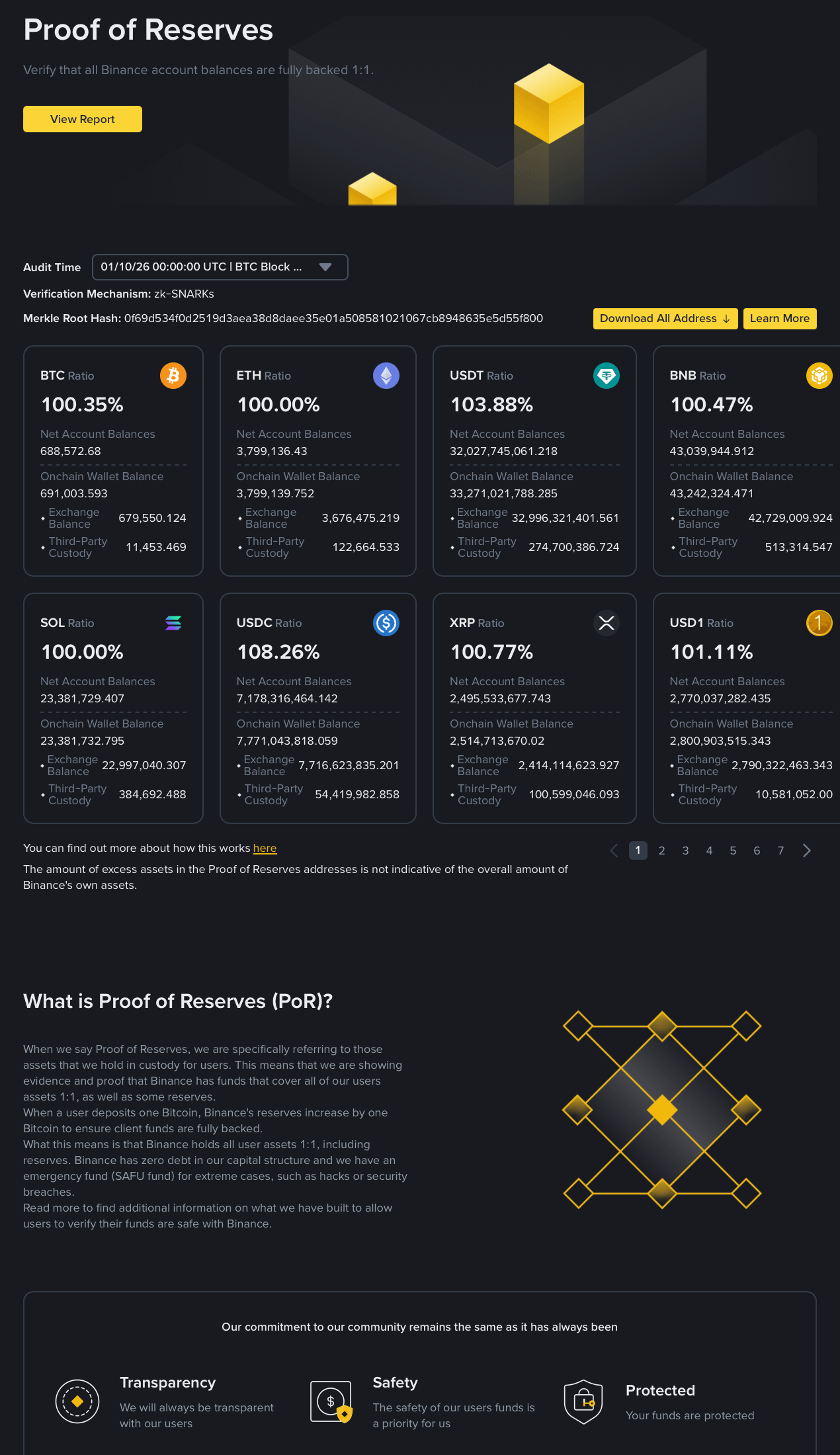
Proof of Reserves, usually shortened to PoR, is a way for a crypto exchange to provide evidence that it holds assets corresponding to customer balances. Binance's published PoR system is designed to let users verify that their balances are included in the verification process and to compare the relevant user liabilities with the assets held in reserve.
The easiest way to understand PoR is to imagine a warehouse. Hundreds of customers have stored goods there, and each customer wants evidence that the warehouse still holds enough goods to cover what it owes. A simple statement from the warehouse manager saying "everything is here, trust me" isn't particularly reassuring. A verifiable inventory provides more useful evidence.
In crypto, the inventory is more complicated because the assets are digital and the customer records must remain private. Binance uses a cryptographic structure called a Merkle tree, along with zero-knowledge proof technology known as zk-SNARKs, to help users verify that their account balances are included in the relevant data without revealing other customers' private information.
Here's what that means for you. Suppose your Binance account holds 0.02 BTC. A PoR verification can help you check that your account balance was included in the relevant snapshot and that the published verification supports the stated reserve coverage for the assets examined. You're not simply being asked to accept a number on a dashboard; you have a way to verify your own inclusion in the process.
Binance provides a Proof of Reserves page where users can review reserve information. Its published instructions also explain how to access account verification details through the wallet verification section. Follow the current instructions on the official Binance Proof of Reserves page to check the latest available information.
But here's the part that deserves attention: Proof of Reserves is not the same as a complete financial audit or a guarantee of solvency. A reserve snapshot can show evidence of specified assets at a particular time, but it cannot by itself establish that an exchange has no undisclosed liabilities, no operational problems, or no financial obligations beyond those covered by the report. Its value depends on what was examined, when the snapshot was taken, and how the verification was performed.
Think of PoR as checking that the warehouse has the goods it says it holds, rather than assuming you've audited the entire company's finances. It's a meaningful transparency tool, but it isn't the whole story.
What Is Binance's SAFU Fund and How Does It Protect Users?
SAFU stands for Secure Asset Fund for Users. Binance established this emergency fund in 2018 to provide an additional layer of protection for users in certain extreme circumstances, particularly eligible losses associated with security incidents. Binance has stated that it maintains the fund at a level typically set around $1 billion, although its composition and value can change. In April 2024, Binance announced that it was converting the fund's assets to USDC. Check the official SAFU information for its current status and wallet details.
Why does this matter? Because even a platform with multiple security systems needs to consider what happens if a serious incident gets through those defenses. Prevention is the first objective, but financial resources for eligible recovery claims can provide another layer of protection when prevention fails.
Binance's own history offers a useful example. On May 7, 2019, the exchange disclosed a security breach in which attackers withdrew approximately 7,000 BTC from its hot wallet, worth around $40 million at the time. Binance said the incident affected its hot wallet, which held about 2% of its total BTC holdings, while its other wallets remained unaffected. The company announced that it would cover the losses in full so that affected users would not bear them.
The lesson isn't that hacks are harmless. It's that a security incident can happen even at a major exchange, and the response, available safeguards, and financial resources matter enormously. SAFU is intended to provide an additional protection mechanism for eligible losses, rather than eliminate the possibility of an incident.
There is, however, an important distinction between an emergency fund and a personal insurance policy. SAFU does not mean every loss is automatically reimbursed. Binance's published terms give it discretion to determine which losses and claims qualify, and users should review the current eligibility rules and claim procedures rather than assume that every stolen asset will be replaced.
Imagine someone loses access to their assets following a qualifying security incident involving a vulnerability in the platform's systems. SAFU may be relevant to the recovery process, subject to the fund's terms and Binance's assessment. But if a user voluntarily sends crypto to a scammer, shares their credentials, or falls for a fake investment scheme, reimbursement should not be assumed. The circumstances and applicable eligibility rules matter.
In short, Proof of Reserves and SAFU serve different purposes. One helps provide evidence about asset backing; the other is an emergency fund intended to help cover certain eligible losses. Neither should be confused with a blanket guarantee that every user will recover every asset under every circumstance.
How Does Binance Use AI and Security Technology to Protect User Assets?
Crypto security isn't just about keeping hackers out of a server room. It also involves identifying suspicious patterns, detecting account takeovers, monitoring transactions, and reacting quickly when something doesn't look right. Technology can help security teams process signals at a scale that would be difficult to manage manually.
Binance describes using automated security monitoring and risk controls to help identify suspicious account activity and protect users. Such systems can support the detection of unusual behavior and trigger additional verification or temporary withdrawal restrictions when risks need to be investigated.
Imagine that you normally log in from your usual device and make small withdrawals to a wallet you've used before. Suddenly, someone attempts to access your account from an unfamiliar environment and initiates a large withdrawal to a new address. A security system may flag the activity for further checks rather than treating it exactly like your ordinary transactions. That is the general idea behind risk-based monitoring, although the exact signals and thresholds used by any particular system are not necessarily public.
AI and automated monitoring can also help identify patterns across large volumes of transactions, but it's important not to assume that every security control is AI-powered or that an automated system will catch every scam. Fraudsters adapt, legitimate activity can look unusual, and sophisticated attacks may evade detection. Security technology works best as one layer in a broader defense.
Your own settings remain crucial. Enable strong authentication, consider a withdrawal address whitelist, use an anti-phishing code, and review the devices that have accessed your account. If you receive an unexpected security alert, verify it through the official Binance app or website instead of clicking the link in the message. Binance's security guidance explains these steps and why they matter.
For beginners, this is the practical takeaway: an exchange can invest in sophisticated monitoring, but your account can still be exposed through a compromised email, a stolen password, a fake support agent, or a malicious link. Good security combines platform defenses with sensible personal habits.
What Happens to My Assets if a Crypto Exchange Becomes Insolvent?
This is the question behind many users' concerns, and it deserves a direct answer: if a crypto exchange becomes insolvent, access to your assets may be delayed or restricted, and you may face uncertainty about how much you can recover. The outcome depends on the exchange's legal structure, how customer assets are held, applicable laws, and the circumstances of the insolvency.
Insolvency generally means that a company cannot meet its financial obligations as they fall due or that its liabilities exceed its assets under the relevant legal test. It does not automatically mean that every customer loses everything, but it can trigger legal proceedings, restrictions on withdrawals, asset recovery efforts, and disputes over who is entitled to what.
This is one reason Proof of Reserves matters, but it also explains why PoR alone is insufficient. Evidence that an exchange held particular assets at a given snapshot does not, by itself, prove that the business has no other liabilities or that every customer can immediately withdraw their full balance if the company fails.
SAFU is a separate protection mechanism, but it should not be interpreted as a blanket guarantee against insolvency. Its intended purpose and eligibility rules determine what it may cover; users should not assume that a general business failure automatically qualifies for reimbursement.
For example, imagine you hold $2,000 worth of crypto on an exchange that suddenly suspends withdrawals because of financial trouble. Even if the exchange previously published reserve information, you might not be able to access your funds immediately. Whether you eventually recover all, some, or none of the assets depends on the actual financial and legal circumstances.
This doesn't mean that everyone should avoid exchanges. Centralized platforms offer convenience, trading tools, liquidity, and services that many users rely on. It means you should understand the trade-off: when you keep crypto with a centralized exchange, you rely on that platform to safeguard and make your assets available under its terms.
If you prefer direct control over your crypto, a self-custody wallet may be an alternative for assets you don't need to keep on an exchange. But self-custody transfers responsibility to you. Lose your recovery phrase, sign a malicious transaction, or send funds to the wrong address, and there may be no customer support team able to restore them.
The sensible approach is to choose a platform carefully, review its transparency and security practices, secure your account, and keep only the amount on an exchange that makes sense for your needs and risk tolerance.
Frequently Asked Questions
Is my money safe on Binance? Binance has multiple safeguards designed to protect customer assets, including Proof of Reserves, account security features, risk monitoring, and the SAFU emergency fund. These measures provide different forms of protection, but none eliminates every risk. Your safety also depends on how you secure your account, the risks associated with holding assets on a centralized exchange, and the terms governing your funds.
What happens to my money if Binance shuts down? The outcome would depend on why the platform shut down, its financial position, the legal process involved, and the rules governing customer assets. Withdrawals could be restricted while the situation is assessed, and recovery would not necessarily be immediate or complete. Proof of Reserves and SAFU serve useful purposes, but neither guarantees that every customer will recover every asset in a shutdown or insolvency scenario.
What security measures does Binance use to prevent unauthorized transactions? Binance offers security features including two-factor authentication, supported passkeys and authentication methods, anti-phishing codes, withdrawal address whitelisting, and monitoring systems designed to identify suspicious activity. Users can strengthen their protection by enabling available security features, reviewing account access, securing their email, and avoiding suspicious links or requests for verification codes.
How is Binance's SAFU fund different from Proof of Reserves? Proof of Reserves provides cryptographic evidence intended to help users verify the inclusion of their balances and assess reserve backing for the assets covered by the verification. SAFU is an emergency fund intended to help protect users against certain eligible losses. One is a transparency mechanism; the other is a financial protection mechanism. Neither guarantees protection against every type of loss.
Does Binance reimburse users if funds are stolen in a hack? Binance has a Secure Asset Fund for Users designed to help cover certain eligible losses arising from security incidents. Its response to the May 2019 breach, in which approximately 7,000 BTC were stolen from its hot wallet, is a notable historical example: Binance committed to covering the affected users' losses in full. However, reimbursement is not automatic for every incident or type of loss. Eligibility depends on the circumstances and the applicable SAFU terms.
Can I verify Binance's Proof of Reserves myself? Yes. Binance provides a Proof of Reserves page where users can review the published reserve information and access the verification process. Its instructions explain how to check whether your account balance was included in a particular verification. Make sure you review the date, assets covered, and scope of the report rather than assuming that one verification proves every aspect of the exchange's financial position.
Should I keep all my crypto on Binance? That depends on how you use your assets and your personal risk tolerance. Keeping crypto on an exchange can make trading and accessing platform services more convenient, while self-custody gives you direct control over your private keys. Neither option is risk-free. If you choose self-custody, you become responsible for safeguarding your recovery phrase and authorizing transactions correctly. Consider your needs, security knowledge, and the consequences of losing access before deciding where to hold your assets.
Final Verdict: Is Your Money Safe on Binance?
Binance has established several layers of protection, including Proof of Reserves, account security controls, automated risk monitoring, and SAFU. These measures address different risks, from unauthorized account access to reserve transparency and certain eligible losses arising from security incidents.
The important distinction is that security features can reduce risk, but they cannot eliminate it. Proof of Reserves is not a complete solvency guarantee, SAFU is not universal insurance, and even sophisticated security systems cannot prevent every attack or user mistake.
If you use Binance, take advantage of its available security features, verify information through official channels, understand the limits of its protection mechanisms, and think carefully about how much crypto you need to keep on a centralized exchange.
Because in crypto, protecting your assets isn't just about choosing a platform that says it takes security seriously. It's about understanding the evidence, knowing what the safeguards actually cover, and making decisions with your eyes open.
This article is for educational purposes and does not guarantee the safety of funds or provide financial or legal advice. Binance's policies, SAFU eligibility, and security features may change; consult its current official documentation for the latest terms.