


Ray Kurzweil, a 78-year-old futurist, is creating an artificial intelligence clone of himself that can talk, think, and learn from interactions, but he plans to keep it conversing with people even after he dies, reports The Information on Tuesday.
The clone, named RAI, is a collaboration between Kurzweil Technologies, the company owned by him, and Praxis AI, which markets its products as Human-First Digital Twins.
RAI was built from decades of Kurzweil’s work
RAI was jointly launched by the two firms on July 6, 2026, and describes itself as an attempt to capture not just what Kurzweil wrote but how he thinks, derived from six decades of his writing, interviews, and personal memories. It uses a Praxis architecture known as the “3D Digital Brain,” and it has its own governance layer and a provenance layer called PraxisShield and Praxis IP Vault respectively.
There is limited information about the construction of RAI provided by the firms at the beginning, but The Information has now found out that it operates on a Google language model and takes inspiration from 11 books by Kurzweil, a lot of videos and podcasts, hundreds of articles written about him, and many other sources he personally approved of. The exact Google model used is still unknown.
RAI delivered one of Kurzweil’s most quoted AI lines
RAI went live on July 10, 2026, during Kurzweil’s Center Stage talk at the UN’s AI for Good Global Summit. He later appeared with it on the closing-day panel, “What Could the Next Decade of AI Mean for Humanity?”, moderated by The Economist’s deputy executive editor Kenneth Cukier.
The summit’s own writeup was headlined “We will not be replaced by AI, we will merge with it.” But the specific statement “We are going to merge with them” was delivered by RAI as it continued the discussion on Kurzweil’s behalf.
Kurzweil’s comments were more particular, however. He asserted that AGI would compute significantly faster than humans and that biology was increasingly being transformed into information technology.
Although the underlying idea was consistent with his views, the exact wording that he would go on to be quoted for after the conference was from his AI version.
Praxis claims 97% accuracy without independent testing
According to Praxis, the review layer called Superbrain examines every answer prior to it reaching the user, “keeping accuracy above 97%” and boasts 400 percent better performance than regular retrieval-augmented generation.
The company mentions a United States Patent Application, number 19/647,154, that covers fourteen technological breakthroughs, and notes that each answer is referenced and can be traced to the passage approved by an expert.
None of it is independently verified. The 97% figure is Praxis’s own measurement against an undisclosed benchmark, and no third party has published an evaluation of RAI. The act of referencing solves the problem of a replica making up something that was never even said by its source, but the very process of generating content from scratch can produce a response the source itself wouldn’t accept.
Kurzweil’s 2032 longevity prediction remains far ahead of the evidence
Awarded the Robert A. Muh Alumni Award by the Massachusetts Institute of Technology (MIT) on October 8, 2025, Ray Kurzweil predicted that by about 2032, the rate of scientific advancement could be such that one reaches longevity escape velocity where “a year of additional life expectancy is gained per year of remaining life.” MIT reported the prediction as part of his “Reinventing Intelligence” lecture.
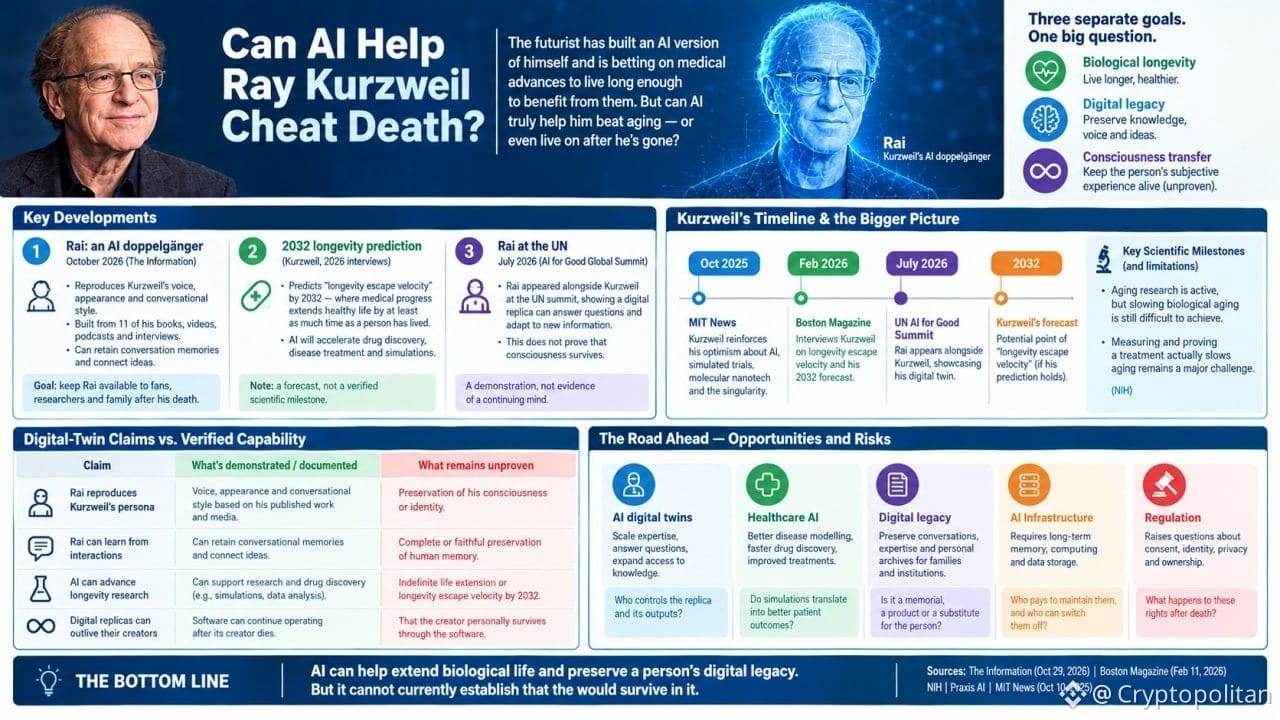 Ray Kurzweil Immortality Timeline
Current human research is far more modest. NIH-funded researchers led by Columbia epidemiologist Daniel Belsky developed DunedinPACE using data from more than 1,000 people born in New Zealand in 1972 and 1973. This test measures the speed of biological aging using DNA methylation at 173 locations, and those who score faster show greater likelihood of developing diseases, becoming disabled, and dying early.
In the CALERIE trial, there was a statistically significant reduction in the rate of DunedinPACE in individuals that had lowered their calorie intake.
NIH experts have highlighted proven interventions like regular physical activity, non-smoking, maintaining proper weight, getting enough sleep, being vaccinated, and screening for hypertension and high cholesterol.
This implies that some components of aging are quantifiable and that they are potentially slightly changeable. These results don’t show anything resembling adding a year of life for each year of life added.
The prediction of Kurzweil from 2032 thus stands as an extrapolation of future science, not a reality based on today’s human longevity data.
Don’t just read crypto news. Understand it. Subscribe to our newsletter. It's free.