

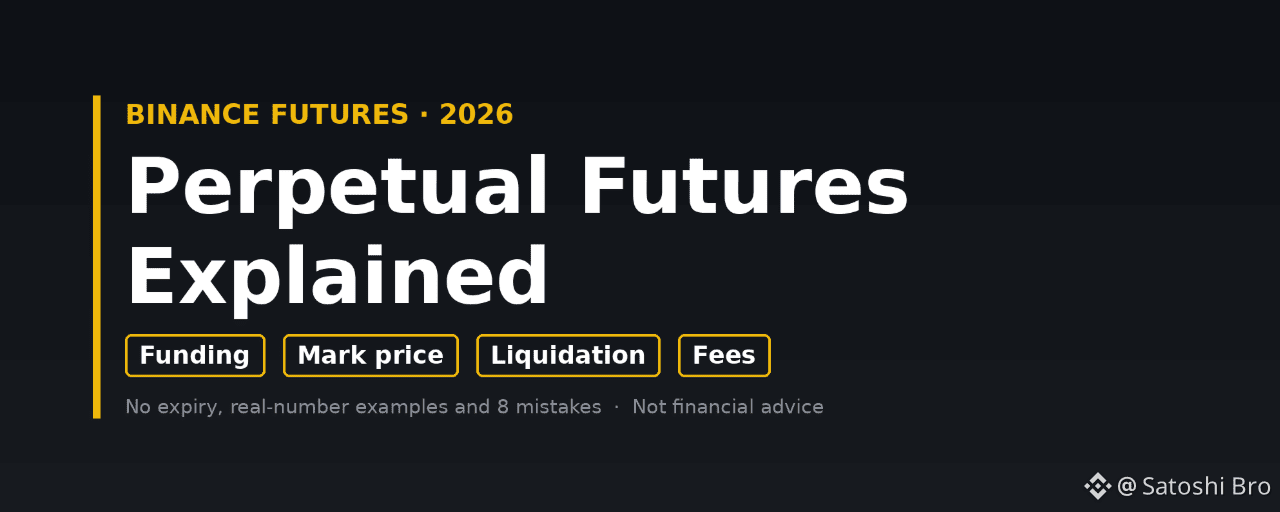

Open the Binance Futures page and the default market is BTCUSDT with a small "Perp" tag next to it. That tag is short for perpetual, and it changes how the contract behaves more than most new traders realize.
The quick answer: a Binance perpetual future is a futures contract with no expiry date. You can hold it for an hour or a year, and instead of settling on a fixed date, longs and shorts swap a small funding payment every few hours to keep the contract price close to the real spot price. Your profit, loss and liquidation are measured against a mark price, not the last trade on the chart.
👉 Open a Binance account with 20% off Futures and Spot trading fees
Below are the four moving parts of a perpetual contract, how funding is calculated with real numbers, and eight mistakes that quietly drain new perpetual traders.
So what makes a contract perpetual?
A traditional futures contract has a delivery or settlement date. When that date arrives, the contract closes at the settlement price whether you like it or not.
A perpetual contract removes that date. To stop its price drifting away from the coin it tracks, Binance uses four pieces that work together.
No expiry: The position stays open until you close it or it gets liquidated. There's nothing to roll over.
Index price: A weighted average of the coin's spot price across several major exchanges. It represents the "real" market value.
Mark price: A fair-value price built from the index price. Binance uses it to calculate unrealized PnL and to decide when a position is liquidated.
Funding rate: A periodic payment between traders. When the contract trades above the index, longs pay shorts. When it trades below, shorts pay longs.
All four sit in the header bar above the chart. In the screenshot below, the last trade was 79,723.2, the mark price 79,728.0, the index 79,758.5, and the funding rate 0.00394% with just under six hours on the countdown.
Binance doesn't collect the funding payment. It moves directly from one side of the market to the other, which is why it isn't listed on the fee schedule.
How is the funding payment worked out?
The formula is simpler than it looks.
Funding payment = position value × funding rate, where position value is your size multiplied by the mark price at the funding time.
On most USDⓈ-M contracts funding is exchanged every 8 hours, so three times a day. Some contracts use shorter intervals, and the countdown in the header always shows when the next one is due.
Take a long of 0.1 BTC with BTC at $80,000. The position value is $8,000. Here is what different rates mean in dollars, using illustrative rates rather than live ones.
Rate 0.01% (a calm market): $8,000 × 0.0001 = $0.80 per payment, $2.40 a day, roughly $72 over 30 days.
Rate 0.05% (a busy market): $4 per payment, $12 a day, about $360 over 30 days.
Rate 0.10% (a crowded rally): $8 per payment, $24 a day. Over a month that's $720.
Rate -0.02% (shorts paying): As a long you receive $1.60 per payment instead of paying.
Now put that next to your margin. If you opened the 0.1 BTC long at 10x, your margin is $800. At a 0.10% rate, a month of funding would eat $720, almost the entire deposit, even if BTC never moved.
That single comparison explains why perpetuals suit short and medium holds far better than "set and forget" positions.
Perpetual or quarterly - which contract fits your plan?
Binance also lists delivery futures, usually labelled with a quarterly expiry date. They track the same coins, but the cost structure is different.
Perpetual: No expiry and a funding payment every interval. Best when you want flexibility and expect to hold for hours, days or a few weeks.
Quarterly: A fixed settlement date and no funding. The price usually sits at a premium or discount to spot, and that gap closes as expiry approaches.
USDⓈ-M vs COIN-M: USDⓈ-M contracts use USDT or USDC as margin and pay PnL in stablecoins. COIN-M contracts use the coin itself as margin, so your collateral rises and falls with the market too.
For a first perpetual trade, a USDⓈ-M contract like BTCUSDT keeps the maths in dollars, which makes every example in this article easy to check. If you've never placed a futures order, this walkthrough of opening a first Binance Futures position covers the screens and buttons.
Mistake 1 - Treating funding as somebody else's cost
Funding is invisible on the order panel, so it's easy to forget. It only shows up later in your transaction history, one small line at a time.
A trader who holds the 0.1 BTC long from above for three weeks at an average 0.03% rate pays $8,000 × 0.0003 × 63 payments, or about $151. If BTC rose 1% in that time, the $80 price gain is wiped out and then some.
The fix: Before a multi-day hold, multiply your position value by the current rate and by the number of payments you expect. If that number is bigger than your target profit, the trade doesn't work as a perpetual.
Mistake 2 - Opening a position seconds before the funding time
Funding is paid by whoever holds a position at the exact funding timestamp. How long you held it before that moment doesn't matter.
Open a $20,000 long two minutes before the timestamp at a 0.08% rate and you pay $16 for two minutes of exposure. Close two minutes before the timestamp instead and you pay nothing.
The fix: Glance at the countdown before entering or exiting. If the rate is high and against you, waiting a few minutes on either side can be worth more than the trading fee.
The opposite trick has limits too. Opening just before the timestamp to collect a payment rarely works, because price often moves against crowded sides around funding and your trading fees can exceed what you receive.
Why does the chart say one price and your PnL another?
This is mistake number three, and it causes a lot of confused messages to support.
The candles on the chart show the last traded price on Binance. Your unrealized PnL and liquidation use the mark price. On a sudden wick, the last price can spike well past your liquidation level while the mark price, anchored to the index, moves much less.
Say you're long at $80,000 with 10x isolated margin. With a typical small maintenance margin, the liquidation price lands around $72,400. A thin-book wick on the last price to $72,000 doesn't liquidate you if the mark price only touches $73,500. A slow grind where the mark price reaches $72,400 does.
The reverse is also true. Your position can be liquidated while the chart never seems to touch your level, because the mark price is what counts.
The fix: Switch the chart to the mark price when you're watching a level closely, and check your exact figure in the Liquidation Price tab of the Futures calculator before you open the trade.
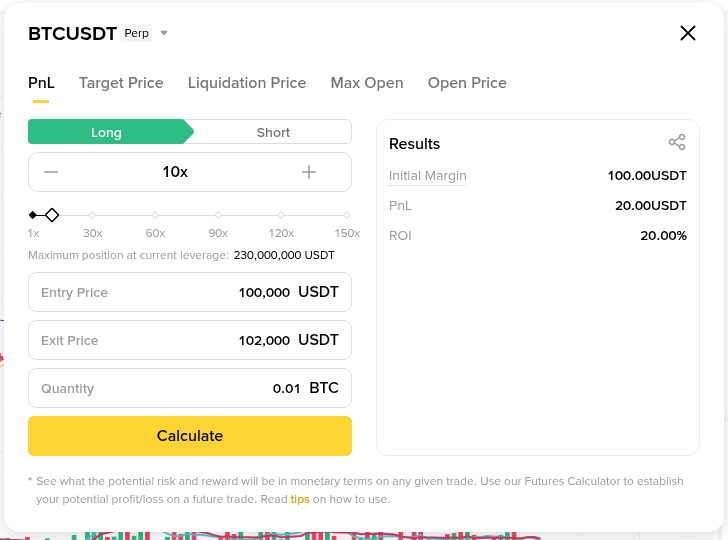
The same calculator shows the effect of leverage on your result, and our guide to how Binance Futures PnL and ROI are calculated breaks down why a 2% price move can show as a 20% ROI.
Mistake 4 - Choosing leverage before choosing size
Many beginners pick a leverage number first, often 20x or 50x because the slider allows it, then fill whatever size the margin supports. That's backwards.
Start with the dollar amount you can afford to lose if the trade fails, then work out the position size, and let leverage follow.
Example plan: You accept a $100 loss and your stop is 2% below entry. The position value should be $100 ÷ 0.02 = $5,000.
At 5x leverage: That $5,000 position needs $1,000 margin, and liquidation sits far below your stop.
At 25x leverage: The same $5,000 position needs only $200 margin, but liquidation sits a little under 4% away, uncomfortably close to a 2% stop on a volatile day.
Both trades risk the same $100 if the stop works. The high-leverage version just leaves less room for slippage, gaps and wicks.
Mistake 5 - Leaving cross margin on with your whole wallet inside
Cross margin lets every open position draw on the full balance of your Futures wallet. That can keep a losing trade alive longer, which is exactly the danger.
Imagine $3,000 in the Futures wallet and one $800-margin long in cross mode. If the trade goes badly, it can keep pulling from the remaining $2,200 before liquidation. The loss you planned at $800 can become most of the wallet.
The fix: Use isolated margin for single ideas, so the most a position can lose is the margin you assigned to it. Keep only the money you're actively trading in the Futures wallet and leave the rest in Spot or Funding.
Are you paying the taker fee on every single order?
Mistake six is the quiet one. On USDⓈ-M perpetuals, a regular user pays 0.0200% as a maker and 0.0500% as a taker, so market orders cost two and a half times as much as resting limit orders.
The fee is charged on position value, not on your margin. That's why leverage makes it feel bigger than the percentage suggests.
Taker in and out on $16,000: $8 + $8 = $16 round trip. At 20x that position uses $800 margin, so fees are 2% of your capital before the price moves.
Maker in and out on $16,000: $3.20 + $3.20 = $6.40.
Maker in, taker out (a common mix): $3.20 + $8 = $11.20.
Ten taker round trips a week: $160 a week, or about $8,320 over a year of the same activity.
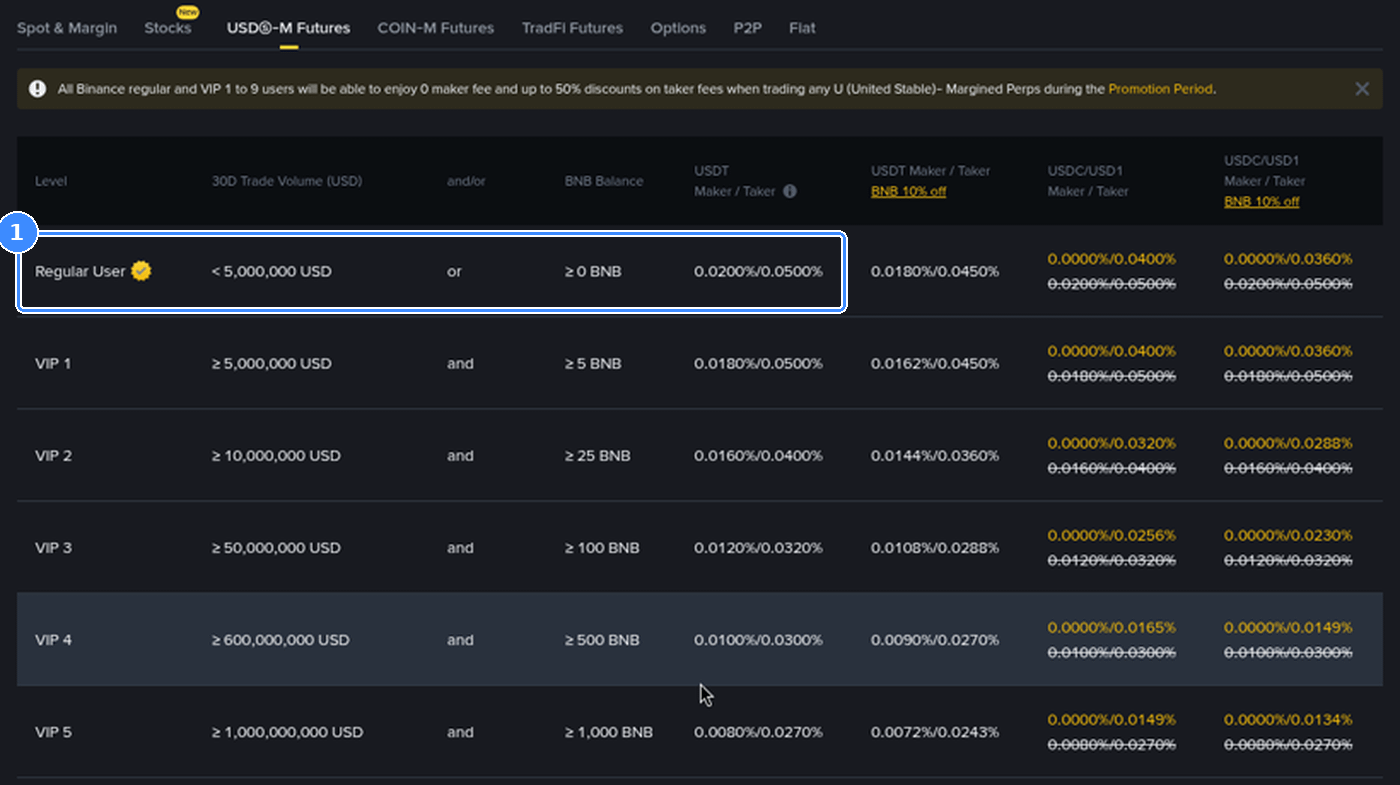
Signing up with the code 20LESSFEES takes a flat 20% off Spot and Futures trading fees, which turns the 0.0500% taker rate into 0.0400% and the 0.0200% maker rate into 0.0160%. On those ten weekly round trips that's $32 a week back in your pocket. Eligible new users can also unlock a welcome bonus of up to $19,800 by completing the listed tasks.
The fix: Use limit orders for planned entries, keep market orders for exits where speed matters, and check the fee rate shown at the bottom of the order panel.
Mistake 7 - Assuming a hedged position costs nothing
A popular idea is to buy 1 BTC on Spot and short 1 BTC on the perpetual. Price moves cancel out, and when funding is positive the short side collects it.
It can work, but it isn't free money.
Funding can flip: A rate that pays you 0.01% today can turn negative next week, and then your short pays the longs.
Fees on both legs: Opening and closing both sides of a $80,000 hedge at taker rates costs roughly $160 on Spot (0.1% each way) and $80 on the perpetual (0.05% each way), about $240 total before any funding arrives.
Margin still matters: The short can be liquidated in a sharp rally if its margin is thin, even though the Spot coin gained the same amount.
At a 0.01% rate, $80,000 earns $8 per payment, so it takes 30 payments, ten full days, just to cover the $240 in fees.
Mistake 8 - Forgetting that perpetuals can be liquidated in your sleep
No expiry also means no natural end. A position you opened on Friday keeps running all weekend, through news, thin liquidity and funding changes.
The fix: Attach a take-profit and stop-loss when you open the trade rather than planning to add them later, and set price alerts at levels that matter to you. If you can't check the market for 24 hours, size the position as if you'll come back to the worst move of the day.
A two-minute routine before every perpetual trade
Read the header: Mark price, index price, funding rate and the countdown.
Estimate funding: Position value × rate × expected number of payments.
Size from risk: Dollar loss you accept ÷ stop distance = position value.
Pick margin mode: Isolated for single trades, unless you fully understand cross.
Check liquidation: Use the calculator and make sure it sits well beyond your stop.
Choose order type: Limit where you can, market only when speed matters.
Set exits: TP/SL attached before you walk away.
New to Binance and planning to trade perpetuals regularly? The current Binance new-user bonus campaign lists the tasks and rewards available to eligible accounts, and fee savings matter most for exactly the kind of frequent trading perpetuals encourage.
FAQ
Do Binance perpetual futures ever expire?
No. A perpetual position stays open until you close it, it hits a take-profit or stop-loss, or it's liquidated. Delivery contracts are the ones with a settlement date.
Who receives the funding I pay?
Traders on the other side of the market. If longs pay, the money goes to shorts, and the other way round when the rate is negative. Binance doesn't keep it.
Can the funding rate change while my position is open?
Yes. The rate is recalculated continuously and the figure in the header is an estimate until the funding time. A long hold will see many different rates.
Do I pay funding if I close before the funding time?
No. Only positions open at the exact funding timestamp pay or receive it.
Why was I liquidated when the chart never reached my price?
Liquidation follows the mark price, not the last traded price shown by default on the chart. The two can differ, especially during fast moves.
Is the 20% fee discount applied to funding payments?
No. The discount applies to trading fees only. Funding is a payment between traders and stays the same for everyone.
Disclosure: 20LESSFEES is my Binance sign-up code. This is educational content, not financial advice. Leveraged perpetual futures carry a high risk of loss, including your full margin.