


The biggest crypto move may not happen when the Fed announces its decision. It may happen when investors realize what that decision means for future liquidity.
On October 28, the Federal Open Market Committee (FOMC) is scheduled to announce its latest monetary policy decision. For crypto investors, this is more than an interest-rate event. It is a test of global risk appetite, institutional positioning, and the market's expectations for future monetary policy.
But why does a US central bank decision matter so much to a global market that operates 24/7?
Let's break it down.
1. The Fed's Real Power: The Price of Capital
The Federal Reserve does not control Bitcoin, Ethereum, or Solana directly. Its influence comes through the cost of borrowing, Treasury yields, the US dollar, and financial conditions.
History offers a clear lesson.
In 2022, the Fed began an aggressive interest-rate hiking cycle to combat inflation. Higher yields made traditional fixed-income investments more attractive, while tighter financial conditions increased pressure on risk-sensitive assets.
Crypto was not immune.
The lesson is straightforward: when capital becomes more expensive and investors become less willing to take risks, speculative assets can face selling pressure. When financial conditions ease, risk appetite may improve. However, neither outcome is automatic.
2. Hawkish vs. Dovish: Two Different Market Scenarios
🔴 Scenario A: A Hawkish Fed
If policymakers signal that inflation remains a concern and interest rates may stay elevated for longer, markets could interpret the message as negative for risk assets.
Potential consequences:
The US dollar could strengthen.
Treasury yields could rise.
Institutional investors could reduce exposure to volatile assets.
Bitcoin could face resistance, while altcoins could experience sharper corrections.
🟢 Scenario B: A Dovish Fed
If policymakers signal that inflation is cooling and future rate cuts remain possible, risk appetite could improve.
Potential consequences:
Treasury yields could decline.
The dollar could weaken.
Investors could become more willing to allocate capital to growth assets.
BTC could attract renewed buying interest, potentially supporting ETH and SOL.
However, there is an important distinction: a dovish signal is not the same as an immediate liquidity injection. Rate expectations, actual financial conditions, and institutional capital flows must still align before a sustained crypto rally can develop.
3. The Geopolitical Connection: Why Global Events Matter
The Fed does not operate in isolation.
Wars, energy-price shocks, trade restrictions, and geopolitical tensions can influence inflation, economic growth, and global demand for US dollars.
For example, a major oil-supply disruption could push energy prices higher. If that feeds into inflation, the Fed may have less room to cut rates even when economic growth weakens.
That creates a difficult situation for investors: slower growth alongside persistent inflation.
The US dollar also holds a central position in global trade and finance. During periods of uncertainty, demand for dollar liquidity can increase, potentially putting pressure on emerging-market currencies and risk-sensitive investments.
For crypto traders, the key is to understand the chain reaction:
Geopolitical shock → Inflation expectations → Fed policy outlook → Dollar and Treasury yields → Institutional risk appetite → Crypto price action.
This is where macroeconomic analysis becomes a practical trading tool.
4. What Could Happen to BTC, ETH and SOL?
Let's look at the three assets investors should monitor.
₿ Bitcoin (BTC): The Market's Risk Barometer
Bitcoin's reaction to the Fed could influence sentiment across the wider crypto market.
A dovish surprise, combined with falling yields and a weaker dollar, could support a bullish move.
Conversely, rising yields and a stronger dollar could create selling pressure.
Watch for a confirmed breakout, trading volume, and whether BTC holds its reclaimed support levels. A sudden price spike without sustained buying could turn into a bull trap.
◆ Ethereum (ETH): The Recovery Test
ETH could benefit if improving financial conditions encourage investors to take on more risk.
But a bullish macro backdrop alone is not enough. ETH needs sustained demand and a convincing technical structure.
Watch whether it forms higher lows, breaks nearby resistance, and outperforms BTC. If Bitcoin weakens sharply, ETH could struggle even if the Fed sounds dovish.
◎ Solana (SOL): Higher Potential, Higher Risk
SOL may attract attention if capital rotates into higher-beta altcoins during a broader crypto recovery.
However, that potential comes with greater volatility. If market sentiment deteriorates, SOL could experience a deeper pullback than Bitcoin.
Confirmation matters more than excitement. Monitor trading volume, support levels, and BTC's overall direction before considering an entry.
5. The Institutional Capital Flow Most Traders Overlook
Institutional investors do not make decisions based solely on a headline.
They assess expected returns, borrowing costs, liquidity conditions, portfolio risk, and alternative investment opportunities.
A rate cut that is already priced into the market may produce little upside. In contrast, an unexpected shift in the Fed's outlook could trigger a substantial repricing across asset classes.
That is why the market's reaction matters more than the announcement itself.
Before taking a position, monitor four indicators:
US Dollar Index (DXY): Is the dollar strengthening or weakening?
US Treasury yields: Are bond yields rising or falling after the announcement?
Institutional flows: Are available fund-flow data showing stronger demand or persistent outflows?
Bitcoin market structure: Is BTC holding support, breaking resistance, or trapping late buyers?
These signals help distinguish a genuine change in market conditions from a short-lived reaction.
6. A Practical Risk Map for Retail Investors
Here is how different macro outcomes could affect a crypto portfolio:
Hawkish surprise + rising yields + stronger dollar: Defensive positioning may be appropriate. Avoid chasing breakouts and reassess exposure to highly volatile altcoins.
Dovish surprise + falling yields + weaker dollar: A bullish setup may develop, but wait for price confirmation rather than buying solely on the announcement.
Dovish headline + rising yields: Be cautious. Bond-market reactions may suggest that investors remain concerned about inflation or future policy.
Hawkish headline + falling yields: Avoid assuming the initial headline tells the whole story. The market may have expected an even more restrictive outcome.
For risk management, consider scaling into positions, defining stop-loss levels, and keeping leverage conservative. Never risk money you cannot afford to lose.
Final Takeaway
The upcoming FOMC decision could become an important catalyst for Bitcoin, Ethereum, and Solana. But the real opportunity lies in understanding how monetary policy expectations translate into dollar strength, Treasury yields, liquidity conditions, and institutional positioning.
Smart investors do not simply ask whether the Fed will cut or hold rates.
They ask whether the decision changes the outlook for capital.
Your Turn: What is your strategy for the October FOMC decision? Will $BTC lead a recovery, will $ETH regain momentum, or could $SOL deliver a stronger move if risk appetite improves?
Share your analysis in the
#bitcoin #Ethereum #solana 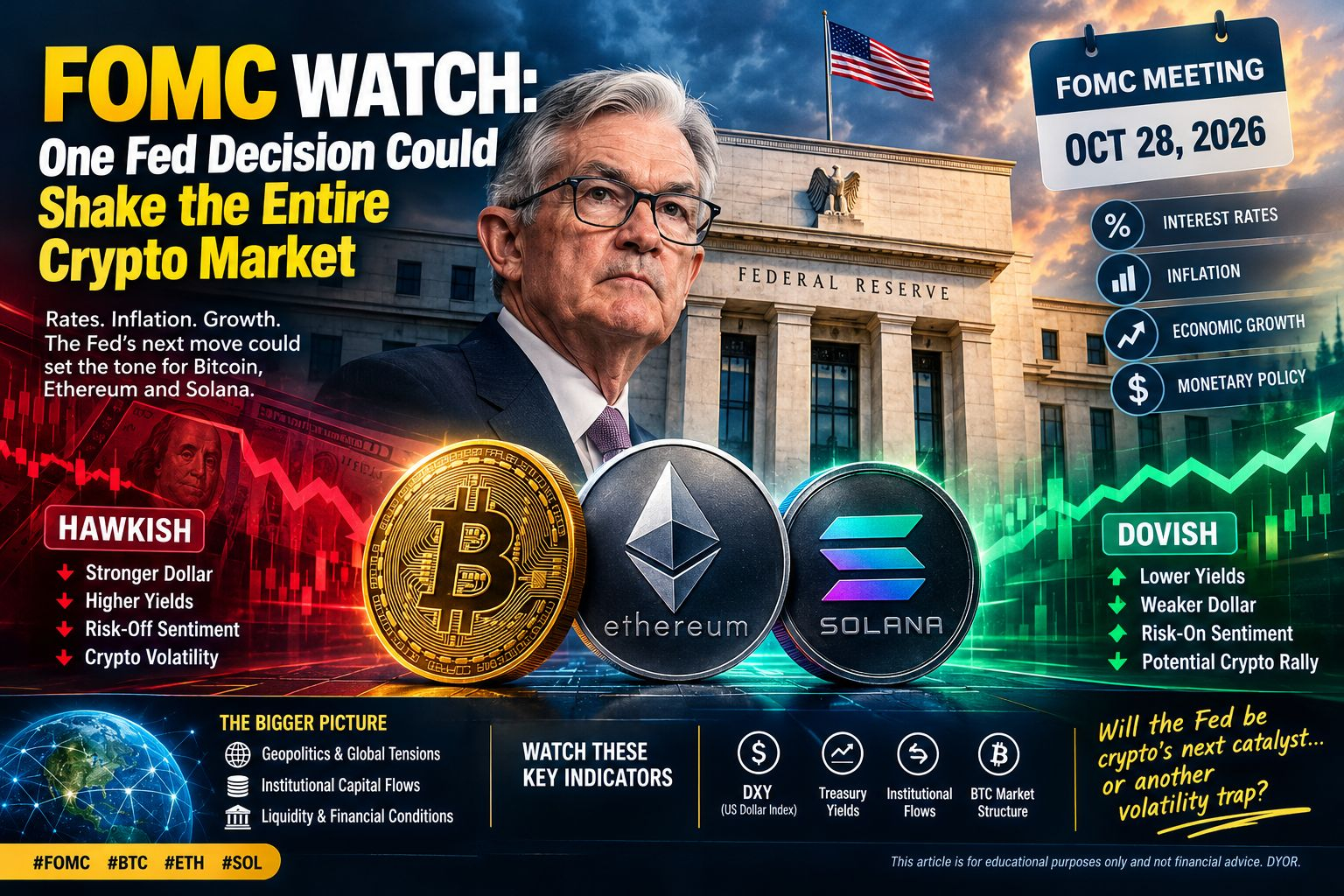 #BinanceSquare


