

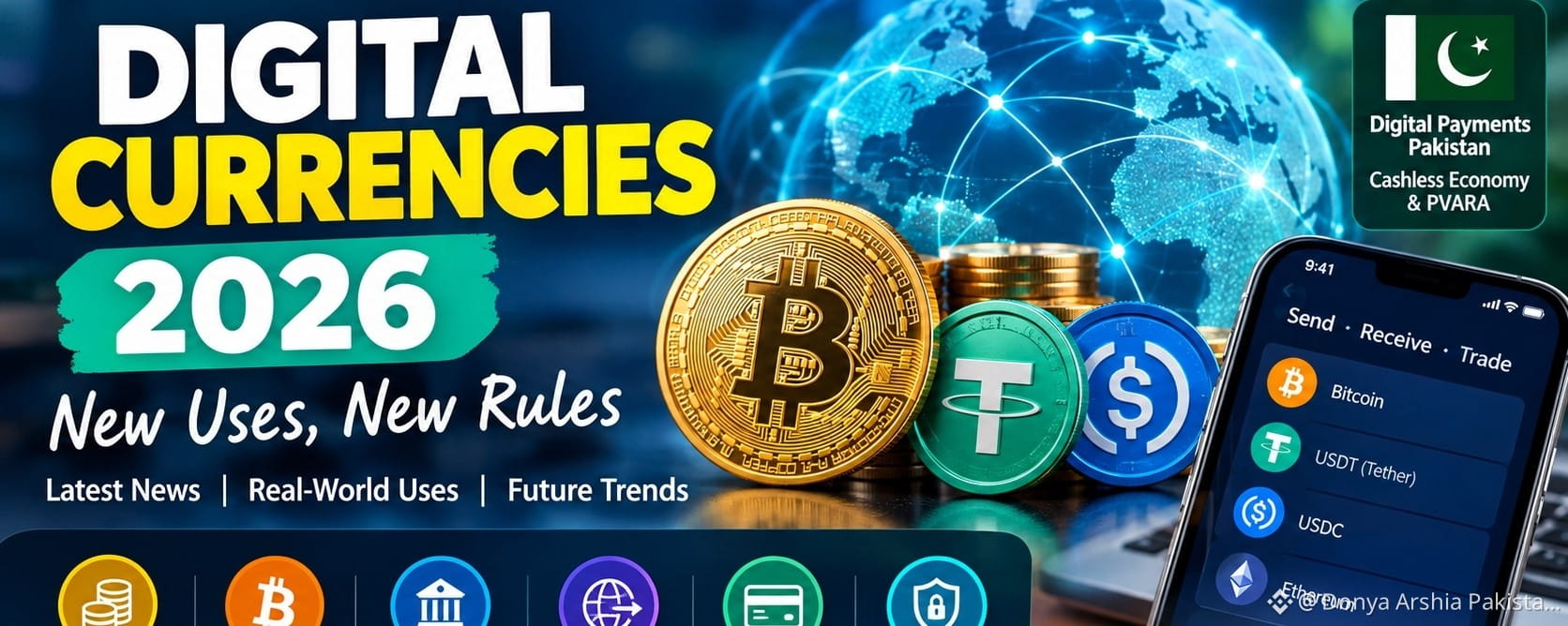

Digital Currencies in 2026: Latest Developments, Real-World Uses and Future Trends
Updated: October 27, 2026
Digital currencies are becoming an increasingly important part of the global financial system. From cryptocurrency trading to online payments, international transfers and government-backed digital money, financial technology is changing how people and businesses move value.
However, digital currencies are not all the same. Understanding their different types, practical uses and associated risks is essential before using or investing in them.
1. Stablecoins Are Expanding Beyond Cryptocurrency Trading
Stablecoins are digital tokens designed to maintain a relatively stable value, often by being linked to a currency such as the US dollar. Examples include USDT and USDC.
Unlike Bitcoin, which can experience substantial price fluctuations, stablecoins are designed to reduce short-term price volatility. Their potential applications include:
- Transferring money across borders.
- Settling payments between businesses.
- Moving funds between cryptocurrency platforms.
- Making certain online payments where supported.
- Providing access to dollar-linked digital value in supported markets.
A recent Brookings analysis reports that stablecoin supply reached approximately $273 billion in 2026, reflecting the growing scale of this market. However, stablecoins still carry risks, including issuer failure, redemption restrictions, regulatory changes and loss of their intended price peg.
Source: "Brookings — Stablecoins and the Global South" (https://www.brookings.edu/articles/stablecoins-can-transform-the-global-south-by-reimagining-digital-finance-trade-and-development/)
2. Pakistan Is Moving Towards a More Digital Economy
Pakistan is pursuing two related but distinct developments: expanding digital payments and establishing a regulatory framework for virtual assets.
On October 13, 2026, Pakistan's Finance Division reviewed progress under the Cashless Pakistan initiative. The government reported that the number of merchants accepting electronic payments had increased fourfold during the previous fiscal year. It also reported substantial progress in digitising public-sector payments. These developments could make everyday transactions more convenient and improve financial inclusion.
Separately, Pakistan's virtual-asset regulatory framework is developing under the Pakistan Virtual Assets Regulatory Authority (PVARA). Official regulatory information lists the Virtual Asset Services Regulations and activity-specific regulations notified on August 21, 2026.
These developments should not be confused with an official launch of a national cryptocurrency. Digital wallets, bank transfers, Bitcoin and stablecoins are different financial products with different legal and operational characteristics.
Sources: "Government of Pakistan — Cashless Pakistan update" (https://pid.gov.pk/site/press_detail/34289) | "PVARA — Regulatory Framework" (https://pvara.gov.pk/regulations)
3. Central Bank Digital Currencies: Digital Money Issued by Governments
Central bank digital currencies, or CBDCs, are digital forms of money issued by a country's central bank. They differ from privately issued cryptocurrencies because they represent central-bank money rather than a token whose market price is determined by trading.
The European Central Bank is preparing for a potential digital euro. In October 2026, the ECB discussed how digital public money could support everyday payments and the settlement of tokenised financial assets.
A digital euro is not the same as Bitcoin, and preparations do not mean it has already been launched. The ECB has been developing the necessary infrastructure while retaining a final decision on issuance.
Source: "European Central Bank — Money in the Digital Age" (https://www.ecb.europa.eu/press/key/date/2026/html/ecb.sp261006~0da978f159.mt.html)
4. How People Actually Use Digital Currencies
The practical uses of digital currencies vary by country, platform and regulatory environment.
International transfers: Certain digital assets may enable transfers between supported services across borders. Users must account for network fees, conversion costs, local regulations and withdrawal options.
Online transactions: Some merchants and service providers accept selected cryptocurrencies or stablecoins. Acceptance is not universal, and ordinary bank cards or electronic payments may be more convenient for everyday purchases.
Trading and investing: People buy and sell digital assets hoping to benefit from price changes. However, cryptocurrency prices can fall sharply, and there is no guarantee of profit.
Blockchain-based applications: Digital tokens can support decentralised applications, digital ownership records and tokenised financial assets. The usefulness and reliability of these applications differ significantly.
Savings and transfers using stablecoins: Dollar-linked tokens may be useful in certain supported situations, but they are not equivalent to insured bank deposits and do not eliminate currency, platform or counterparty risk.
5. What Beginners Should Know Before Using Crypto
Digital currencies offer new possibilities, but responsible use requires careful decisions.
- Learn how a blockchain, wallet address and transaction fee work.
- Verify the recipient address and network before transferring funds.
- Never share your password, private key or wallet recovery phrase.
- Beware of guaranteed-return offers, fake investment schemes and fraudulent support accounts.
- Check the legal requirements and withdrawal options applicable in your country.
- Avoid borrowing money or using leverage to speculate on volatile assets.
- Understand that a transaction sent to the wrong address may be difficult or impossible to reverse.
For Pakistani users, it is particularly important to check current PVARA requirements and the rules applicable to the specific platform and service being used.
6. The Future: More Digital Payments, but Not Without Risks
The future of digital finance may involve a combination of conventional bank accounts, instant electronic payments, regulated stablecoins, CBDCs and blockchain-based financial services.
Greater adoption will depend on practical benefits, consumer protection, reliable technology, regulatory clarity and public trust. No single digital currency is guaranteed to replace cash or traditional banking.
The most important distinction is between using digital currencies as a payment tool and buying them as an investment. The first focuses on convenience and transferring value; the second involves financial risk and uncertain returns.
Conclusion
Digital currencies are evolving from a niche technology into a broader part of financial innovation. Stablecoins are expanding, governments are exploring digital forms of money, and Pakistan is advancing both electronic payments and virtual-asset regulation.
For ordinary users, the best starting point is education rather than speculation. Understanding how a digital asset works, what it costs to use and how its risks can be managed is more valuable than following every market prediction.
Disclaimer: This article is for educational purposes only and does not constitute financial, investment or legal advice. Digital assets carry risks, and regulations can change. Verify current official guidance before making transactions or investment decisions. @Bitcoin