

A market analysis agent might need raw on-chain data, a service to clean it, another model to interpret it, and a separate agent to check the findings. Each service could come from a different provider, and each may charge for its work.
What stands out to me is the gap between an agent knowing what to do next and actually being able to do it. If it has to stop and wait for a human to approve every small payment, the workflow breaks at exactly the point where automation should be helping.
Pay-per-request offers a more practical way to handle this. The agent pays for the service it needs when it needs it, without requiring a person to process every transaction. That only works if payments are fast and cheap enough to keep up with the tasks being performed.
Kite’s whitepaper identifies economically viable micropayments as one of the conditions for agents to become real economic actors.
Kite Passport supports two approaches to machine-to-machine payments:
x402: A service can return HTTP 402 Payment Required with payment instructions. The agent uses a spending session previously approved by the user through a passkey to create a signed authorization and retry the request. Once payment is confirmed, the service returns the result.
MPP (Machine Payments Protocol): Developed by Stripe and Tempo, MPP offers another protocol for machine-to-machine payments. Providers that support it can offer it alongside x402 or as an alternative.
The spending session is what makes this more than unrestricted autonomous spending. The user sets the total budget, per-transaction limit, and session duration in advance. The agent can pay without requesting approval for every transaction, but its authority remains bounded by those permissions.
Consider a market analysis agent working through a real task. It pays for raw data, sends that data to a specialist service for processing, then uses the results to finish its analysis. Each payment can happen within the same approved session, provided there is enough budget left and the session has not expired. If either limit is reached, the agent cannot continue making payments without new authorization.
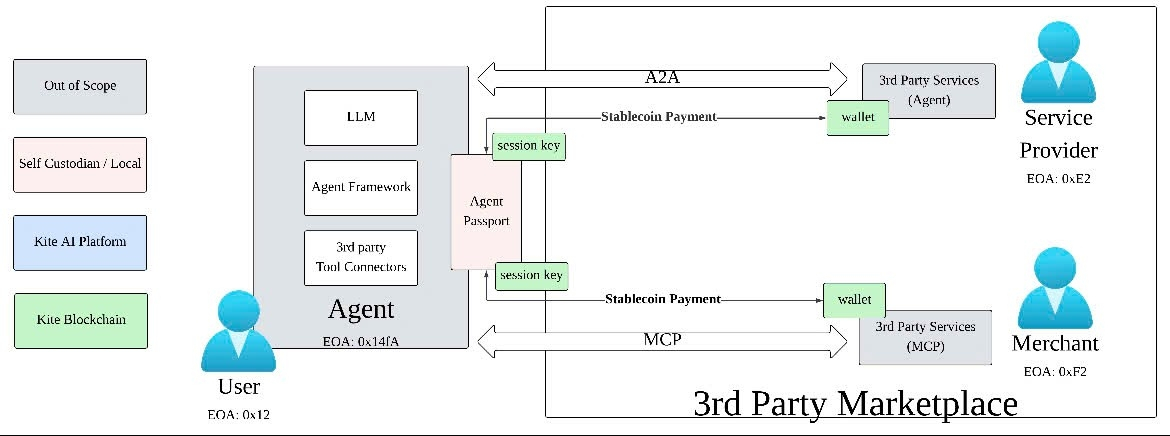
I think this is an important detail in how we should evaluate AI agents. Reasoning through a task is one thing; obtaining the resources needed to finish it is another. If every service call creates a new manual step, the agent’s ability to work independently remains limited.
Kite Passport is addressing this payment problem through x402 and compatibility with protocols such as MPP. What matters is whether agents can pay for the services they need while staying within the limits set by their users. That is how payment can become part of a continuous workflow instead of another reason for it to stop.